
About
In this first stage, the catalogue focuses on the modern and contemporary architecture designed and built between 1832 –year of construction of the first industrial chimney in Barcelona that we establish as the beginning of modernity– until today.
The project is born to make the architecture more accessible both to professionals and to the citizens through a website that is going to be updated and extended. Contemporary works of greater general interest will be incorporated, always with a necessary historical perspective, while gradually adding works from our past, with the ambitious objective of understanding a greater documented period.
The collection feeds from multiple sources, mainly from the generosity of architectural and photographic studios, as well as the large amount of excellent historical and reference editorial projects, such as architectural guides, magazines, monographs and other publications. It also takes into consideration all the reference sources from the various branches and associated entities with the COAC and other collaborating entities related to the architectural and design fields, in its maximum spectrum.
Special mention should be made of the incorporation of vast documentation from the COAC Historical Archive which, thanks to its documental richness, provides a large amount of valuable –and in some cases unpublished– graphic documentation.
The rigour and criteria for selection of the works has been stablished by a Documental Commission, formed by the COAC’s Culture Spokesperson, the director of the COAC Historical Archive, the directors of the COAC Digital Archive, and professionals and other external experts from all the territorial sections that look after to offer a transversal view of the current and past architectural landscape around the territory.
The determination of this project is to become the largest digital collection about Catalan architecture; a key tool of exemplar information and documentation about architecture, which turns into a local and international referent, for the way to explain and show the architectural heritage of a territory.
About us
Project by: 
Created by: 
Directors:
2019-2026 Aureli Mora i Omar OrnaqueDocumental Commission:
2019-2026 Ramon Faura Carolina B. Garcia Eduard Callís Francesc Rafat Pau Albert Antoni López Daufí Joan Falgueras Mercè Bosch Jaume Farreny Anton Pàmies Juan Manuel Zaguirre Josep Ferrando Gemma Ferré Inés de Rivera Fernando Marzá Moisés Puente Aureli Mora Omar OrnaqueCollaborators:
2019-2026 Lluis Andreu Sergi Ballester Marianela Pla Maria Jesús Quintero Lucía M. Villodres Montse ViuExternal Collaborators:
2019-2026 Helena Cepeda Inès MartinelWith the support of:
Generalitat de Catalunya. Departament de CulturaCollaborating Entities:
ArquinFADFundació Mies van der Rohe
Fundación DOCOMOMO Ibérico
Basílica de la Sagrada Família
Museu del Disseny de Barcelona
Fomento
AMB
EINA Centre Universitari de Disseny i Art de Barcelona
IEFC
Fundació Domènench Montaner.
ETSAB
Suggestion box
Request the image
We kindly invite you to help us improve the dissemination of Catalan architecture through this space. Here you can propose works and provide or amend information on authors, photographers and their work, along with adding comments. The Documentary Commission will analyze all data. Please do only fill in the fields you deem necessary to add or amend the information.
The Arxiu Històric del Col·legi d'Arquitectes de Catalunya is one of the most important documentation centers in Europe, which houses the professional collections of more than 180 architects whose work is fundamental to understanding the history of Catalan architecture. By filling this form, you can request digital copies of the documents for which the Arxiu Històric del Col·legi d'Arquitectes de Catalunya manages the exploitation of the author's rights, as well as those in the public domain. Once the application has been made, the Arxiu Històric del Col·legi d'Arquitectes de Catalunya will send you an approximate budget, which varies in terms of each use and purpose.
close
close
Works


On the Map
Awarded
Cataloged
Disappeared
All works
Constellation
Chronology
-
Ganduxer 96 Dwellings
Estudi BSSV, Miquel Batalla i Peralta, José María Sen Tato, Àngel Serrano i Freixas, Esteve Vicens i Buj
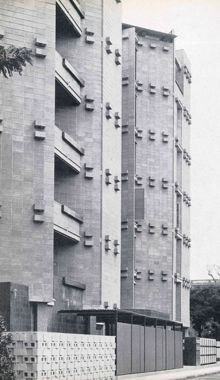 The building comprises a basement, semi-basement, mezzanine, four upper storeys and a penthouse level. The basement accommodates the private garage and the building’s service installations. The semi-basement contains the main entrances, entrance hall, residents’ club, a rental apartment, the concierge’s lodge and the caretaker’s dwelling. The upper floors, including the penthouse level, are arranged with two apartments per floor. The penthouse apartments follow a reduced programme, with one fewer bedroom and one fewer bathroom than the apartments on the lower levels. The structure consists of a reinforced concrete frame, using vibrated concrete foundations supported by piles with an average depth of 12 metres and reinforced concrete bracing. The floor slabs are formed with joists and hollow blocks on the first floor and ceramic floor systems on the remaining levels, throughout incorporating flat beams. The solid wall sections are constructed using BESSER-TORHO vibro-compressed concrete blocks. Only three block types were employed: U-shaped lintel units, solid facing blocks for the exposed slab edges, and hollow enclosure blocks positioned in front of an air cavity and gypsum board partition walls. These elements are arranged between floor slabs along their greater dimension, acting as anchoring supports. Openings are enclosed with Flanders timber joinery, complemented by fixed and operable elements in natural anodised aluminium. In response to the site conditions, the floor layouts were designed to achieve, wherever possible, similar programmes and spatial arrangements for the two apartments on each level, despite the constraints imposed by adjoining buildings on two sides of the plot. This was achieved through an arrangement of octagonal axes set at 45 degrees to the bisector formed by Carrer Ganduxer and Sant Casimir. As a result, each pair of apartments differs only in orientation through a 90-degree rotation. Both benefit from broad views over Carrer Ganduxer and are protected from overlooking by neighbouring properties, both laterally and directly opposite. This configuration also ensures that all principal rooms, with the exception of certain service areas, enjoy orientations ranging from south-east to west, while the north-facing walls remain largely blind. The building’s architectural expression and volumetric composition arise directly from the floor plan. This is particularly evident in the alternation between projecting solid angles and recessed terraces corresponding to the openings. At the same time, the clarity and simplicity of the two principal volumes forming each vertical stack of apartments are preserved, with both volumes linked by the vertical circulation cores.
 -
FAD Award
Shortlisted. Category: Interior Design Cinc d'Oros Bookshop
