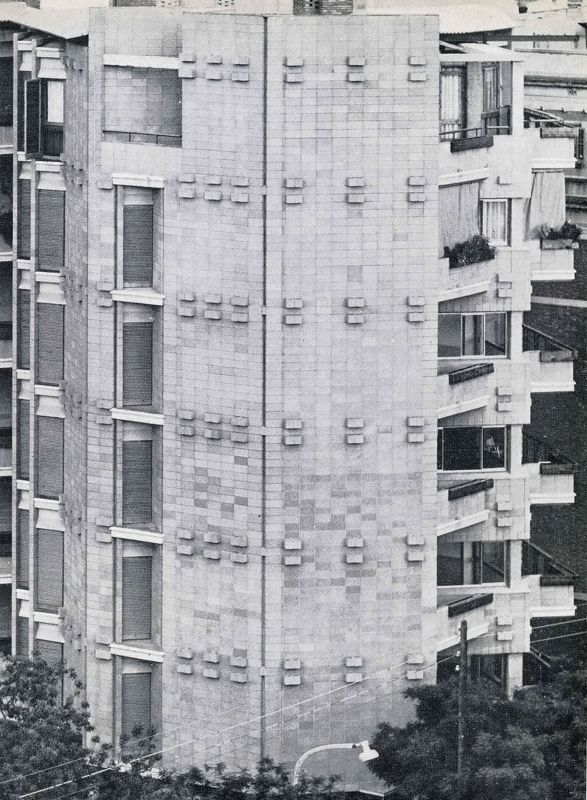
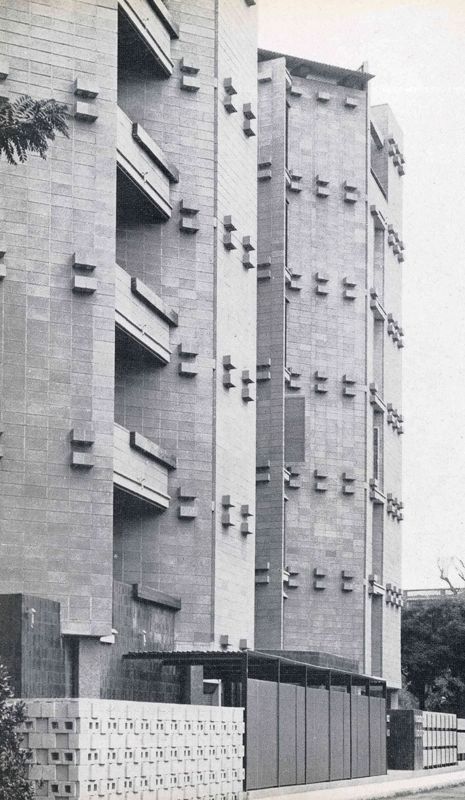
The building comprises a basement, semi-basement, mezzanine, four upper storeys and a penthouse level.
The basement accommodates the private garage and the building’s service installations. The semi-basement contains the main entrances, entrance hall, residents’ club, a rental apartment, the concierge’s lodge and the caretaker’s dwelling. The upper floors, including the penthouse level, are arranged with two apartments per floor. The penthouse apartments follow a reduced programme, with one fewer bedroom and one fewer bathroom than the apartments on the lower levels.
The structure consists of a reinforced concrete frame, using vibrated concrete foundations supported by piles with an average depth of 12 metres and reinforced concrete bracing. The floor slabs are formed with joists and hollow blocks on the first floor and ceramic floor systems on the remaining levels, throughout incorporating flat beams.
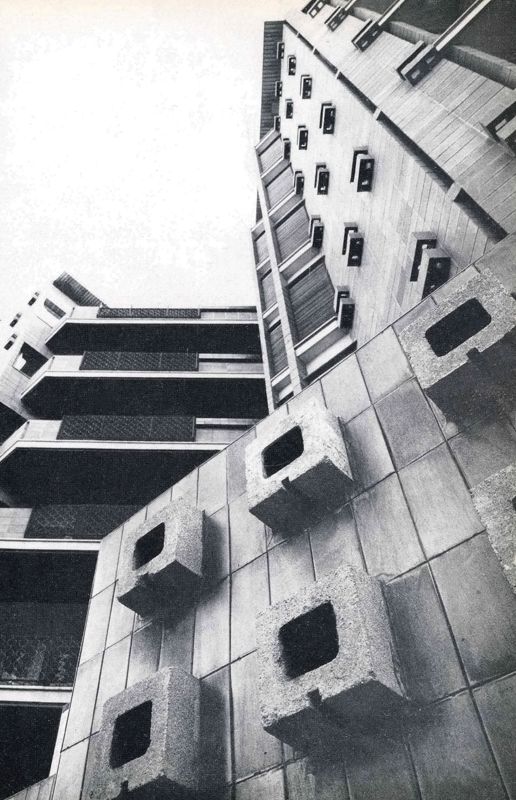
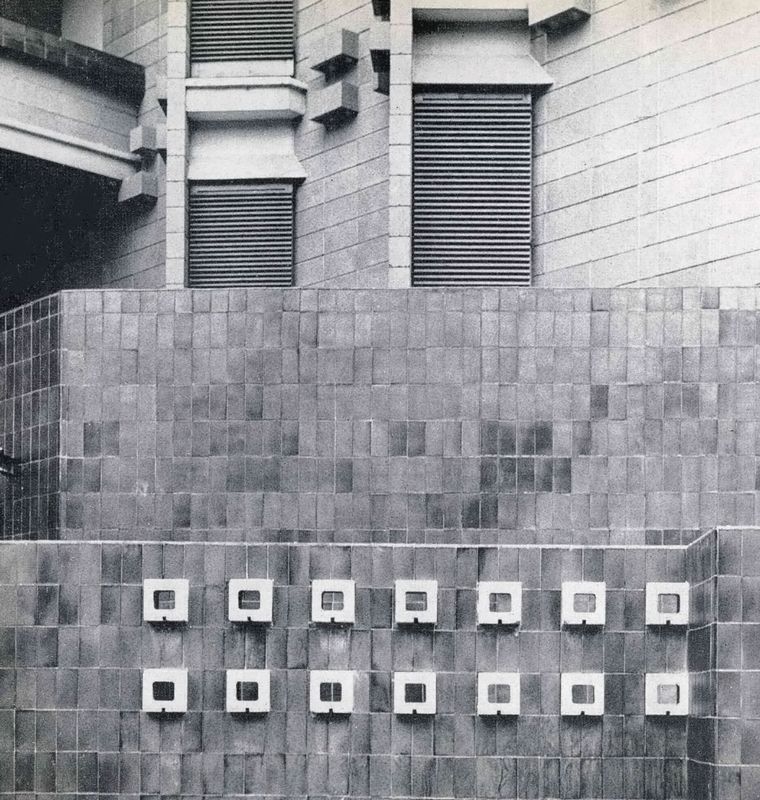
The solid wall sections are constructed using BESSER-TORHO vibro-compressed concrete blocks. Only three block types were employed: U-shaped lintel units, solid facing blocks for the exposed slab edges, and hollow enclosure blocks positioned in front of an air cavity and gypsum board partition walls. These elements are arranged between floor slabs along their greater dimension, acting as anchoring supports.
Openings are enclosed with Flanders timber joinery, complemented by fixed and operable elements in natural anodised aluminium.
In response to the site conditions, the floor layouts were designed to achieve, wherever possible, similar programmes and spatial arrangements for the two apartments on each level, despite the constraints imposed by adjoining buildings on two sides of the plot. This was achieved through an arrangement of octagonal axes set at 45 degrees to the bisector formed by Carrer Ganduxer and Sant Casimir.
As a result, each pair of apartments differs only in orientation through a 90-degree rotation. Both benefit from broad views over Carrer Ganduxer and are protected from overlooking by neighbouring properties, both laterally and directly opposite.
This configuration also ensures that all principal rooms, with the exception of certain service areas, enjoy orientations ranging from south-east to west, while the north-facing walls remain largely blind.
The building’s architectural expression and volumetric composition arise directly from the floor plan. This is particularly evident in the alternation between projecting solid angles and recessed terraces corresponding to the openings. At the same time, the clarity and simplicity of the two principal volumes forming each vertical stack of apartments are preserved, with both volumes linked by the vertical circulation cores.
Source: Hogar y Arquitectura. Nº78. Edificio de viviendas de renta limitada en Barcelona, estudio BSSV, Arquitectos: Miguel Batalla, José María Sen, Ángel Serrano, Esteban Vicens. Madrid : Ediciones y publicaciones populares, 1968