Intro

About

In this first stage, the catalogue focuses on the modern and contemporary architecture designed and built between 1832 –year of construction of the first industrial chimney in Barcelona that we establish as the beginning of modernity– until today.

The project is born to make the architecture more accessible both to professionals and to the citizens through a website that is going to be updated and extended. Contemporary works of greater general interest will be incorporated, always with a necessary historical perspective, while gradually adding works from our past, with the ambitious objective of understanding a greater documented period.

The collection feeds from multiple sources, mainly from the generosity of architectural and photographic studios, as well as the large amount of excellent historical and reference editorial projects, such as architectural guides, magazines, monographs and other publications. It also takes into consideration all the reference sources from the various branches and associated entities with the COAC and other collaborating entities related to the architectural and design fields, in its maximum spectrum.

Special mention should be made of the incorporation of vast documentation from the COAC Historical Archive which, thanks to its documental richness, provides a large amount of valuable –and in some cases unpublished– graphic documentation.

The rigour and criteria for selection of the works has been stablished by a Documental Commission, formed by the COAC’s Culture Spokesperson, the director of the COAC Historical Archive, the directors of the COAC Digital Archive, and professionals and other external experts from all the territorial sections that look after to offer a transversal view of the current and past architectural landscape around the territory.

The determination of this project is to become the largest digital collection about Catalan architecture; a key tool of exemplar information and documentation about architecture, which turns into a local and international referent, for the way to explain and show the architectural heritage of a territory.

Aureli Mora i Omar Ornaque
Directors arquitecturacatalana.cat

credits

About us

Project by:

Created by:

Directors:

2019-2026 Aureli Mora i Omar Ornaque

Documental Commission:

2019-2026 Ramon Faura Carolina B. Garcia Eduard Callís Francesc Rafat Pau Albert Antoni López Daufí Joan Falgueras Mercè Bosch Jaume Farreny Anton Pàmies Juan Manuel Zaguirre Josep Ferrando Fernando Marzá Moisés Puente Aureli Mora Omar Ornaque

Collaborators:

2019-2026 Lluis Andreu Sergi Ballester Maria Jesús Quintero Lucía M. Villodres Montse Viu

External Collaborators:

2019-2026 Helena Cepeda Inès Martinel

With the support of:

Generalitat de Catalunya. Departament de Cultura

Collaborating Entities:

ArquinFAD


Fundació Mies van der Rohe


Fundación DOCOMOMO Ibérico


Basílica de la Sagrada Família


Museu del Disseny de Barcelona


Fomento


AMB


EINA Centre Universitari de Disseny i Art de Barcelona


IEFC


Fundació Domènench Montaner.

Design & Development:

edittio Nubilum
Suggestions

Suggestion box

Request the image

We kindly invite you to help us improve the dissemination of Catalan architecture through this space. Here you can propose works and provide or amend information on authors, photographers and their work, along with adding comments. The Documentary Commission will analyze all data. Please do only fill in the fields you deem necessary to add or amend the information.

The Arxiu Històric del Col·legi d'Arquitectes de Catalunya is one of the most important documentation centers in Europe, which houses the professional collections of more than 180 architects whose work is fundamental to understanding the history of Catalan architecture. By filling this form, you can request digital copies of the documents for which the Arxiu Històric del Col·legi d'Arquitectes de Catalunya manages the exploitation of the author's rights, as well as those in the public domain. Once the application has been made, the Arxiu Històric del Col·legi d'Arquitectes de Catalunya will send you an approximate budget, which varies in terms of each use and purpose.

Detail:

* If the memory has known authorship or rights, cite them in the field above 'Comments' .

Remove * If the photographs has known authorship or rights, cite them in the field above 'Comments'.
You can attach up to 5 files of up to 10 MB each.

Informació bàsica de protecció de dades

Responsable del tractament: Col·legi d Arquitectes de Catalunya 'COAC'
Finalitat del tractament: Tramitar la sol·licitud de còpies digitals dels documents dels quals l’Arxiu Històric del COAC gestiona els drets d'explotació dels autors, a més d'aquells que es trobin en domini públic.
Legitimació del tractament: El seu consentiment per tractar les seves dades personals.
Destinatari de cessions o transferències: El COAC no realitza cessions o transferències internacionals de dades personals.
Drets de les persones interessades: Accedir, rectificar i suprimir les seves dades, així com, l’exercici d’altres drets conforme a l’establert a la informació addicional.
Informació addicional: Pot consultar la informació addicional i detallada sobre protecció de dades en aquest enllaç

How to get there

In Pictures

View all images
  • Church of Pompeia

  • Church of Pompeia

  • Church of Pompeia

  • Church of Pompeia

  • Church of Pompeia

  • Church of Pompeia

  • Church of Pompeia

  • Church of Pompeia

  • Church of Pompeia

  • Church of Pompeia

  • Church of Pompeia

  • Church of Pompeia

  • Church of Pompeia

  • Church of Pompeia

  • Church of Pompeia

  • Church of Pompeia

  • Church of Pompeia

  • Church of Pompeia

  • Church of Pompeia

  • Church of Pompeia

  • Church of Pompeia

  • Church of Pompeia

  • Church of Pompeia

  • Church of Pompeia

  • Church of Pompeia

  • Church of Pompeia

Memory

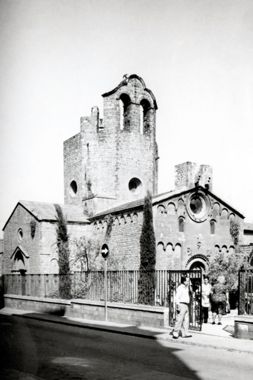
Located on one of the city’s most dynamic thoroughfares, the Church of Pompeia still helps to preserve the stately character that the area possessed at the time of its construction. Owing to its privileged location, it is one of its author’s most popular works. As in other religious buildings by Sagnier, the complex —comprising the church and the adjoining convent of Franciscan friars (Capuchins)— is conceived in a freely interpreted Neo-Gothic language. The church, with three naves separated by slender columns, takes up elements of the Catalan Gothic tradition, such as the central nave of Santa Àgueda in the former Palace of the Counts of Barcelona, while the architect’s inventiveness is evident in the floral-stylised capitals and the triangular openings. On the stone façade, the sculptural work of Josep Llimona stands out: a relief on the doorway and a figure of Saint Francis of Assisi on the upper gable.

The convent (completed in 1915), by contrast, is somewhat more austere, in keeping with the Franciscan tradition of humility, and combines stone and brick. It consists of three bays running parallel to the alignment of the exterior façades; between these and the lateral nave of the church an irregular courtyard is formed, decorated with mosaic ornamentation. One of the most notable spaces in the convent is the large three-storey library (the upper floors protected by a metal balustrade), which is lit from above by a skylight.

In 1936 the interior of the sanctuary was destroyed, and the high altarpiece was lost, with paintings by Joan Llimona and centred on the image of Our Lady of Pompeii, the work of his brother, the sculptor Josep Llimona (both co-founders, together with Sagnier, of the Sant Lluc Artistic Circle). After the Spanish Civil War, the complex was rebuilt by the architect Pere Benavent, who sought to restore the original appearance of the interior, while also taking the opportunity to construct a crypt beneath the central nave.

Author: Santi Barjau

Source: enricsagnier.com

The building is located on the block bounded by the streets Riera de Sant Miquel, Sèneca, Minerva and Avinguda Diagonal. The building stands on the corner plot between Avenida Diagonal (number 450) and Riera de Sant Miquel.

The church, which stands perpendicular to Avinguda Diagonal, is the easternmost building in the complex. Attached to one of its sides is the monastery itself, with a series of buildings which, delimiting the angular shape of the plot, are situated around a large triangular courtyard which recalls the traditional monastic layout with a cloister in the centre.
The church, dedicated to the Virgin of the Rosary, is part of Sagnier's Catalan Art Nouveau period of neo-Gothic inspiration, which the architect usually used for the buildings of worship he designed. It consists of three naves separated by slender columns with vegetal capitals and covered with polychrome and gilded wooden beams over pointed arches. The central nave, higher than the side naves, has a series of openings that give it light in the form of portholes. On the other hand, in the side naves, only the one facing the courtyard of the complex has windows (it receives light directly from this patio), while the one on the other side has none, as it is a partition with the neighbouring property.

The chancel has a hexagonal floor plan. The upper band of the headwall is configured as a body of pointed windows with tracery and is covered with a ribbed vault. At the foot of the church is the heart of the church, which has two levels. The lower one is configured as a portico, as it is precisely where the entrance to the church is located, and is covered with a forging with polychrome, gilded wooden beams that form the base of the upper floor where the organ is located.

The walls are covered with a plaster that imitates rows of ashlars and is spatially ornamental in the upper part of the arches.

The façade, also following the Gothic style, stands out for its verticality, accentuated by the entrance doorway to the church. This main entrance is crowned with a gable with a relief on the tympanum, carried out by Josep Llimona. The image of Saint Francis of Assisi on the upper part is by the same artist. The central body of the façade is framed by two turreted structures which, inside, correspond to the side naves. Of these elements, the one that adjoins the neighbouring property is only half a storey high, unlike the other, which is higher, giving rise to the church's bell tower.

The façade of the monastery, which faces Riera de Sant Miquel and the chamfer with Avinguda Diagonal, is made of exposed brick combined with stone and stands out for the robustness of the constructive elements that make it up, especially the columns of the openings. Access to the monastery is through a door located on the chamfer of the building which, flanked by two windows with sculpted lintels, is completely framed by a lowered pointed arch. This first section of the chamfer is made of stone and is complemented by a gallery of windows set between very sturdy columns with short, wide shafts. From this level onwards, the facing is made of brick, reserving the stone for the corners, the window frames and the crowning of the façade. As far as the side façades are concerned, the same arrangement of materials is maintained depending on the height level - stone on the ground floor and brick on the rest. The gallery of windows on the ground floor, the two storeys of brick windows with stone lintels and the sill developed at the ground floor level stand out.

One of the most important spaces in the complex is the library, also designed by Sagnier, which has little to do with the neo-Gothic style of the complex. It was conceived as a three-storey metal structure, accessed via a spiral staircase, which receives zenithal lighting through a skylight.

Source: Inventari del Patrimoni Arquitectònic de Catalunya (IPAC)

Authors

How to get there

On the Map

Awarded
Cataloged
Disappeared
All works

Constellation

Routes & Notes (1)

Bústia suggeriments

Ajuda’ns a millorar el web i el seu contingut. Proposa’ns obres, aporta o esmena informació sobre obres, autors i fotògrafs, o comenta’ns el què penses. Participa!