
About
In this first stage, the catalogue focuses on the modern and contemporary architecture designed and built between 1832 –year of construction of the first industrial chimney in Barcelona that we establish as the beginning of modernity– until today.
The project is born to make the architecture more accessible both to professionals and to the citizens through a website that is going to be updated and extended. Contemporary works of greater general interest will be incorporated, always with a necessary historical perspective, while gradually adding works from our past, with the ambitious objective of understanding a greater documented period.
The collection feeds from multiple sources, mainly from the generosity of architectural and photographic studios, as well as the large amount of excellent historical and reference editorial projects, such as architectural guides, magazines, monographs and other publications. It also takes into consideration all the reference sources from the various branches and associated entities with the COAC and other collaborating entities related to the architectural and design fields, in its maximum spectrum.
Special mention should be made of the incorporation of vast documentation from the COAC Historical Archive which, thanks to its documental richness, provides a large amount of valuable –and in some cases unpublished– graphic documentation.
The rigour and criteria for selection of the works has been stablished by a Documental Commission, formed by the COAC’s Culture Spokesperson, the director of the COAC Historical Archive, the directors of the COAC Digital Archive, and professionals and other external experts from all the territorial sections that look after to offer a transversal view of the current and past architectural landscape around the territory.
The determination of this project is to become the largest digital collection about Catalan architecture; a key tool of exemplar information and documentation about architecture, which turns into a local and international referent, for the way to explain and show the architectural heritage of a territory.
About us
Project by: 
Created by: 
Directors:
2019-2026 Aureli Mora i Omar OrnaqueDocumental Commission:
2019-2026 Ramon Faura Carolina B. Garcia Eduard Callís Francesc Rafat Pau Albert Antoni López Daufí Joan Falgueras Mercè Bosch Jaume Farreny Anton Pàmies Juan Manuel Zaguirre Josep Ferrando Gemma Ferré Inés de Rivera Fernando Marzá Moisés Puente Aureli Mora Omar OrnaqueCollaborators:
2019-2026 Lluis Andreu Sergi Ballester Marianela Pla Maria Jesús Quintero Lucía M. Villodres Montse ViuExternal Collaborators:
2019-2026 Helena Cepeda Inès MartinelWith the support of:
Generalitat de Catalunya. Departament de CulturaCollaborating Entities:
ArquinFADFundació Mies van der Rohe
Fundación DOCOMOMO Ibérico
Basílica de la Sagrada Família
Museu del Disseny de Barcelona
Fomento
AMB
EINA Centre Universitari de Disseny i Art de Barcelona
IEFC
Fundació Domènench Montaner.
ETSAB
Suggestion box
Request the image
We kindly invite you to help us improve the dissemination of Catalan architecture through this space. Here you can propose works and provide or amend information on authors, photographers and their work, along with adding comments. The Documentary Commission will analyze all data. Please do only fill in the fields you deem necessary to add or amend the information.
The Arxiu Històric del Col·legi d'Arquitectes de Catalunya is one of the most important documentation centers in Europe, which houses the professional collections of more than 180 architects whose work is fundamental to understanding the history of Catalan architecture. By filling this form, you can request digital copies of the documents for which the Arxiu Històric del Col·legi d'Arquitectes de Catalunya manages the exploitation of the author's rights, as well as those in the public domain. Once the application has been made, the Arxiu Històric del Col·legi d'Arquitectes de Catalunya will send you an approximate budget, which varies in terms of each use and purpose.
close
close

Works (10)
On the Map
Awarded
Cataloged
Disappeared
All works
Constellation
Chronology (13)
-
Reforma de l'Antiga Foneria de Canons. Banc de Barcelona
Josep Oriol Mestres i Esplugas
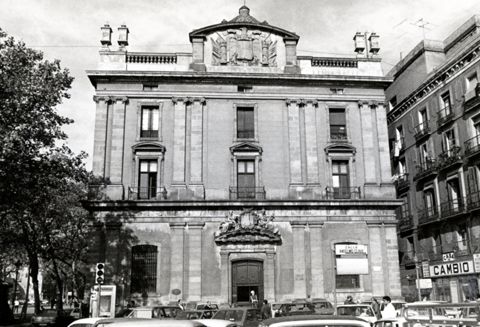 La restauració va adaptar l’antic edifici al gust classicista de l’època. A la façana principal destaquen dues escultures obra de Venanci Vallmitjana.
 -
Casa Evarist Arnús
Josep Oriol Mestres i Esplugas
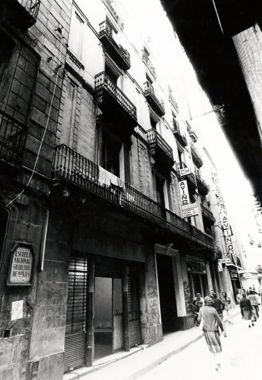 Edifici entre mitgeres de planta baixa i quatre plantes, amb una façana simètrica i una entrada d’estil neoclàssic. Els balcons i les motllures disminueixen progressivament cap als pisos superiors, tant en longitud com en profunditat. Hi ha tres balcons per pis, excepte al primer, que presenta una balconera correguda. L’edifici es remata amb una cornisa decorada amb motllures. Disposa d’un pati de planta quadrada, amb columnes a l’accés. En aquest pati, hi ha tres finestres per pis a cada costat; al primer pis, aquestes obertures adopten la forma d’arcs amb motllures. Cada planta compta amb dos pisos.
 -
Parròquia de Santa Maria del Remei
Josep Oriol Mestres i Esplugas
 Església d’una sola nau, amb una façana presidida per un rosetó i una arqueria cega utilitzada com a motiu ornamental. El conjunt queda coronat per una cornisa perimetral que reforça la unitat compositiva de l’edifici. Al costat oest s’hi adossa la rectoria.
 -
Gran Teatre del Liceu First Reconstruction
Josep Oriol Mestres i Esplugas
 Edifici entre mitgeres que fa cantonada, format per planta baixa i quatre pisos. La façana, d'estil neoclàssic, destaca per les grans obertures en arc i les balconades amb balustrada. L'accés principal s'organitza mitjançant un pòrtic de tres arcades que condueix a un vestíbul d'ordre grec, dividit en tres naus. A continuació s'hi desenvolupa l'escala principal, íntegrament revestida de marbre. Al replà principal hi destaca l'estàtua de la Música, obra de Vallmitjana, presidint l'espai i emmarcada entre dues làpides commemoratives. El saló de fumar, situat al primer pis, està decorat en estil neoromànic, d'acord amb el gust del Segon Imperi francès (segons A. Cirici), i presenta columnes corínties. La sala de butaques té una capacitat de 1.500 localitats, distribuïdes entre la platea, l'amfiteatre i cinc pisos. Les pintures són obra de Martí Alsina, Vicens, Rigalt i Cada. L'embocadura de l'escenari fa 14 metres d'amplada, mentre que la sala té una superfície de 1.117 m² i una alçada de 20,50 metres.
 -
Torre de les Aigües of L'Eixample
Josep Oriol Mestres i Esplugas
 When, in 1862, the new Eixample district began to be developed, the city council had not yet resolved to supply drinking water to all its dwellings. On the 14th of October of that same year, the honorary intendant of the province of Barcelona, Jaume Safont i Lluch, granted this land to the Societat de Crèdit i Foment de l'Eixample de Barcelona, which in turn hired the architect Josep Oriol Mestres i Esplugas to design a water tower to supply the area. The municipal architect did not initially approve Mestres' project (a hexagonal tower which was 24 m high with a capacity for 730 m³ of water) because it exceeded the maximum height of 20 m permitted in the Eixample. In May 1867, Mayor Luis Rodríguez Téllez signed the building permits, considering that it was not possible to guarantee a good water flow in the tall buildings if the tower was the same height as the tall buildings. This construction formed part of a group of buildings intended for the elevation and distribution of water by means of a 20 hp steam engine (which was later electrified) to raise the water from the lower well to the upper reservoir. With a hexagonal ground plan, the structure of this tower's elevation comprises six levels, the last of which was used as a water tank, and a roof terrace. These levels are visible from the outside through the brick mouldings that mark the presence of the floor slabs. The entire construction is made of exposed brick and the openings are in the form of semi-circular arches without frames. On the first four levels, the flat enclosing walls are evenly connected to the corner pillars. However, on the fourth level, instead of windows, there are balconies resting on lowered arches with brick balustrades forming rhomboids. From this level onwards, the reinforcement walls have a circular plan that is adapted to the building by means of segmental arches and brick corbels. The fifth level has the openings in the form of twinned arches within blind arches. As this was originally the last level reserved for the upper cistern, it has the old crowning of the building, with a cornice decorated with corbels. The sixth level rises above this cornice, which is the result of a later raising, and has a new stucco cornice decorated with corbels and oculi. Ventilation on this level is provided by narrow vents cut directly into the wall. Inside, six radially arranged walls compartmentalise the space and distribute the enormous weight of the upper cistern. Each of these compartments is covered with supporting lowered vaults, except for the compartment containing the staircase leading to the top of the tower.
 -
Remodelling of the Pre-existing Building of the Royal Academy of the Sciences and the Arts
Josep Oriol Mestres i Esplugas, I. Reventós
-
Restauració i Façana Neogòtica de la Església de Sant Jaume
Josep Oriol Mestres i Esplugas
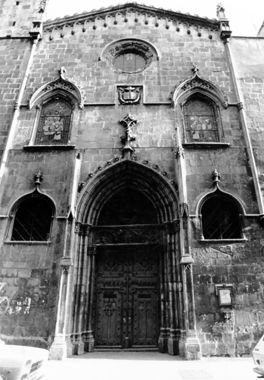 Construïda l’any 1394 sobre una antiga sinagoga, aquesta església d’estil gòtic conserva de la seva etapa inicial únicament la portalada. L’edifici actual presenta una planta de creu llatina, amb una sola nau dividida en cinc trams i capelles laterals. La profunda reforma dirigida per Oriol Mestres amplià el presbiteri i dotà la façana d’una decoració neogòtica que encara es conserva. A l’interior, destaca l’altar major, una obra gòtica de talla procedent de l’antic retaule major de la Catedral, datada al segle XV.
 -
Edifici Companyia de Tabacs de Filipines
Josep Oriol Mestres i Esplugas
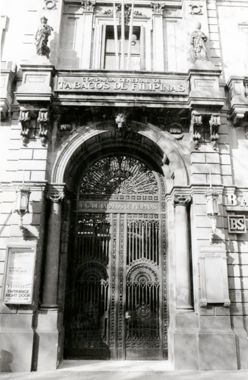 Edifici entre mitgeres fent cantonada, de planta baixa i quatre plantes, amb un llenguatge neoclàssic. Els balcons presenten balustres que disminueixen d’alçada a mesura que s’ascendeix. La façana està decorada amb escultures, columnes i pilastres adossades, mentre que les impostes ressalten els forjats. L’edifici es corona amb una cornisa i una barana de balustres que rematen la composició.
 -
Main Façade and Lantern Tower of Barcelona Cathedral
August Font Carreras, Josep Oriol Mestres i Esplugas
 This project undoubtedly became the most significant achievement in August Font’s career as an architect. The Cathedral of Barcelona was begun in 1298. By the early 15th century, discussions began about how the façade would be designed. A master builder from Rouen, Normandy, named Carlí Galter or Galtés, created a design for the main façade that was never executed, likely due to lack of funds. As a result, the façade remained a simple wall with a doorway, windows, and steps, with no harmony with the rest of the magnificent Gothic cathedral. Similarly, the lantern tower was completed only up to the base of the drum. In the 19th century, there was an urgent need to finally complete the cathedral. The initiative came from the banker Manel Girona, who tried unsuccessfully to secure funding and then decided to finance the works himself. Later, his children, Manel and Anna, did the same for the lantern tower. The selection of the project was highly controversial: Girona himself had drawn the proposed design, endorsed by Josep Oriol Mestres, the cathedral architect and a personal friend. Public opinion preferred the design of Joan Martorell, far more ornate, majestic, and vertically emphasised. However, the Royal Academy of Fine Arts of San Fernando, responsible for settling such disputes, rejected Martorell’s design on rather weak grounds and chose the design submitted by Mestres and drawn by Girona. Inspired by Master Carlí’s original concept, Josep Oriol Mestres began working with August Font, who was his assistant. Construction finally began on 4 July 1887 and was completed on 12 February 1890, the feast day of Saint Eulalia. It should be noted that the façade was not executed exactly as we see it today: originally, it included decoration on the jambs with the apostles, Christ in the main mullion, a tympanum with openwork tracery, archivolts with the 24 elders, angels and prophets, a gable with a lobed rose window, and buttresses on each side adorned with various sculptures crowned with canopies and gables. However, when the scaffolding was removed, modifications were made in response to criticism. Josep Oriol Mestres had passed away, and August Font assumed the role of cathedral architect. He added the two lateral towers and a series of decorative elements to enrich the façade. Manel Girona pledged to fund these enhancements. After the banker’s death, his children financed the lantern tower, with construction beginning in 1906 and finishing in 1912. This work, too, was not free from controversy, as the final result included many elements reminiscent of the Martorell design, which had been highly praised by the people of Barcelona but swiftly rejected by the Royal Academy.


