About
In this first stage, the catalogue focuses on the modern and contemporary architecture designed and built between 1832 –year of construction of the first industrial chimney in Barcelona that we establish as the beginning of modernity– until today.
The project is born to make the architecture more accessible both to professionals and to the citizens through a website that is going to be updated and extended. Contemporary works of greater general interest will be incorporated, always with a necessary historical perspective, while gradually adding works from our past, with the ambitious objective of understanding a greater documented period.
The collection feeds from multiple sources, mainly from the generosity of architectural and photographic studios, as well as the large amount of excellent historical and reference editorial projects, such as architectural guides, magazines, monographs and other publications. It also takes into consideration all the reference sources from the various branches and associated entities with the COAC and other collaborating entities related to the architectural and design fields, in its maximum spectrum.
Special mention should be made of the incorporation of vast documentation from the COAC Historical Archive which, thanks to its documental richness, provides a large amount of valuable –and in some cases unpublished– graphic documentation.
The rigour and criteria for selection of the works has been stablished by a Documental Commission, formed by the COAC’s Culture Spokesperson, the director of the COAC Historical Archive, the directors of the COAC Digital Archive, and professionals and other external experts from all the territorial sections that look after to offer a transversal view of the current and past architectural landscape around the territory.
The determination of this project is to become the largest digital collection about Catalan architecture; a key tool of exemplar information and documentation about architecture, which turns into a local and international referent, for the way to explain and show the architectural heritage of a territory.
About us
Project by: 
Created by: 
Directors:
2019-2026 Aureli Mora i Omar OrnaqueDocumental Commission:
2019-2026 Ramon Faura Carolina B. Garcia Eduard Callís Francesc Rafat Pau Albert Antoni López Daufí Joan Falgueras Mercè Bosch Jaume Farreny Anton Pàmies Juan Manuel Zaguirre Josep Ferrando Gemma Ferré Inés de Rivera Fernando Marzá Moisés Puente Aureli Mora Omar OrnaqueCollaborators:
2019-2026 Lluis Andreu Sergi Ballester Marianela Pla Maria Jesús Quintero Lucía M. Villodres Montse ViuExternal Collaborators:
2019-2026 Helena Cepeda Inès MartinelWith the support of:
Generalitat de Catalunya. Departament de CulturaCollaborating Entities:
ArquinFADFundació Mies van der Rohe
Fundación DOCOMOMO Ibérico
Basílica de la Sagrada Família
Museu del Disseny de Barcelona
Fomento
AMB
EINA Centre Universitari de Disseny i Art de Barcelona
IEFC
Fundació Domènench Montaner.
ETSAB
Suggestion box
Request the image
We kindly invite you to help us improve the dissemination of Catalan architecture through this space. Here you can propose works and provide or amend information on authors, photographers and their work, along with adding comments. The Documentary Commission will analyze all data. Please do only fill in the fields you deem necessary to add or amend the information.
The Arxiu Històric del Col·legi d'Arquitectes de Catalunya is one of the most important documentation centers in Europe, which houses the professional collections of more than 180 architects whose work is fundamental to understanding the history of Catalan architecture. By filling this form, you can request digital copies of the documents for which the Arxiu Històric del Col·legi d'Arquitectes de Catalunya manages the exploitation of the author's rights, as well as those in the public domain. Once the application has been made, the Arxiu Històric del Col·legi d'Arquitectes de Catalunya will send you an approximate budget, which varies in terms of each use and purpose.
close
close
Works (11)
On the Map
Awarded
Cataloged
Disappeared
All works
Constellation
Chronology (14)
-
El Sargazo Apartments
Taller de Arquitectura, Ricardo Bofill Leví
 The complex, located in a pine forest near Castelldefels beach, consists of 33 summer apartments grouped in several buildings and a tower that houses a water tank and other facilities. These are compact volumes, with rationalist windows, plastered and painted in different ranges of red.
 -
Johann Sebastian Bach 28 Apartment Building
Taller de Arquitectura, Emili Bofill i Benessat, Ricardo Bofill Leví
 The plot’s peculiar conditions lead to a distributive solution that leaves aside the typological repertoire of urban environment housing. The only façade to the street faces north. On the south side, the connection space with the inner courtyard is very small and is located in a corner. Bofill chooses to place the living rooms on the side of the street and direct the bedrooms towards the inner courtyard, creating one of its own which guarantees good lighting and ventilation in the back of the apartments. The two bedroom wings open in a staggered direction, and the master bedroom is at the end, in the best position. In the remaining spaces between both bodies are the kitchens, with an opening to the courtyard, and the bathrooms, at the partitions. The façade facing the street combines some ceramic lattice locks with wooden shutters, which close the living rooms asymmetrically.
 -
FAD Award
Shortlisted. Category: Architecture Johann Sebastian Bach 28 Apartment Building
FAD Award
Award-Winner / Winner. Category: ArchitectureNicaragua DwellingsNicaragua Dwellings
Taller de Arquitectura, Emili Bofill i Benessat, Ricardo Bofill Leví
 This is a controlled rent housing program on a north-facing corner plot. The distribution frees up a large courtyard at the back, which allows for lighting and ventilation of the bedrooms in the side homes. The central house faces the street, although it offers almost blind walls on the corner and opens to the east and west. The building offers an image of brick screens that open in a fan towards the two favourable orientations, from where the view is more transparent. A unique housing developed on three levels gives rise to the declining volumes of the roof.
Johann Sebastian Bach - Francesc Pérez-Cabrero Dwellings
Taller de Arquitectura, Emili Bofill i Benessat, Ricardo Bofill Leví
 The building meets a program of 12 rent-free homes and 21 controlled rent homes, plus a secluded penthouse understood as a unique piece. Bofill refers to the traditional construction with a brick factory to fit the circular perimeter of the square and provide it with a defining character. Both hierarchies of houses are reflected on the façade and, in the manner of the local modernist tradition, small-scale elements (drainage pipes, gargoyles, chimney pipes, railings) are used to give expressiveness to the building, understood as a delicate work of brick factory and iron elements that adopt a sculptural quality.
FAD Award
Shortlisted. Category: ArchitectureJohann Sebastian Bach - Francesc Pérez-Cabrero DwellingsLafi Phyto-Chemical Laboratories
Taller de Arquitectura, Ricardo Bofill Leví
 Designed for the manufacture of phytochemicals, this building is the perfect example of RBTA regionalist period, with large cubic volumes suspended in the void and special attention given to the design details. The building is of exposed traditional red brick, with large glazed window openings. Conceived as a single building, it reveals itself as three pavilions which have been adapted to the undulating site. The different species of plants along the façade and the domestic appearance of the building facilitated its integration into what was a rural setting at the time, and it has been taken to be a private villa for decades. The progressive degradation of the area as a result of indiscriminate industrial development has left the laboratories looking today like a lush green garden amid a sea of eyesores.
Club Esportiu Mas Pei
Taller de Arquitectura, Ricardo Bofill Leví
 Sited on a cliff, this sports club that includes a swimming pool, tennis courts and a restaurant, offers dramatic views over the Catalan Costa Brava. Perfectly integrated in its natural environment, the building’s roof garden has been planted with native vegetation around the swimming pool. Another example of RBTA’s Critical Regionalism period, the design widely incorporates the use of exposed red brick and tiles that resonates with the local culture.
Gaudí Neighbourhood
Taller de Arquitectura, Anna Bofill Levi, Ricardo Bofill Leví
 El projecte respon a un encàrrec de l’Administració per fer un conjunt d’habitatges socials en un indret perifèric de Reus. Bofill opta per fer una lectura positiva de la vida col·lectiva de la petita localitat industrial, i reprodueix al nou barri l’amalgama de locals comercials, supermercats, bars, equipaments de lleure i els mateixos habitatges. El barri està format per torres de vuit plantes, resultat de la combinació d’un nombre limitat de tipus d’habitatges, que incorporen dos, tres i quatre dormitoris. De l’acoblament dels diferents tipus en surt una varietat de plantes sempre orientades als quatre vents, que poden juxtaposar dues torres en un mateix bloc i que poden variar en alçària d’una planta a l’altra. Totes les torres queden unides per quatre nivells de passeres que permeten circular horitzontalment sense necessitat de baixar al carrer. L’èxit de l’operació va portar a projectar-ne una segona i una tercera fase.
El Castell de Kafka Residential Building
Taller de Arquitectura, Ricardo Bofill Leví, Manuel Nuñez Yanowsky, Peter Hodgkinson
 The approach to the project is born from the influence that the Archigram group exercised in the sixties on some members of the Taller de Arquitectura. It was a matter of clearly separating the order of the circulations from the order of the houses, and of conceiving some vertically growing cubes that could be connected to the network of circulations without their own structural servitudes. The stairwells are made of load-bearing brick walls, which extend to support half of each unit, while the other half rests on a metal pillar located in one corner. Each cube contains an environment – living room-dining room or bathroom-bedroom - separated by a difference in level. The law of vertical growth follows the guidelines of a mathematical equation. It was about adapting architecture to unconventional forms of leisure, linked to a dramatic conception of existence which was very typical of that decade.
Bofill House
Taller de Arquitectura, Ricardo Bofill Leví
 Bofill construeix la casa d’estiueig dels seus pares al voltant d’una antiga masia en runes, i reparteix les diferents parts del programa en pavellons independents. Un gran basament es relaciona amb el terreny exterior per mitjà d’escalinates i conté la piscina, que actua com a centre de tot el conjunt. El pavelló principal, en forma de L, conté la sala d’estar, la sala de música i el dormitori principal a la planta baixa, i la biblioteca, la sala de jocs i una segona sala d’estar a la primera planta, que queda connectada amb la piscina a través d’una escalinata. Un segon pavelló a tocar de la piscina conté el menjador, entès com a centre de reunió de tota la casa. Els mòduls restants, de 3 x 6 x 6 metres, contenen els dormitoris dels fills i queden encavallats al basament. A la plataforma central es genera un paisatge d’escalinates i xiprers que alliberen la vida a la casa de qualsevol forma de relació funcional.
Walden 7
Taller de Arquitectura, Anna Bofill Levi, Ricardo Bofill Leví, Ramon Collado, Joan Malagarriga, Peter Hodgkinson, Dolors Rocamora, Xavier Bagué Bofill
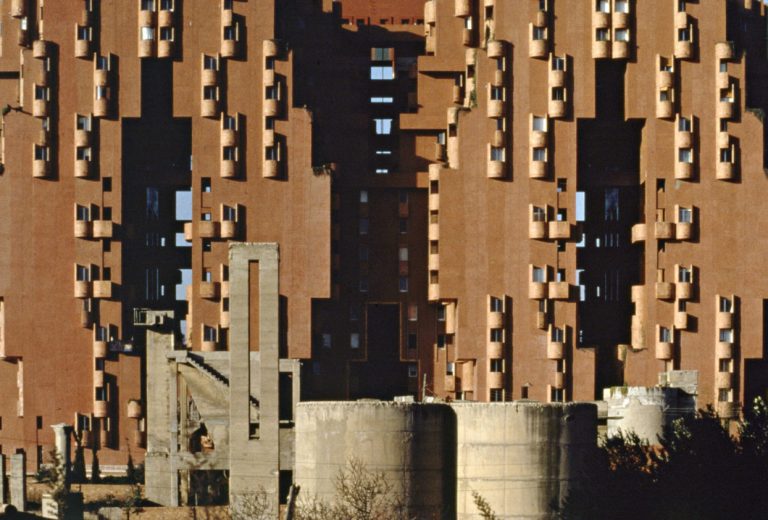
 With a lower budget than that usually used for social housing, and with atypical financing instruments, Ricard Bofill and Taller de Arquitectura manage to carry out a set of homes that start from the criticism of the existing city and propose architectural and existential alternatives. These are 18 towers that curve as they rise until they touch the neighbouring towers, leaving in the centre large, interconnected voids that encourage the relationship between the different homes. The set shows on the outside facings covered with red ceramic and with very small openings. The inner courtyards, on the other hand, are treated with very bright colours. The types of housing try numerous combinations starting from a square module, which can be doubled or form groups of four, establishing new possibilities of interrelation between the inhabitants of each unit.
Taller de Arquitectura
Taller de Arquitectura, Emili Bofill i Benessat, Anna Bofill Levi, Ricardo Bofill Leví, Ramon Collado, Joan Malagarriga, Peter Hodgkinson, Dolors Rocamora
 In 1973 Ricardo Bofill discovered a disused concrete factory on the outskirts of Barcelona, an industrial complex from the beginning of the 20th century. "In front of me - he says - there were 30 immense silos, a very tall chimney, four kilometers of underground, gigantic machinery rooms. During my first visit to the old cement factory, I suddenly thought that something horrible could become something very beautiful, just as idiocy can sometimes be transformed into genius. The concrete factory corresponds to the first period of the industrialisation of Barcelona and was not built according to a previous general plan but by juxtaposing different elements. The result was then a series of volumes added to each other and different manufacturing chains that recall vernacular architecture but with an industrial aspect. I kept going deeper and little by little I realised that the different aesthetics developed since the last World War were present in the factory: the hard and sculptural treatment of matter, with broken volumes, stairs that go nowhere, powerful spaces already useless and strange proportions yet full of magic. I decided to keep that factory with the intention of transforming the roughness into a work of art and set up my Architecture Workshop there which, in the long term, could be used as a foundation for research on the shape and design of the city. This transformation has been carried out gradually and even now I continue to add new workspaces by adapting the old ruins still standing. However, I believe that the factory will always be a work in progress, which is part of its fascination". After deconstructing the existing volumes, there were eight silos that Ricardo Bofill adapted to accommodate the offices, model laboratory, archives, library and a space, the largest of all, which preserves the skin and breadth of the old building and is named "La Catedral". This has the function of an exhibition hall for the projects, multimedia projections, meeting with clients and visitors and social and cultural gatherings linked to the professional activity of the architect. The Architecture Workshop is surrounded by large green spaces planted with olive, cypress, palm and eucalyptus trees.
Routes & Notes (12)
-

Apunts 8
-

Rutes 78
-

Apunts 10
-

Apunts 4
-
Rutes 133
-

Apunts 3
Authors (7)