In this first stage, the catalogue focuses on the modern and contemporary architecture designed and built between 1832 –year of construction of the first industrial chimney in Barcelona that we establish as the beginning of modernity– until today.
The project is born to make the architecture more accessible both to professionals and to the citizens through a website that is going to be updated and extended. Contemporary works of greater general interest will be incorporated, always with a necessary historical perspective, while gradually adding works from our past, with the ambitious objective of understanding a greater documented period.
The collection feeds from multiple sources, mainly from the generosity of architectural and photographic studios, as well as the large amount of excellent historical and reference editorial projects, such as architectural guides, magazines, monographs and other publications. It also takes into consideration all the reference sources from the various branches and associated entities with the COAC and other collaborating entities related to the architectural and design fields, in its maximum spectrum.
Special mention should be made of the incorporation of vast documentation from the COAC Historical Archive which, thanks to its documental richness, provides a large amount of valuable –and in some cases unpublished– graphic documentation.
The rigour and criteria for selection of the works has been stablished by a Documental Commission, formed by the COAC’s Culture Spokesperson, the director of the COAC Historical Archive, the directors of the COAC Digital Archive, and professionals and other external experts from all the territorial sections that look after to offer a transversal view of the current and past architectural landscape around the territory.
The determination of this project is to become the largest digital collection about Catalan architecture; a key tool of exemplar information and documentation about architecture, which turns into a local and international referent, for the way to explain and show the architectural heritage of a territory.
We kindly invite you to help us improve the dissemination of Catalan architecture through this space. Here you can propose works and provide or amend information on authors, photographers and their work, along with adding comments. The Documentary Commission will analyze all data. Please do only fill in the fields you deem necessary to add or amend the information.
The Arxiu Històric del Col·legi d'Arquitectes de Catalunya is one of the most important documentation centers in Europe, which houses the professional collections of more than 180 architects whose work is fundamental to understanding the history of Catalan architecture. By filling this form, you can request digital copies of the documents for which the Arxiu Històric del Col·legi d'Arquitectes de Catalunya manages the exploitation of the author's rights, as well as those in the public domain. Once the application has been made, the Arxiu Històric del Col·legi d'Arquitectes de Catalunya will send you an approximate budget, which varies in terms of each use and purpose.
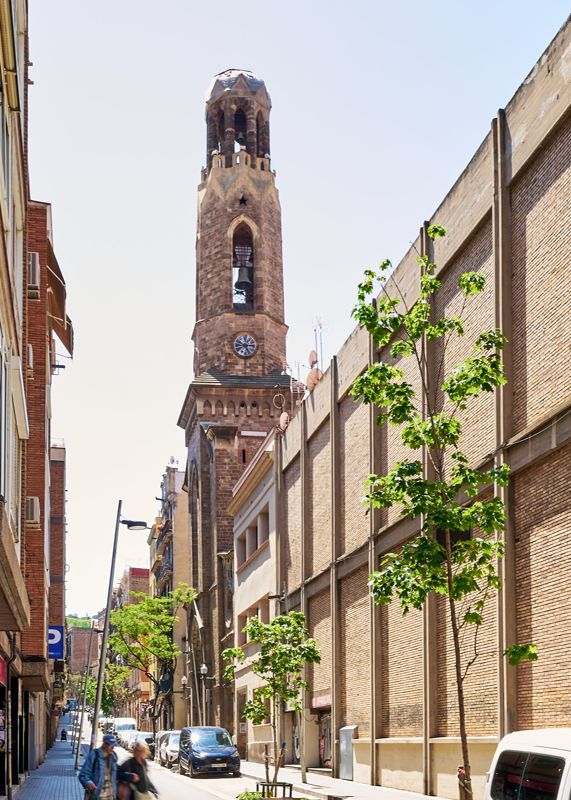
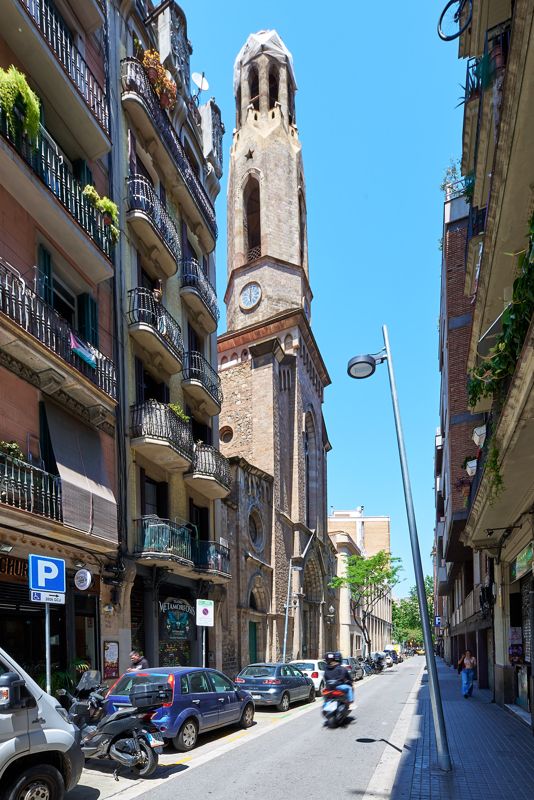
The Church of Santa Madrona is located within the block bounded by Carrer Tapioles, Carrer Blai, Carrer Margarit, and Avinguda del Paral·lel in the Sants-Montjuïc district, with its main façade facing Carrer Tapioles.
This late 19th-century religious building functions both as a church and rectory. Of particular historical value, and under special protection, is the rear portal, a Baroque doorway preserved from the earlier church.
The church has a cruciform plan, with a single nave flanked by lateral chapels set between the buttresses. The apse lies within the interior courtyard of the block, surrounded by auxiliary constructions behind residential buildings. A small passage connects the apse area to Carrer Margarit, providing a view of the Gate of the Convent of Saint John of Jerusalem.
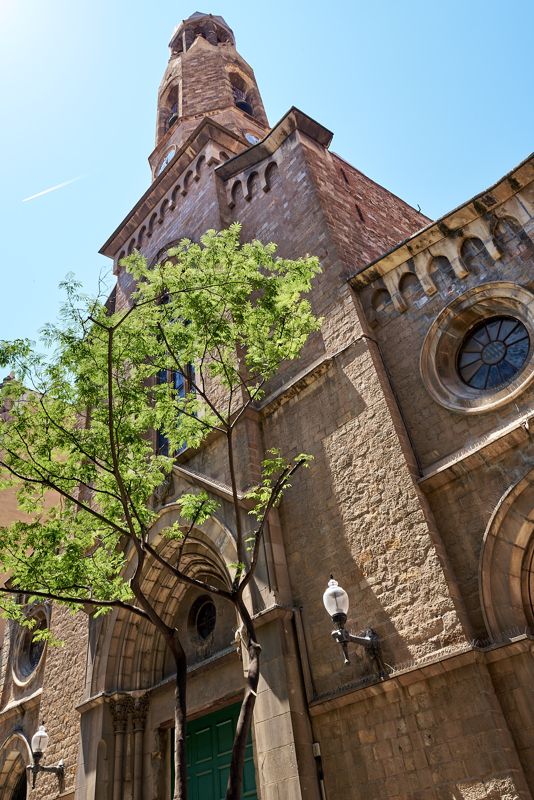
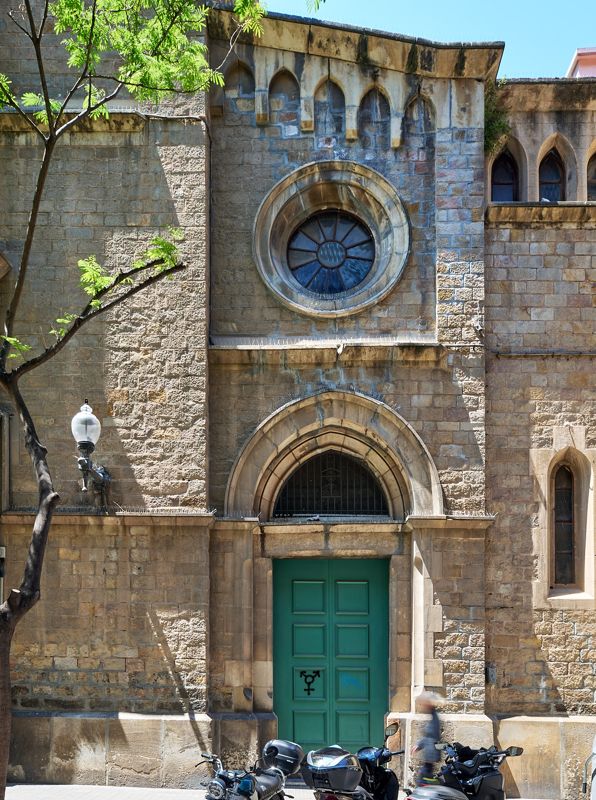
The main façade, oriented east, is symmetrically composed of three sections: the central nave and the lateral chapel wings. A projecting portion of the nave façade houses the entrance and a rose window above a vertically proportioned window with polychrome glass. The entrance portal is rectangular and flanked by columns, rising into four archivolts that meet at a pointed arch.
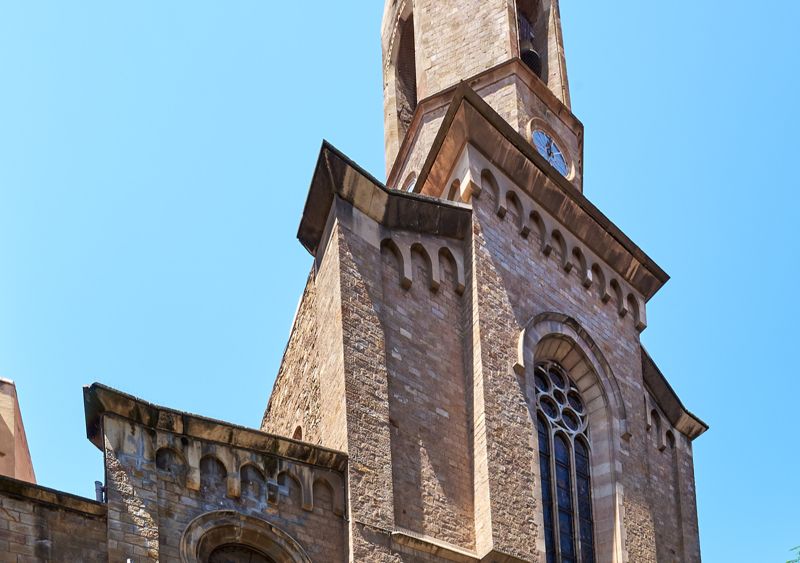
The nave façade expresses the slope of the roof, which is double-pitched, with the chapel roofs following the same slope at a lower height. All eaves are classical stone profiles with small arches beneath.
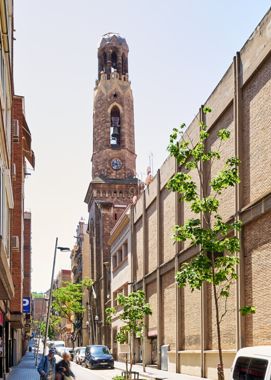
The bell tower rises from the projecting section of the main façade, centrally located, and reaches a height comparable to the nave. Its vertical progression transitions from a square to an octagonal plan, gradually reducing in size. The southern façade is mostly blank, except for a large rose window in the transept façade and small circular windows between the nave buttresses.
All roofs are double-pitched, with the crossing crowned by a semi-spherical dome matching the diameter of the central nave. This dome is illuminated by pointed-arch windows in the lantern. The apse is covered by a smaller dome. All façades are constructed with regularly arranged stone ashlar.
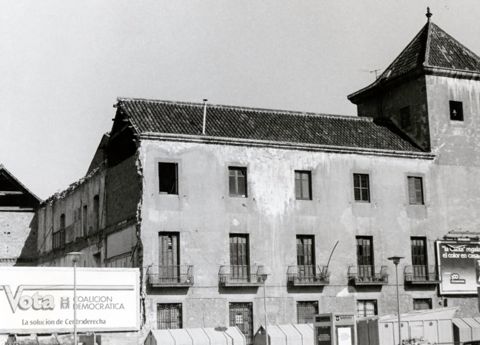
The church is considered Neo-Gothic due to the stylistic proportions and decorative elements. Artistically notable is the portal of the Convent of Saint John of Jerusalem, fully in stone and embedded in the exterior of the apse. It features a rectangular opening flanked by composite columns and a classical entablature with an oval shield. Above this is a richly decorated Baroque niche, originally housing the image of the titular saint, which has been destroyed.

T113 Arquitectura, Giuseppe Giacalone, Maria del Mar Viladot


T113 Arquitectura, Giuseppe Giacalone, Maria del Mar Viladot

T113 Arquitectura, Giuseppe Giacalone, Maria del Mar Viladot