How to get there

About
In this first stage, the catalogue focuses on the modern and contemporary architecture designed and built between 1832 –year of construction of the first industrial chimney in Barcelona that we establish as the beginning of modernity– until today.
The project is born to make the architecture more accessible both to professionals and to the citizens through a website that is going to be updated and extended. Contemporary works of greater general interest will be incorporated, always with a necessary historical perspective, while gradually adding works from our past, with the ambitious objective of understanding a greater documented period.
The collection feeds from multiple sources, mainly from the generosity of architectural and photographic studios, as well as the large amount of excellent historical and reference editorial projects, such as architectural guides, magazines, monographs and other publications. It also takes into consideration all the reference sources from the various branches and associated entities with the COAC and other collaborating entities related to the architectural and design fields, in its maximum spectrum.
Special mention should be made of the incorporation of vast documentation from the COAC Historical Archive which, thanks to its documental richness, provides a large amount of valuable –and in some cases unpublished– graphic documentation.
The rigour and criteria for selection of the works has been stablished by a Documental Commission, formed by the COAC’s Culture Spokesperson, the director of the COAC Historical Archive, the directors of the COAC Digital Archive, and professionals and other external experts from all the territorial sections that look after to offer a transversal view of the current and past architectural landscape around the territory.
The determination of this project is to become the largest digital collection about Catalan architecture; a key tool of exemplar information and documentation about architecture, which turns into a local and international referent, for the way to explain and show the architectural heritage of a territory.
About us
Project by: 
Created by: 
Directors:
2019-2026 Aureli Mora i Omar OrnaqueDocumental Commission:
2019-2026 Ramon Faura Carolina B. Garcia Eduard Callís Francesc Rafat Pau Albert Antoni López Daufí Joan Falgueras Mercè Bosch Jaume Farreny Anton Pàmies Juan Manuel Zaguirre Josep Ferrando Gemma Ferré Inés de Rivera Fernando Marzá Moisés Puente Aureli Mora Omar OrnaqueCollaborators:
2019-2026 Lluis Andreu Sergi Ballester Marianela Pla Maria Jesús Quintero Lucía M. Villodres Montse ViuExternal Collaborators:
2019-2026 Helena Cepeda Inès MartinelWith the support of:
Generalitat de Catalunya. Departament de CulturaCollaborating Entities:
ArquinFADFundació Mies van der Rohe
Fundación DOCOMOMO Ibérico
Basílica de la Sagrada Família
Museu del Disseny de Barcelona
Fomento
AMB
EINA Centre Universitari de Disseny i Art de Barcelona
IEFC
Fundació Domènench Montaner.
ETSAB
Suggestion box
Request the image
We kindly invite you to help us improve the dissemination of Catalan architecture through this space. Here you can propose works and provide or amend information on authors, photographers and their work, along with adding comments. The Documentary Commission will analyze all data. Please do only fill in the fields you deem necessary to add or amend the information.
The Arxiu Històric del Col·legi d'Arquitectes de Catalunya is one of the most important documentation centers in Europe, which houses the professional collections of more than 180 architects whose work is fundamental to understanding the history of Catalan architecture. By filling this form, you can request digital copies of the documents for which the Arxiu Històric del Col·legi d'Arquitectes de Catalunya manages the exploitation of the author's rights, as well as those in the public domain. Once the application has been made, the Arxiu Històric del Col·legi d'Arquitectes de Catalunya will send you an approximate budget, which varies in terms of each use and purpose.
close
close
Memory
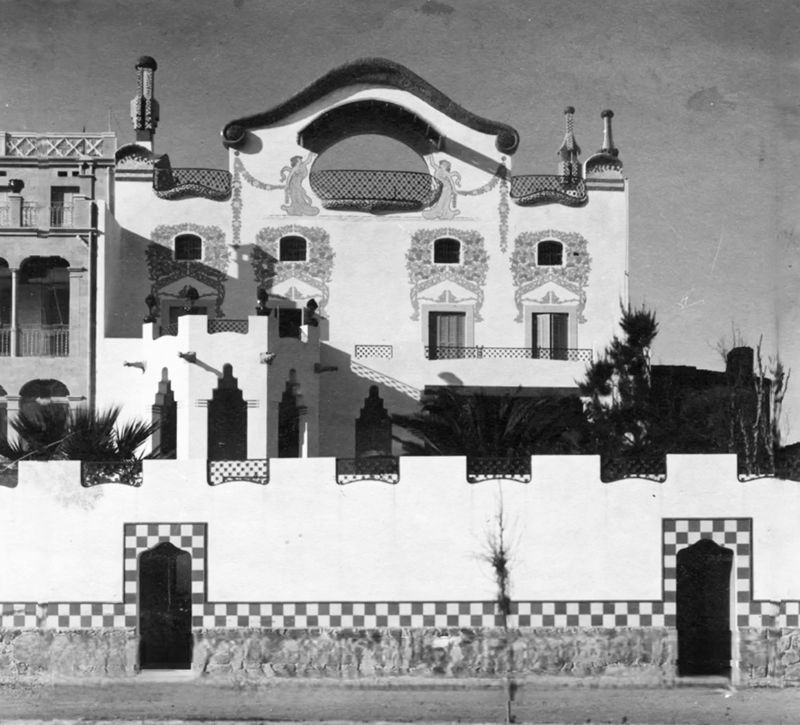
Casa construïda per Antoni Falguera Silvilla (1876-1945), arquitecte i historiador de l'art, que va col·laborar amb J. Puig i Cadafalch i J.Godoy en l'obra “L'arquitectura romànica a Catalunya”. L'estil i alguns elements de la casa són molt propers a l'arquitectura de Gaudí i els seus seguidors, com Valeri i Pupurull o Josep Maria Jujol (Casa Negre, 1915). La família d'aquest arquitecte era propietària de l'actual Museu Municipal de Tossa, al Palau del Batlle i la Torre d'es Codolar (Vila Vella).
La casa fou un encàrrec de Joan Sans Moré el 1906. La seva idea fou una residència al passeig marítim sobre una casa de pescadors en ruïnes. Els Sans eren coneguts com a comerciants i negociants de suro. Anys abans Joan Sans havia fet fortuna amb el comerç del suro a Colòmbia.
Es tracta d'un edifici rectangular entre mitgeres, de tres crugies, quatre plantes i terrassa. La coberta és aterrassada i en destaca la cornisa coronada per un frontó ondulat ple de trencadís ceràmic de color verd de forma convexa i terminacions cargolades. La decoració interior i exterior és típicament modernista i les obertures són rectangulars, d'arcs esglaonats i d'arcs carpanells. Destaquen també les decoracions de ferro de forja en balcons i terrassa superior.
La façana principal està orientada a l'oest i dona a la plaça d'Espanya. És d'estil clàssic i no té res a veure amb la façana que dona al passeig marítim.
La façana posterior, que mira al mar, és d'estil modernista, arrebossada i pintada de blanc. Les dues primeres plantes emergeixen, a la part dreta de l'edifici, amb un cos pentagonal que culmina amb un gran balcó també pentagonal. En aquest cos hi ha 4 gàrgoles de pedra i obertures en forma d'arc esglaonat. Al segon pis hi ha dues gàrgoles que representen muses, iconografia característica del Modernisme. La part original més ben conservada és el primer pis. Bona part de l'edifici modernista ha estat tapada per construccions posteriors.
El pati té un magnífic pou de forja amb elements vegetals i animals, i està revestit de trencadís de color verd i vermell. També hi ha una font amb dos peixos entrellaçats. A més, dues grans palmeres completen l'entorn espacial d'aquest edifici.
Authors
On the Map
Awarded
Cataloged
Disappeared
All works


