Intro

About

In this first stage, the catalogue focuses on the modern and contemporary architecture designed and built between 1832 –year of construction of the first industrial chimney in Barcelona that we establish as the beginning of modernity– until today.

The project is born to make the architecture more accessible both to professionals and to the citizens through a website that is going to be updated and extended. Contemporary works of greater general interest will be incorporated, always with a necessary historical perspective, while gradually adding works from our past, with the ambitious objective of understanding a greater documented period.

The collection feeds from multiple sources, mainly from the generosity of architectural and photographic studios, as well as the large amount of excellent historical and reference editorial projects, such as architectural guides, magazines, monographs and other publications. It also takes into consideration all the reference sources from the various branches and associated entities with the COAC and other collaborating entities related to the architectural and design fields, in its maximum spectrum.

Special mention should be made of the incorporation of vast documentation from the COAC Historical Archive which, thanks to its documental richness, provides a large amount of valuable –and in some cases unpublished– graphic documentation.

The rigour and criteria for selection of the works has been stablished by a Documental Commission, formed by the COAC’s Culture Spokesperson, the director of the COAC Historical Archive, the directors of the COAC Digital Archive, and professionals and other external experts from all the territorial sections that look after to offer a transversal view of the current and past architectural landscape around the territory.

The determination of this project is to become the largest digital collection about Catalan architecture; a key tool of exemplar information and documentation about architecture, which turns into a local and international referent, for the way to explain and show the architectural heritage of a territory.

Aureli Mora i Omar Ornaque
Directors arquitecturacatalana.cat

credits

About us

Project by:

Created by:

Directors:

2019-2026 Aureli Mora i Omar Ornaque

Documental Commission:

2019-2026 Ramon Faura Carolina B. Garcia Eduard Callís Francesc Rafat Pau Albert Antoni López Daufí Joan Falgueras Mercè Bosch Jaume Farreny Anton Pàmies Juan Manuel Zaguirre Josep Ferrando Gemma Ferré Inés de Rivera Fernando Marzá Moisés Puente Aureli Mora Omar Ornaque

Collaborators:

2019-2026 Lluis Andreu Sergi Ballester Marianela Pla Maria Jesús Quintero Lucía M. Villodres Montse Viu

External Collaborators:

2019-2026 Helena Cepeda Inès Martinel

With the support of:

Generalitat de Catalunya. Departament de Cultura

Collaborating Entities:

ArquinFAD


Fundació Mies van der Rohe


Fundación DOCOMOMO Ibérico


Basílica de la Sagrada Família


Museu del Disseny de Barcelona


Fomento


AMB


EINA Centre Universitari de Disseny i Art de Barcelona


IEFC


Fundació Domènench Montaner.


ETSAB

Design & Development:

edittio Nubilum
Suggestions

Suggestion box

Request the image

We kindly invite you to help us improve the dissemination of Catalan architecture through this space. Here you can propose works and provide or amend information on authors, photographers and their work, along with adding comments. The Documentary Commission will analyze all data. Please do only fill in the fields you deem necessary to add or amend the information.

The Arxiu Històric del Col·legi d'Arquitectes de Catalunya is one of the most important documentation centers in Europe, which houses the professional collections of more than 180 architects whose work is fundamental to understanding the history of Catalan architecture. By filling this form, you can request digital copies of the documents for which the Arxiu Històric del Col·legi d'Arquitectes de Catalunya manages the exploitation of the author's rights, as well as those in the public domain. Once the application has been made, the Arxiu Històric del Col·legi d'Arquitectes de Catalunya will send you an approximate budget, which varies in terms of each use and purpose.

Detail:

* If the memory has known authorship or rights, cite them in the field above 'Comments' .

Remove * If the photographs has known authorship or rights, cite them in the field above 'Comments'.
You can attach up to 5 files of up to 10 MB each.

Informació bàsica de protecció de dades

Responsable del tractament: Col·legi d Arquitectes de Catalunya 'COAC'
Finalitat del tractament: Tramitar la sol·licitud de còpies digitals dels documents dels quals l’Arxiu Històric del COAC gestiona els drets d'explotació dels autors, a més d'aquells que es trobin en domini públic.
Legitimació del tractament: El seu consentiment per tractar les seves dades personals.
Destinatari de cessions o transferències: El COAC no realitza cessions o transferències internacionals de dades personals.
Drets de les persones interessades: Accedir, rectificar i suprimir les seves dades, així com, l’exercici d’altres drets conforme a l’establert a la informació addicional.
Informació addicional: Pot consultar la informació addicional i detallada sobre protecció de dades en aquest enllaç

How to get there

In Pictures

  • Churches of Les Llars Mundet

  • Churches of Les Llars Mundet

  • Churches of Les Llars Mundet

  • Churches of Les Llars Mundet

  • Churches of Les Llars Mundet

  • Churches of Les Llars Mundet

  • Churches of Les Llars Mundet

  • Churches of Les Llars Mundet

  • Churches of Les Llars Mundet

  • Churches of Les Llars Mundet

  • Churches of Les Llars Mundet

  • Churches of Les Llars Mundet

  • Churches of Les Llars Mundet

  • Churches of Les Llars Mundet

  • Churches of Les Llars Mundet

  • Churches of Les Llars Mundet

  • Churches of Les Llars Mundet

  • Churches of Les Llars Mundet

View all images
  • Churches of Les Llars Mundet

  • Churches of Les Llars Mundet

  • Churches of Les Llars Mundet

  • Churches of Les Llars Mundet

  • Churches of Les Llars Mundet

  • Churches of Les Llars Mundet

  • Churches of Les Llars Mundet

  • Churches of Les Llars Mundet

  • Churches of Les Llars Mundet

  • Churches of Les Llars Mundet

  • Churches of Les Llars Mundet

  • Churches of Les Llars Mundet

  • Churches of Les Llars Mundet

  • Churches of Les Llars Mundet

  • Churches of Les Llars Mundet

  • Churches of Les Llars Mundet

  • Churches of Les Llars Mundet

  • Churches of Les Llars Mundet

Memory

In 1927, the Barcelona Provincial Council had begun construction on this site of a building intended to replace the premises of the Casa de la Caritat in Raval, but the work remained unfinished. In 1954, Artur Mundet, a businessman from the Empordà region living in Mexico, responded to a request made by the president of the Provincial Council and donated forty million pesetas to build the residential and care complex. On 14 October 1957, General Franco inaugurated the complex, comprising a series of modern, well-equipped buildings designed to care for orphans, the elderly, the needy and the sick, among which was the church of Les Llars Mundet.

The architect, Manuel Baldrich, drew inspiration for the church from models of Nordic architecture, particularly Alvar Aalto, and to decorate the church he called upon a group of contemporary artists of the time: Josep Maria Subirachs, Eudald Serra, Joan Josep Tharrats, Jordi Domènech, Joan Vila Grau and Will Faber.

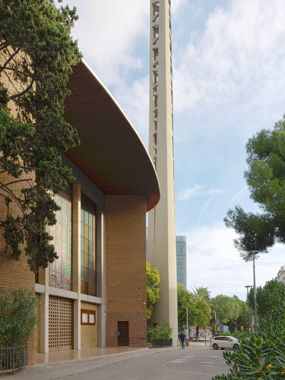
That said, the church is situated within the grounds of Les Llars Anna Gironella de Mundet, in the Montbau neighbourhood. It has a Latin cross plan with a free-standing bell tower.

The main façade is of exposed brickwork. There are no windows or rose windows, and the entire space is occupied by the large bas-relief ‘The Saviour of Suffering Humanity’, the work of Eudald Serra. At the lower level, a concrete porch supported by iron columns shelters the main door, made of glass and wood. The façade is crowned by a triangular shape, which follows the profile of the gabled roof, and a white cross at the apex.
The interior consists of a single nave, 20 metres wide, with a gabled roof, a transept and a polygonal apse. At the chancel end there is a choir loft with an organ.

In keeping with the Gothic tradition, large windows open in the walls, filling the interior with light and colour, but here the concept is taken to the extreme and the walls are opened from top to bottom by large rectangular stained-glass windows that give the nave a systematic rhythm. In these stained-glass windows there is generally a desire for geometric design and a mixture of colours. Those on the left, as you enter the church, are the work of Jordi Domènech and allude to the spiritual works of mercy. Those on the right-hand side refer to the corporal works of mercy and to Saint Joachim, Saint Anthony of Padua and Saint John Bosco; they are the work of Joan Vila Grau, who employed the grattage technique (strokes made with iron or copper powder on the glass) to achieve different textures. Finally, Will Faber created the three stained-glass windows in the chancel dedicated to the Theological Virtues (Faith, Hope and Charity) and those in the transept representing the Cardinal Virtues (Prudence, Justice, Fortitude and Temperance); these are stylistically close to Informalism.

The apse is dominated by a large alabaster sculpture of the Immaculate Conception, the work of Joan Rebull, and the wall was painted by Joan Josep Tharrats with greenish and blue patches evoking the seabed; because of this painting, which is pure chromaticism within abstraction, it was described as Tachism. The high altar, the work of Josep Maria Subirachs, is a large block of stone depicting the Last Supper with twelve chalices representing the apostles; eleven are standing and one is lying down, in reference to Judas. Behind the altar stands a wrought-iron crucifix, also by Subirachs. The artist also created the amboes, a crucifix in the transept, the baptismal font and the torches.

Outside, the bell tower has a rectangular plan and stands 45 metres high. It is constructed of exposed stonework and features small rectangular openings rising up to the top, where there are large rectangular windows. Beneath these windows, there is a clock on the front façade. The roof is flat and crowned with an iron cross.

Source: Inventari del Patrimoni Arquitectònic de Catalunya (IPAC)

Authors

How to get there

On the Map

Awarded
Cataloged
Disappeared
All works

Constellation

Chronology

  1. Churches of Les Llars Mundet

    Manuel Baldrich Tibau

    Churches of Les Llars Mundet

    In 1927, the Barcelona Provincial Council had begun construction on this site of a building intended to replace the premises of the Casa de la Caritat in Raval, but the work remained unfinished. In 1954, Artur Mundet, a businessman from the Empordà region living in Mexico, responded to a request made by the president of the Provincial Council and donated forty million pesetas to build the residential and care complex. On 14 October 1957, General Franco inaugurated the complex, comprising a series of modern, well-equipped buildings designed to care for orphans, the elderly, the needy and the sick, among which was the church of Les Llars Mundet. The architect, Manuel Baldrich, drew inspiration for the church from models of Nordic architecture, particularly Alvar Aalto, and to decorate the church he called upon a group of contemporary artists of the time: Josep Maria Subirachs, Eudald Serra, Joan Josep Tharrats, Jordi Domènech, Joan Vila Grau and Will Faber. That said, the church is situated within the grounds of Les Llars Anna Gironella de Mundet, in the Montbau neighbourhood. It has a Latin cross plan with a free-standing bell tower. The main façade is of exposed brickwork. There are no windows or rose windows, and the entire space is occupied by the large bas-relief ‘The Saviour of Suffering Humanity’, the work of Eudald Serra. At the lower level, a concrete porch supported by iron columns shelters the main door, made of glass and wood. The façade is crowned by a triangular shape, which follows the profile of the gabled roof, and a white cross at the apex. The interior consists of a single nave, 20 metres wide, with a gabled roof, a transept and a polygonal apse. At the chancel end there is a choir loft with an organ. In keeping with the Gothic tradition, large windows open in the walls, filling the interior with light and colour, but here the concept is taken to the extreme and the walls are opened from top to bottom by large rectangular stained-glass windows that give the nave a systematic rhythm. In these stained-glass windows there is generally a desire for geometric design and a mixture of colours. Those on the left, as you enter the church, are the work of Jordi Domènech and allude to the spiritual works of mercy. Those on the right-hand side refer to the corporal works of mercy and to Saint Joachim, Saint Anthony of Padua and Saint John Bosco; they are the work of Joan Vila Grau, who employed the grattage technique (strokes made with iron or copper powder on the glass) to achieve different textures. Finally, Will Faber created the three stained-glass windows in the chancel dedicated to the Theological Virtues (Faith, Hope and Charity) and those in the transept representing the Cardinal Virtues (Prudence, Justice, Fortitude and Temperance); these are stylistically close to Informalism. The apse is dominated by a large alabaster sculpture of the Immaculate Conception, the work of Joan Rebull, and the wall was painted by Joan Josep Tharrats with greenish and blue patches evoking the seabed; because of this painting, which is pure chromaticism within abstraction, it was described as Tachism. The high altar, the work of Josep Maria Subirachs, is a large block of stone depicting the Last Supper with twelve chalices representing the apostles; eleven are standing and one is lying down, in reference to Judas. Behind the altar stands a wrought-iron crucifix, also by Subirachs. The artist also created the amboes, a crucifix in the transept, the baptismal font and the torches. Outside, the bell tower has a rectangular plan and stands 45 metres high. It is constructed of exposed stonework and features small rectangular openings rising up to the top, where there are large rectangular windows. Beneath these windows, there is a clock on the front façade. The roof is flat and crowned with an iron cross.
  2. FAD Award

    Shortlisted. Category: Architecture

    FAD Award

    Llars Anna Gironella de Mundet

    Manuel Baldrich Tibau

Routes & Notes (1)

Related Works

Set Llars Anna Gironella de Mundet

Bústia suggeriments

Ajuda’ns a millorar el web i el seu contingut. Proposa’ns obres, aporta o esmena informació sobre obres, autors i fotògrafs, o comenta’ns el què penses. Participa!