How to get there

About
In this first stage, the catalogue focuses on the modern and contemporary architecture designed and built between 1832 –year of construction of the first industrial chimney in Barcelona that we establish as the beginning of modernity– until today.
The project is born to make the architecture more accessible both to professionals and to the citizens through a website that is going to be updated and extended. Contemporary works of greater general interest will be incorporated, always with a necessary historical perspective, while gradually adding works from our past, with the ambitious objective of understanding a greater documented period.
The collection feeds from multiple sources, mainly from the generosity of architectural and photographic studios, as well as the large amount of excellent historical and reference editorial projects, such as architectural guides, magazines, monographs and other publications. It also takes into consideration all the reference sources from the various branches and associated entities with the COAC and other collaborating entities related to the architectural and design fields, in its maximum spectrum.
Special mention should be made of the incorporation of vast documentation from the COAC Historical Archive which, thanks to its documental richness, provides a large amount of valuable –and in some cases unpublished– graphic documentation.
The rigour and criteria for selection of the works has been stablished by a Documental Commission, formed by the COAC’s Culture Spokesperson, the director of the COAC Historical Archive, the directors of the COAC Digital Archive, and professionals and other external experts from all the territorial sections that look after to offer a transversal view of the current and past architectural landscape around the territory.
The determination of this project is to become the largest digital collection about Catalan architecture; a key tool of exemplar information and documentation about architecture, which turns into a local and international referent, for the way to explain and show the architectural heritage of a territory.
About us
Project by: 
Created by: 
Directors:
2019-2026 Aureli Mora i Omar OrnaqueDocumental Commission:
2019-2026 Ramon Faura Carolina B. Garcia Eduard Callís Francesc Rafat Pau Albert Antoni López Daufí Joan Falgueras Mercè Bosch Jaume Farreny Anton Pàmies Juan Manuel Zaguirre Josep Ferrando Gemma Ferré Inés de Rivera Fernando Marzá Moisés Puente Aureli Mora Omar OrnaqueCollaborators:
2019-2026 Lluis Andreu Sergi Ballester Marianela Pla Maria Jesús Quintero Lucía M. Villodres Montse ViuExternal Collaborators:
2019-2026 Helena Cepeda Inès MartinelWith the support of:
Generalitat de Catalunya. Departament de CulturaCollaborating Entities:
ArquinFADFundació Mies van der Rohe
Fundación DOCOMOMO Ibérico
Basílica de la Sagrada Família
Museu del Disseny de Barcelona
Fomento
AMB
EINA Centre Universitari de Disseny i Art de Barcelona
IEFC
Fundació Domènench Montaner.
ETSAB
Suggestion box
Request the image
We kindly invite you to help us improve the dissemination of Catalan architecture through this space. Here you can propose works and provide or amend information on authors, photographers and their work, along with adding comments. The Documentary Commission will analyze all data. Please do only fill in the fields you deem necessary to add or amend the information.
The Arxiu Històric del Col·legi d'Arquitectes de Catalunya is one of the most important documentation centers in Europe, which houses the professional collections of more than 180 architects whose work is fundamental to understanding the history of Catalan architecture. By filling this form, you can request digital copies of the documents for which the Arxiu Històric del Col·legi d'Arquitectes de Catalunya manages the exploitation of the author's rights, as well as those in the public domain. Once the application has been made, the Arxiu Històric del Col·legi d'Arquitectes de Catalunya will send you an approximate budget, which varies in terms of each use and purpose.
close
-

Esbós Parcial de Façana i Detalls de l'Església dels Sants Just i Pastor
-
- Author:
- August Font Carreras
-
- Type:
- Esbós
-
- Dimensions:
- 49 x 32 cm
-
- Technique:
- Llapis
-
- Support:
- Paper de dibuix
-
- Fonds / Held by:
- Fons August Font Carreras / Arxiu Històric del COAC
-
-

Dibuix de Vidriera de l'Església dels Sants Just i Pastor
-
- Author:
- August Font Carreras
-
- Type:
- Drawing
-
- Dimensions:
- 86 x 45 cm
-
- Technique:
- Llapis, Aquarel·la
-
- Support:
- Paper de dibuix
-
- Fonds / Held by:
- Fons August Font Carreras / Arxiu Històric del COAC
-
-
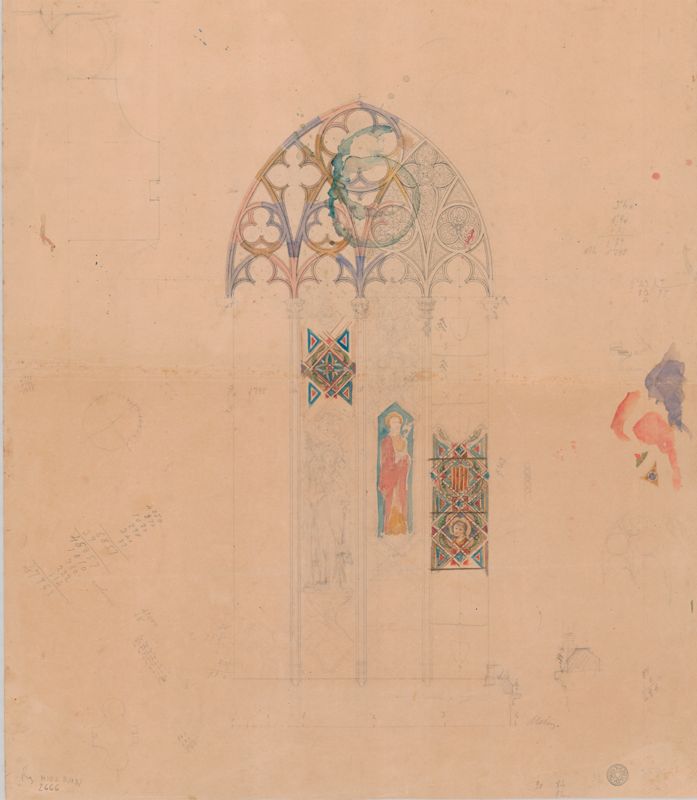
Dibuix Parcial de Vidriera de l'Església dels Sants Just i Pastor
-
- Author:
- August Font Carreras
-
- Type:
- Drawing
-
- Dimensions:
- 57 x 49 cm
-
- Technique:
- Llapis, Aquarel·la
-
- Support:
- Paper de dibuix
-
- Fonds / Held by:
- Fons August Font Carreras / Arxiu Històric del COAC
-
close

Memory
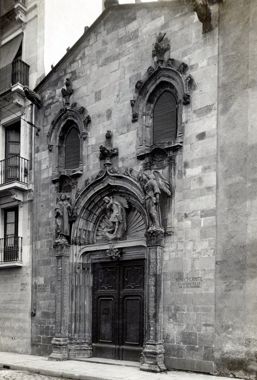
At the end of the 19th century, the façade of this Gothic church was very different from how we see it today. It consisted of a smooth façade with six windows, similar to an ordinary house, where the Archive and other offices were located, and a Renaissance entrance in a protruding section with three doors, crowned with spherical decorative elements.
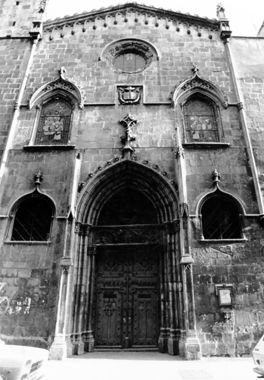
It was deemed necessary to give it another façade, one that was more in keeping with the original Gothic style of the parish. August Font i Carreras was the architect of this church at the time and oversaw all these renovations. It was an important project, as it gave the church a completely new image and was his first religious work.
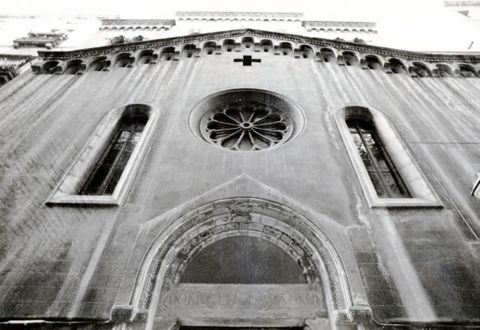
Work on the complex began on 23 June 1879 and was completed in 1881. Font's design for the façade is preserved in the church archives. Stylistically, it follows the Catalan or southern Gothic façade typology, with little ornamentation and simplicity as its main feature. The large pointed arch window emphasises the vertical line, and at the bottom there is a doorway, also with a pointed arch, like the two windows that flank it, with a tympanum decorated with the Virgin and Child and the two saints of the parish kneeling at her feet. The simple, undecorated archivolts give way to a gable topped with a finial.
A common mistake in some publications is to mention Josep Oriol Mestres as the architect of this church's façade instead of August Font. This may be because the two worked together on the cathedral's façade, but Mestres never had anything to do with this project, although he had worked on Saint Justus on a previous altar renovation.
Authors

On the Map
Awarded
Cataloged
Disappeared
All works
Constellation
Chronology (7)
-
Església dels Sants Just i Pastor. Cimbori, Voltes de les Capelles Laterals i Nau Central
autoria desconeguda
-
Church of Saints Justus and Pastor. Restoration of the Main Façade
 At the end of the 19th century, the façade of this Gothic church was very different from how we see it today. It consisted of a smooth façade with six windows, similar to an ordinary house, where the Archive and other offices were located, and a Renaissance entrance in a protruding section with three doors, crowned with spherical decorative elements. It was deemed necessary to give it another façade, one that was more in keeping with the original Gothic style of the parish. August Font i Carreras was the architect of this church at the time and oversaw all these renovations. It was an important project, as it gave the church a completely new image and was his first religious work. Work on the complex began on 23 June 1879 and was completed in 1881. Font's design for the façade is preserved in the church archives. Stylistically, it follows the Catalan or southern Gothic façade typology, with little ornamentation and simplicity as its main feature. The large pointed arch window emphasises the vertical line, and at the bottom there is a doorway, also with a pointed arch, like the two windows that flank it, with a tympanum decorated with the Virgin and Child and the two saints of the parish kneeling at her feet. The simple, undecorated archivolts give way to a gable topped with a finial. A common mistake in some publications is to mention Josep Oriol Mestres as the architect of this church's façade instead of August Font. This may be because the two worked together on the cathedral's façade, but Mestres never had anything to do with this project, although he had worked on Saint Justus on a previous altar renovation.
 -
Església dels Sants Just i Pastor. capella del Sagrament
autoria desconeguda


Archive
-
Esbós
Esbós Parcial de Façana i Detalls de l'Església dels Sants Just i Pastor
Fons August Font Carreras / Arxiu Històric del COAC
-
Drawing
Dibuix de Vidriera de l'Església dels Sants Just i Pastor
Fons August Font Carreras / Arxiu Històric del COAC
-
Drawing
Dibuix Parcial de Vidriera de l'Església dels Sants Just i Pastor
Fons August Font Carreras / Arxiu Històric del COAC