At the end of the 19th century, the most important hospital in the city of Barcelona was the Santa Creu Hospital, located in a medieval building constructed for this purpose in Raval in 1401. It was maintained through charitable donations and support from the authorities.
It should be noted that, in those days, only the poor went to hospital, as those who could afford it would call a doctor to their home. The mortality rate among patients admitted was very high, largely due to infections and contagion.
By the end of the 19th century, the medieval hospital was inadequate for the population of Barcelona, and land was acquired in the Guinardó area to build a new hospital once sufficient funds were available.
In 1896, the Catalan banker Pau Gil died in Paris and left part of his fortune for the construction of a hospital in his native city of Barcelona. The executors held a competition to select the best project based on medical and architectural criteria. In April 1900, the architects’ jury declared the project “Salud” by Josep Domènech i Estapà, who had designed the clinical hospital, as the winner. However, the medical jury left the competition without a declared winner.
On the 19th of April 1901, at a meeting of the Administration Board of the Santa Creu, it was decided to entrust Lluís Domènech i Montaner with the joint project of two hospitals under a general plan for administration and operation, merging what was to be built with Pau Gil’s legacy and what Santa Creu needed.
Original Project:
In his project report, Domènech made it clear that he had conducted an in-depth study of a wide variety of hospitals, listing more than 240 hospitals worldwide, mainly in Europe, arranged alphabetically by city and citing the bibliography consulted for his study.
In the archives of the Architects’ Association, there is a series of handwritten notes by Domènech with references to these hospitals and their bibliographic sources. Domènech synthesised all the proposals, adopting the layout of isolated pavilions (above ground) and underground connecting galleries, while maintaining large, generously proportioned rooms inspired by the Middle Ages, which were better suited to the Mediterranean climate than the lower, central European designs.
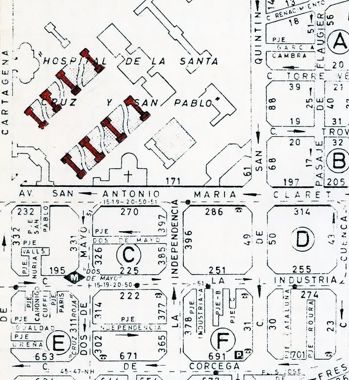
The chosen site was far from the urban congestion of Barcelona but well-connected, located in Guinardó, on the outskirts of the 1860 Eixample Plan. It was bordered by four streets, which were scarcely urbanised at the start of construction. The plot had a considerable slope, with a 35-metre height difference from end to end (equivalent to 12 floors) and an area equivalent to nine Eixample blocks.
The proposal included 145,500 m² for 1,000 patients, giving a ratio of 150 m² per patient, far exceeding the 130 recommended by the medical commission.
The hospital complex did not follow the alignment of the Eixample grid but was rotated 45°, ensuring the longitudinal facades of the pavilions faced perfectly north-south.
The complex envisioned a total of 48 buildings for various uses. The site was divided by two main avenues, 50 metres wide, crossing diagonally and structuring it into four quadrants. The slightly rectangular shape of the plot meant that the diagonals did not align with the four corners.
There were 21 pavilions dedicated to nursing on either side of the grand central avenue, with each pavilion dedicated to various ailments. Around the perimeter of the site were pavilions designated for services requiring independent access from the perimeter streets (dispensary, church, machine rooms, laundries, workshops, children's hospital, water distribution tower, mortuary chapel) without crossing the main complex.
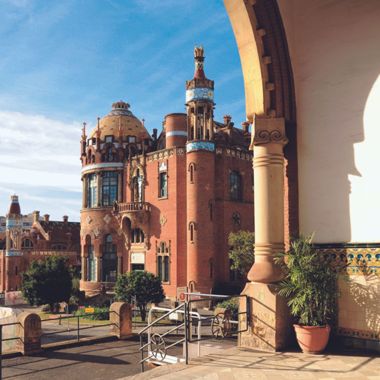
All constructions demonstrated a clear unifying vision, using a rich array of glazed ceramic decorations on all exterior and interior surfaces.
If there is a distinctive element in Domènech’s project, compared to the hospital references he studied, it is precisely this decorative richness.
Administration Pavilion:
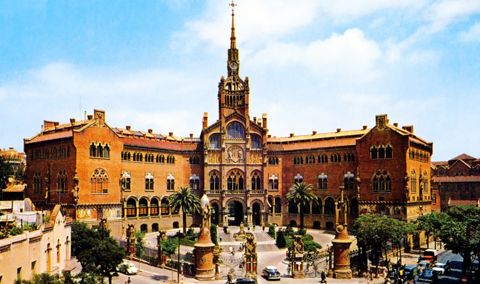
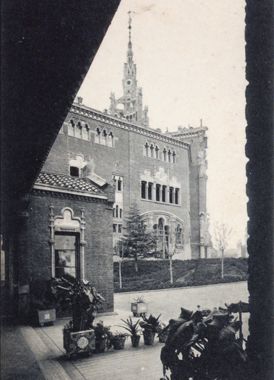
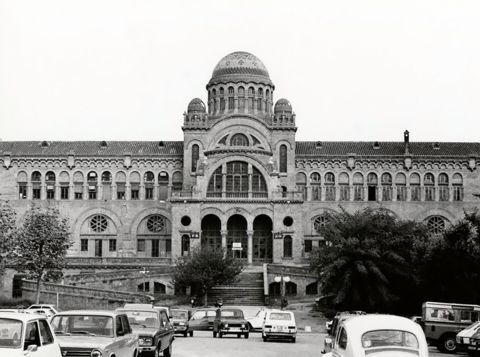
This pavilion serves as the main entrance to the complex. The building has an almost symmetrical configuration, with a central section crowned by the clock tower, two side wings encompassing the front plaza, and two perpendicular end sections reaching the boundaries of the site.
It has a ground floor, two upper floors, an attic under the roof, and a semi-basement with natural lighting and ventilation.
Originally, it housed the administrative areas of the complex, with the east wing for medical functions: patient admissions, medical offices, and a library-museum; the west wing for administrative functions: accounting rooms, offices, general archive, and secretariat; and the central section—the heart of the complex—holding the most prominent features: the entrance porch, monumental staircase, main hall and clock tower.
The representational nature of the building is accentuated by its extensive decorative programme and the superior quality of the materials used. In this regard, the Administration building is a tribute to the expressive possibilities of ceramics in architecture.
A spectacular mosaic frieze runs along the facades of the side wings of the Pavilion, illustrating the history of the hospital institution from its origins to the construction of this new facility.
Noteworthy is the use of exposed brick for the interior walls, combined with a grey block (lime mortar, not kiln-fired), without any final plaster finish, demonstrating Domènech’s emphasis on rational construction as stated in the project report.
Standard Pavilions:
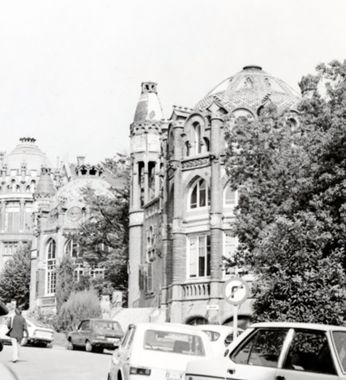
On both sides of the central avenue are the nursing pavilions, of which six were built in this first phase and two more were completed in the next phase.
They all follow a similar layout, with an entrance section adjacent to the main avenue, a longitudinal ward oriented north-south, and an administrative section facing the exterior.
Domènech actually drew a single set of plans on tracing paper for the standard pavilions so that, for those positioned symmetrically, one only needed to flip the sheet.
To enter, one passed through an entrance hall with a day room and services on either side, as well as administrative and sanitary service areas at the rear. The basement floor was initially designated for services and connected to the underground galleries.
The large interior spaces, including flat-brick vaults, were fully decorated with a broad range of glazed or enamelled ceramic tiles, creating a great variety of textures and colours while ensuring hygiene.
Ventilation and natural lighting were carefully studied and described in the project report, using ducts and chimneys within the structural elements. Artificial ventilation and heating systems were also planned, adapting the principles of hospital architecture of the time to the Mediterranean climate.
Operations and Inspection Pavilion:
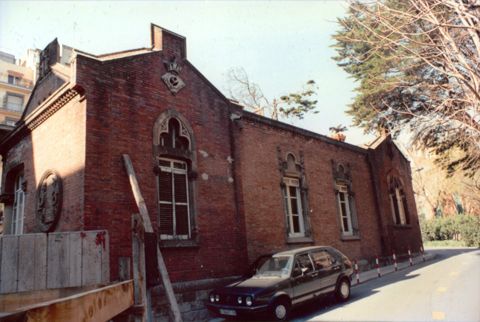
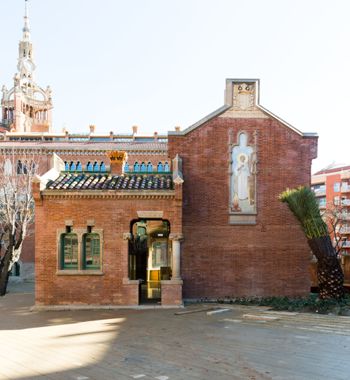
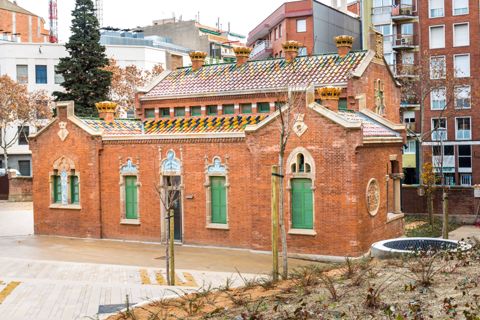
The Sant Jordi and Santa Apol·lònia pavilions, located behind the Administration Pavilion and near the side entrances, were intended for the initial examination of incoming cases. They were not connected to the network of underground galleries to prevent contagion in case of infectious diseases. These pavilions have a single storey and consist of a main block with four cells accessible from a covered exterior gallery, and two end sections: one for the kitchen and staff room and the other for a bathroom and cleaning area.
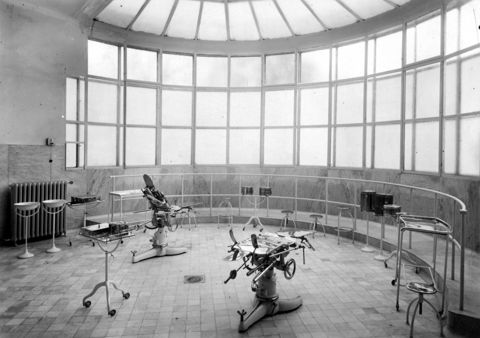
The final pavilion of this first phase is the operations house, which contained the operating theatres. It has a ground floor, two upper floors, and a basement connected to the site's galleries.
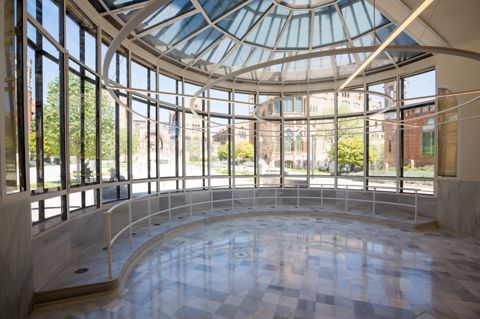
The most significant feature of this building is its compact volume and the presence of three apsidal spaces with glass enclosures (walls and roofs) facing north, providing optimal natural lighting with diffused light for the operating theatres.
Tunnels, Landscaping and Completion of Works:
Beneath the entire site, a network of underground tunnels connected the different pavilions. One network connected the non-infectious area with general services, and a separate network connected the infectious area (except for isolation units).
These underground galleries were designed with natural lighting and ventilation from above and included utility ducts leading to each independent building.
The generous open spaces between buildings were designated for internal circulation routes and gardens. The landscaped areas resolved the topographical variations in an east-west direction.
These terrain variations resulted in winding paths between the pavilions, with a summer garden (cool) to the north and a winter garden (sunny) to the south, featuring plant species of scientific and pharmaceutical interest, as well as aesthetic appeal.
In 1902, the foundation stone was laid, although the project was not yet finished nor the works contracted. The bulk of the construction took place between 1905 and 1912, following the original design. By 1912, Pau Gil’s legacy was exhausted, and the executor prepared to transfer the unfinished pavilions to the Hospital of Santa Creu. While funding was sought, construction halted, leaving a high-quality architectural complex in the heart of the city, half-built and unable to function.
Continuation of Construction:
In 1914, work resumed, with significant financial difficulties, extending over 16 years as funding from the Santa Creu Board and various benefactors allowed (who would lend their names to the pavilions they helped build).
Pere Domènech i Roura began to take a more prominent role in the project, though with austerity measures due to financial constraints. Adjustments were made to the plans of some buildings to fit this austerity, diluting their grandeur and lower-quality materials and decorative elements were used.
Domènech i Montaner died on the 27th of December 1923, without seeing his work completed or in use. In the new pavilions, the ambitious initial project was abandoned, and new building types were developed in response to advances in medical science over the 20 years since the original project was drawn up.
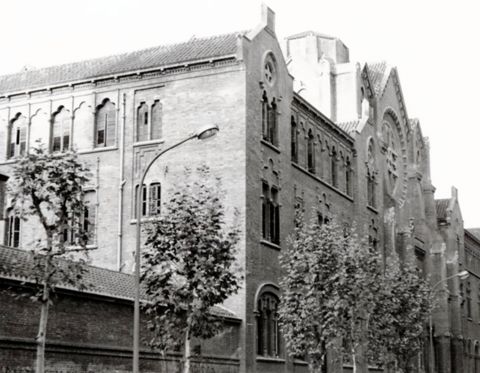
The pavilions in this second phase include the central pavilion, Sant Manel and Sant Rafel pavilions, the church and annexes, the Resurrection pavilion, the laundry pavilion, the machine house, the brickworks extension and the Sant Carles and Santa Victòria pavilions, all respecting the unique layout and character of the initial project.
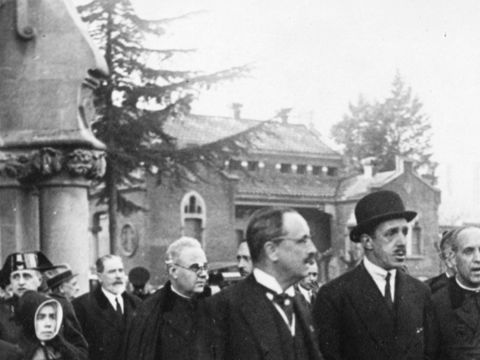
In 1930, the hospital was inaugurated as a modern facility, with 27 pavilions spread over 145,000 m². The City Council granted the title of Hospital of Santa Creu and Sant Pau in recognition of the integration of Pau Gil's legacy with that of the old medieval hospital.