
About
In this first stage, the catalogue focuses on the modern and contemporary architecture designed and built between 1832 –year of construction of the first industrial chimney in Barcelona that we establish as the beginning of modernity– until today.
The project is born to make the architecture more accessible both to professionals and to the citizens through a website that is going to be updated and extended. Contemporary works of greater general interest will be incorporated, always with a necessary historical perspective, while gradually adding works from our past, with the ambitious objective of understanding a greater documented period.
The collection feeds from multiple sources, mainly from the generosity of architectural and photographic studios, as well as the large amount of excellent historical and reference editorial projects, such as architectural guides, magazines, monographs and other publications. It also takes into consideration all the reference sources from the various branches and associated entities with the COAC and other collaborating entities related to the architectural and design fields, in its maximum spectrum.
Special mention should be made of the incorporation of vast documentation from the COAC Historical Archive which, thanks to its documental richness, provides a large amount of valuable –and in some cases unpublished– graphic documentation.
The rigour and criteria for selection of the works has been stablished by a Documental Commission, formed by the COAC’s Culture Spokesperson, the director of the COAC Historical Archive, the directors of the COAC Digital Archive, and professionals and other external experts from all the territorial sections that look after to offer a transversal view of the current and past architectural landscape around the territory.
The determination of this project is to become the largest digital collection about Catalan architecture; a key tool of exemplar information and documentation about architecture, which turns into a local and international referent, for the way to explain and show the architectural heritage of a territory.
About us
Project by: 
Created by: 
Directors:
2019-2026 Aureli Mora i Omar OrnaqueDocumental Commission:
2019-2026 Ramon Faura Carolina B. Garcia Eduard Callís Francesc Rafat Pau Albert Antoni López Daufí Joan Falgueras Mercè Bosch Jaume Farreny Anton Pàmies Juan Manuel Zaguirre Josep Ferrando Gemma Ferré Inés de Rivera Fernando Marzá Moisés Puente Aureli Mora Omar OrnaqueCollaborators:
2019-2026 Lluis Andreu Sergi Ballester Marianela Pla Maria Jesús Quintero Lucía M. Villodres Montse ViuExternal Collaborators:
2019-2026 Helena Cepeda Inès MartinelWith the support of:
Generalitat de Catalunya. Departament de CulturaCollaborating Entities:
ArquinFADFundació Mies van der Rohe
Fundación DOCOMOMO Ibérico
Basílica de la Sagrada Família
Museu del Disseny de Barcelona
Fomento
AMB
EINA Centre Universitari de Disseny i Art de Barcelona
IEFC
Fundació Domènench Montaner.
ETSAB
Suggestion box
Request the image
We kindly invite you to help us improve the dissemination of Catalan architecture through this space. Here you can propose works and provide or amend information on authors, photographers and their work, along with adding comments. The Documentary Commission will analyze all data. Please do only fill in the fields you deem necessary to add or amend the information.
The Arxiu Històric del Col·legi d'Arquitectes de Catalunya is one of the most important documentation centers in Europe, which houses the professional collections of more than 180 architects whose work is fundamental to understanding the history of Catalan architecture. By filling this form, you can request digital copies of the documents for which the Arxiu Històric del Col·legi d'Arquitectes de Catalunya manages the exploitation of the author's rights, as well as those in the public domain. Once the application has been made, the Arxiu Històric del Col·legi d'Arquitectes de Catalunya will send you an approximate budget, which varies in terms of each use and purpose.
close
-

Casa Annita Colomer
-
- Author:
- Josep Maria Pericas i Morros
-
- Type:
- Cianotipia
-
- Fonds / Held by:
- Fons Josep Maria Pericas i Morros / Arxiu Històric del COAC
-
- Rights:
- © Fons Josep Maria Pericas i Morros / Arxiu Històric del COAC
-
-

Planta General del Avantprojecte del Recinte Torribera
-
- Type:
- Plan
-
- Fonds / Held by:
- Fons Josep Maria Pericas i Morros / Arxiu Històric del COAC
-
- Rights:
- © Fons Josep Maria Pericas i Morros / Arxiu Històric del COAC
-

Perspectiva General del Recinte Torribera.
-
- Type:
- Drawing
-
- Technique:
- Aquarel·la
-
- Fonds / Held by:
- Fons Josep Maria Pericas i Morros / Arxiu Històric del COAC
-
- Rights:
- © Fons Josep Maria Pericas i Morros / Arxiu Històric del COAC
close


Works (49)


On the Map
Awarded
Cataloged
Disappeared
All works
Constellation
Chronology (51)
-
Sagrat Cor de Torelló Church
 A small basilica church with three naves and a semicircular apse. It is oriented from north to south, with the main façade to the north. To the west it is connected by an intermediate body to a building that is a Noucentista-style house; on the other hand, its eastern side is free. Both buildings form a well-integrated whole. The church is made, on the outside, of unpolished stone cut into regular ashlars with which the whole construction is made, so that its ornamentation is an inherent part of it. From a stylistic point of view, it is an eclectic building where neo-Romanesque and neo-Gothic elements are combined in a personal reinterpretation that gives it a modern look, with the traditional basilica design, in plan and section, recovered from the Renaissance. The main façade is stepped, becoming lower towards the top due to the section marked by the central nave and the two lower side naves. It ends in a slight stylisation with the help of the bell gable with two openings that crowns the façade. It is marked by an axis of symmetry on which the semicircular arched entrance portal appears, with an archivolt decorated with square geometric motifs. The imposts form a word on the right and left that make up the name Domus Domini. The door is made of riveted wood. A slender, ornate window follows the axis, finished with an openwork arch with a rose window in the tympanum. It illuminates and colours the interior thanks to a polychrome stained glass window that forms very particular waves ornamented with red roses. Below there is a barbican or machicolation, supported by corbels, which serves to protect the doorway. On either side of this central axis, now in the section corresponding to the small naves, there are two more windows in the form of a large loophole with a lobed arch profile. More rustic and protruding features are arranged in its profile. The closure is a stained glass window similar to the central one and is protected by a vertical wrought iron bar decorated with fleurons. The side façades are almost blind and are decorated with a rhythm of corbel cornices on two levels, corresponding to the height of the naves, and are covered with gable roofs. On the eastern side there is a second, simpler door with a semicircular arch and a stone gable. The apse is at the southern end of the main nave, with a series of semi-circular arched and splayed windows along the upper part of the semi-circular perimeter, which illuminate the interior through small cloisters with polychromatic stained glass, forming groups of three in each of the arches. It has a semi-conical roof. The altar is also illuminated by a circular oculus located in the southern end wall of the nave. All the openings filter a polychromatic light through their magnificent stained glass windows, giving the interior a magical air. The central nave is covered by a pointed vault and the arches supporting the side naves are also pointed, with decorated brick capitals. The walls are plastered and painted, with elements in relief of exposed reddish brick, and with stuccoed and painted decorations in the apse. Above the vestibule there is a mezzanine for the choir, which is accessed by a very narrow and steep staircase on each side. It is protected by a highly ornamented wrought iron railing. At the end of the left aisle, right next to the altar, there is an area enclosed by a gate, also made of highly decorated ironwork. Inside is the monstrance and it is illuminated by a polychrome window in the wall at the end of the aisle. The other side aisle is used as a sacristy and is closed off. Opposite it, there is a small altar dedicated to the Virgin. Another element to highlight is a stone baptismal font with a cylindrical section and a conical lid. This church, dedicated to the Sacred Heart, was built following the establishment of the Coromina textile colony. Also known as the Pericas factory, it is located at the end of the municipality of Torelló, under Conanglell. The colony was created on the site of an old mill in 1874. The church, as the portal indicates, was built, or rather finished, in 1906. This was one of the first works designed by the architect Pericas i Morros, who worked within a hybrid aesthetic that revolved around unpolished stone solutions.
 -
Annita Colomer House
 Building between partitions forming a corner. It consists of a ground floor, three upper floors and an attic, with a single-slope roof with Arabic tiles and the corners decorated with green ceramics. The openings are distributed asymmetrically, maintaining a gradation of proportions in height. The balcony tribune, the wrought iron railings and the green ceramic decoration stand out.
 -
Casa Dou
 La casa de la marquesa de Dou és obra de Josep Mª Pericas i data de l'any 1908. L'edifici pertany al període de transició entre el modernisme i el noucentisme. Sí bé tant la torre situada al xamfrà, com a element més contundent, com la utilització de formes curvilínies pertany encara a reminiscències modernistes, l'encaix dels elements en la composició general denota una simplificació formal més d'acord amb la nova arquitectura europea de la que l'autor en reflecteix la influència.
 -
Bayés House
 Building between partitions consisting of a ground floor, two upper floors and an attic, with an irregular profile at façade level. On the ground floor there are two semicircular voussoir doorways, one next to the other. Other windows are located on the same floor. On the two upper floors, the openings are distributed symmetrically, following vertical axes. Most of them are cantilevered balconies, with wrought-iron railings, flat decorated lintels and stone ashlar jambs. These balconies maintain a gradation of proportions in height. The two twin windows stand out, those on the first floor with semicircular arches and those on the second floor with lobed arches. On the third floor there is a gallery that runs along the entire façade, with semicircular arched openings.
 -
Monument to Father Cinto Verdaguer
 Monument erected in the centre of the square in homage to the poet Jacint Verdaguer i Santaló from Folgueroles. It stands on a pyramidal base flanked by four monoliths. The pyramid is truncated at a height of approximately one metre and is topped by another polyhedral structure, crowned by a kind of pinnacle and a rose window. Attached to this conical body are images of Saint Francis, the Virgin Mary, the martyr Saint Hyacinth and the Sacred Heart. On the front there are several inscriptions and a medallion with the bust of the poet. It is built with greyish Folgueroles stone, and at the bottom there is a garden protected by wrought iron railings. The initiative to pay tribute to the poet from Folgueroles came from the ‘Catalunya Vella’ society in Vic, and the inauguration, on 8 May 1908, coincided with the events marking the 50th anniversary of the restoration of the Floral Games. The first stone was laid on 5 April. The stone was donated by Mr Casarramona and was probably extracted from the quarries of the Arumí country house in Folgueroles. The work was paid for by public subscription and the stonemasons worked selflessly. The inauguration of the monument (also known as the pedrón) was a solemn affair. A special train was chartered to bring guests from Barcelona, and carriages then took them from Vic to Folgueroles, where they received a solemn welcome: all the men of the village, dressed in the traditional barretina musca hat, gathered at the fountain of the parish priest Alguer, Teodoro Llorente...). Bishop Torres i Bages presided over the ceremony, which included fireworks, Sardana dances and, when the bust was unveiled, the release of doves.
 -
Església de Sant Sever. Restauració de la Façana
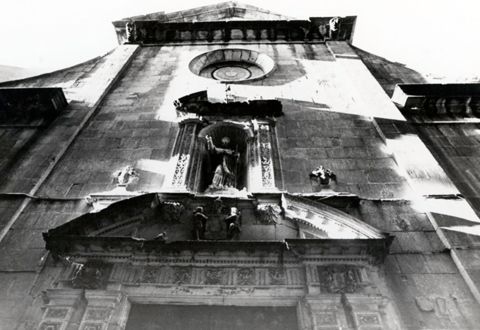 Es tracta d’un temple d’una sola nau, amb capelles laterals i un absis poligonal. A l’interior conserva encara una rica decoració barroca, amb tribunes amb gelosies, voltes esgrafiades, el retaule major i la petxina de l’absis decorada al fresc. La façana és senzilla, i la portada s’ha conservat en força bon estat.
 -
Monument to Jacint Verdaguer
 The monument built to Jacint Verdaguer was built between 1914 and 1924 at the intersection of the streets Passeig Sant Joan, Mallorca and Avinguda Diagonal. The team formed by the architect Josep M. Pericas and the sculptor Joan Borrell, who were the winners of the public competition called by the Barcelona City Council in 1912, were responsible for the project. Later on, the brothers Miquel and Llucià Oslé joined them. The monument consists of a column which is more than 20 metres high, at the top of which there is the figure of priest Jacint Verdaguer. The column is surrounded by a circular stone structure decorated with sculptures and reliefs. The element that surrounds the column has a circular plan and sits on top of a base or podium, from which a facing is developed entirely in stone, with large regular ashlars. It consists of three openings (or points of passage) and three elements of semicircular plan that are attached to this base and that develop in height creating a towered structure that is crowned with a sculpture. These figures, made by Joan Borrell Nicolau, are made in bronze and represent allegories of poetry: epic, mystical and popular. Between these figures and arranged at the top of the monument's closing structure, above three corbels, there are a series of reliefs by the brothers Llucià and Miquel Oslé and Sàenz de Medrano that represent various scenes from the poem L' Atlàntida, a poem written by Verdaguer. In the centre of the complex, in a small garden area, there is the large column on which the bronze figure of Jacint Verdaguer made by the sculptor Joan Borrell stands. As already mentioned, access to the column is made through three steps that are configured as small openings flanked by two pillars that are finished with an almost spherical element and decoration of sinuous lines inspired by plants. On the pillar there are small engravings with putti holding garlands. The column built entirely of stone blocks is crowned with a very schematic Corinthian capital that is topped with a hexagonal abacus that serves as the basis for the sculpture of the priest. In the upper part of the column there is a text that says "To Monsignor Jacint Verdaguer". Shortly after the poet Jacint Verdaguer (Folgueroles, 1845 - Vil·la Joana, Vallvidrera, 1902) died, the need to erect a monument to him was felt by all; however, the competition for the project was not called until 1912. The winner was the team formed by the architect Josep M. Pericas and the sculptor Joan Borrell, although eventually the Oslé brothers, who had presented an alternative project, also participated. Borrell made the statue of priest Jacinto (in bronze) and the allegories in poetry (in stone). Llucià and Miquel Oslé made the reliefs on the frieze that surrounds the column and refer to the poem written by Jacint Verdaguer, L'Atlàntida. The foundation stone was laid in 1914, but the works lasted until 1924. The redevelopment works of Diagonal and Passeig de Sant Joan in the second half of the 20th century made the stand at the foot of the monument disappear.
 -
Concurs Anual d'Edificis i Establiments Urbans
Award-Winner / Winner. Category: Arquitectura - Millor Establiment ConstruïtFarmàcia EspinósEl Puig de les Tres Creus
 The hill of the three crosses is accessed via a winding path that partly coincides with the Via Crucis that leaves from the Rocaprevera sanctuary. The top of the hill is completely flat and a terrace has been built with stone slabs. The edge has a railing made of stone posts supporting an iron handrail. On the east side are the three crosses on a stone base. The central cross is larger than the others. It is a representation of Calvary, with Jesus in the centre and the two thieves on either side. The crosses are made of iron and have a base of chipped stone with a column and polygonal capital. The crosses are Greek with a circle connecting the arms. The compass rose is depicted on the pavement and marks the location of nearby towns and peaks. It seems that before 1686 there were three wooden crosses in the same place. The Feast of the Holy Cross was celebrated here on the 3rd of May. A Way of the Cross procession would leave the church of Sant Feliu and reach this peak. Afterwards, a procession with litany chants would take place. In 1736, the crosses were repaired, as they were made of wood and easily damaged. At the beginning of the 20th century, the main cross was made of wood and the others were made of iron and placed on a stone column. In 1913, the Constantinian festivities were celebrated and new crosses were placed, which were paid for by public subscription.
Puig Housing Building
 Building between partitions with a ground floor and four storeys, with a wide, symmetrical, flat façade crowned by the barbican of the gable roof. This façade has a voussoir-arched entrance doorway protected by a polygonal moulding, while on the first floor there are two vertical semi-hexagonal tribunes flanking the central area, which is crowned by a pentagonal pan. The floors are marked by stone impost lines, as are the doorways and windows. Thus, the imposts connect the tribunes with the double windows of the central body and with the group of three arcades on the upper floor. The façades are stuccoed, with geometric sgraffitoes surrounding and decorating the frame and the sides of the openings. Below the barbican there is a ceramic tile frieze and terracotta figures. The building was constructed in the incipient expansion of Vic from the opening of the street that linked the Plaça del Mercadal with the train station. It was the first rented housing building in the city, and was commissioned in 1917 by the dyeing businessman Antoni Puig Danís to the architect Josep Maria Pericas i Morros. Around this time, Pericas began to acquire his own language based on European trends, moving towards a new rationalist style.
Pericas House
 Casa Pericas is located on the block in the Eixample district bounded by Rambla de Catalunya, Carrer Còrsega and Avinguda Diagonal. Located at the junction of the latter two thoroughfares, it is a residential building with three façades articulated by means of two cylindrical tribunes. The building consists of a structure on the ground floor, mezzanine, main floor and five upper floors, all covered by a flat, walkable rooftop. Its openings are arranged in five horizontal sections separated by imposts. The lower section comprises the ground floor and the mezzanine with ashlar stone fittings. The ground floor has a doorway on the right-hand corner of the façade facing the diagonal street, with a framed round-arched doorway closed by an ornate iron door. This entrance leads to a vestibule area and a central light courtyard where the residents' staircase is located. The rest of the openings, corresponding to the commercial area (in this case a bank), are framed by classicist columns. The second section contains the main floor, where the stone balustrades of the balconies and their sculpted framing stand out. The third section contains the next four floors, with a wall covered with sgraffito work reminiscent of ashlar stone. There are some panels, also sgraffitoed, with figurative decoration and bucolic themes. The openings have windows and balconies with wrought-iron closures and sgraffito ornamentation on their bases and frames. The final section comprises a continuous gallery with small windows with semicircular arches crowned by a sgraffito border, all crowned by a powerful eave that overhangs the façade line and the flat roof enclosed by a balustrade. The two vertical tribunes at the corners give continuity to the façade, avoiding sharp angles. These are reminiscent of German expressionism and are topped by a wavy gable.
Rocaprevera Sanctuary
 Chapel with a cruciform floor plan, semicircular gable and attached bell tower. The current appearance of the building bears little resemblance to the original church. The renovation carried out by Josep Maria Pericas gave it a personal style. The sanctuary consists of two adjoining buildings: the church and the hermit's dwelling. The main façade of the church is aligned with the single-storey building that serves as a dwelling. The entrance door, which is centred on the façade, is arched and protected by a porch with a sloping roof supported by Doric columns. Above the porch is a niche that houses the sculpture of the Virgin of Rocaprevera. The church is shaped like a single-nave basilica but is made up of several juxtaposed sections. It has a square floor plan on the first level and a circular floor plan on the second, with semicircular openings. The nave has a gabled roof with the ridge parallel to the longitudinal axis of the basilica. It is hidden behind a Baroque pediment. Inside, the choir stands out, with green glazed ceramic tiles between the cairons and wooden beams. This treatment is used on the ceiling of the main nave. The walls of the nave are reinforced by blind arcades that could resemble small chapels, but as they are very shallow, they do not serve as such. At the base of the apse, there is a covering of well-cut and polished stone blocks, crowned by rows of arcades with stained glass windows and a border imitating saw teeth. It is structured on two floors: one in the lower part, which is below the level of the nave, like a crypt, and an upper one, which serves as a chapel for the Virgin Mary and is accessed via the ambulatory. The interior of the apse is illuminated by multiple polychrome stained glass windows. It has a transept with a dome, which is square on the outside but forms a false flat coffered ceiling on the inside, covered with a green ceramic roof. On each side there is an oculus that can be opened using a system of shutters. It also has a square bell tower with a cylindrical lantern topped with a conical roof and a weather vane. The chapel of Santa Maria de Rocapervera was built in 1284 by Monsignor Marco Roca. It was originally an oratory that has been rebuilt three times: as a Romanesque chapel in the 15th century (1429 by Antoni Vinyes) and as a popular chapel in the 18th century (1781). Finally, it was rebuilt in 1923-1924 due to popular devotion associated with the cult of the Virgin Mary. The current temple is majestic in size and is the result of the so-called ‘Pericas style’, halfway between Noucentisme and Catalan Art Nouveau with borrowings from classical and Romanesque aesthetics.
Mitjans Tower
Rafael Masó i Valentí, Josep Maria Pericas i Morros
 Building designed by Pericas, with symmetrical façades and a hipped roof. Masó participated in the election and supply of the ceramic material for the props and the pavements, and he drew two squares "in cross stitch" for the pavements of the porch and the dining room. The furniture designed by Masó for the couple's first home, in Barcelona’s Gran Via, is preserved.
Torre d'en Franch Chapel
 Civil building. Square-shaped country house with a hipped roof and a lantern in the centre of the building, which opens onto courtyards and is also covered by a hipped roof. The façade faces south and has a semicircular arch doorway formed by small voussoirs. On each side of the building there is a small annex covered by a single-pitched roof. On the right-hand side, next to this, there is a doorway that closes off the courtyard, which is located on the eastern side. On the north side, there is an exit on the first floor that extends towards the side walls, forming balustrades. The north side is made of red brick, with various decorative shapes playing with this material. This part of the house is surrounded by gardens, with a fountain dedicated to Sant Jordi and a chapel dedicated to the Virgin of Carmen. The state of conservation is average, and the façade should be taken care of. The chapel has a single nave oriented from east to west. In the gable end is the apse preceded by a dome, with the lantern protruding from the body of the building. The façade has a stepped gable end and the doorway is preceded by a thick arcade that protects the semicircular arch doorway; this section is covered by a single slope. On the left side there is a cylindrical bell tower, the upper part of which is decorated with serrated patterns and has openings. The walls of the nave and apse have Romanesque-style windows. The lower part of the walls of the temple are made of bluish chipped stone, while the rest of the walls are plastered and painted yellow. The building is in good condition. This old farmhouse belongs to the municipality of Vic and is located outside the city. It is near the Sierra de Sant Ferm, a village that grew up around a farmhouse of the same name, just a few metres from the railway level crossing. It is one of the few country houses in the Vic area that preserves tradition and continues to be used for agricultural work. Judging by its style, it was probably renovated in the late 19th or early 20th century, acquiring the stately appearance that it still retains today. There is one section for the owners and another for the peasants. The church within the grounds of the Torre d'en Franch country house is located in its garden. It is linked to the history of the house, although the chapel is much older. It is dedicated to the Virgin of Carmen and, according to the date carved on a stone at the western end of the ridge, it was built in 1928.
Torre Nova de la Coromina
 Residential house with a rectangular layout, ground floor and two storeys, featuring a hipped roof formed by flat tiles arranged diagonally like scales. It also has a square-section tower attached to the left side. This tower consists of four storeys with a hipped roof. The windows are located only on the top floor, giving the tower the appearance of a Romanesque bell tower. At the apex of the roof there is a weather vane. Its height makes it stand over four metres above the house. It is constructed with unpolished ashlar, giving it a rustic appearance. The dwelling has a refined appearance thanks to its decorative elements. While the same type of stone forms the plinth, the jambs and the openings on the first floor, the rest of the walls are rendered and painted yellow. The house's entrance portal is next to the tower and is arched, forming a flattened arch that blends into the plinth. On the same axis, and at the first-floor level, there is a greenish ashlar stone engraved with the date 1921 and signed with the initials J.Mª P, the name of the architect who designed the project. On the first floor, rectangular and relatively large windows are arranged, connected by strips of unpolished stone. On the second floor, the openings are smaller, and the lintels are decorated with finely detailed esgrafiados in a reddish hue, just below the cornice. On the northern side, there is a gallery with a single-pitched roof and small windows in the upper section. In the southeast corner stands the Virgin of the Rosary. In the centre of the northeast façade, there is a semicircular bay window with a conical roof. It is opened by a mullioned window divided by two columns of composite Corinthian style. On the northwest façade, also on the first floor, there is an attached gallery open with three semicircular arches. At its western end there is a private chapel with a semicircular apse covered by a gable roof. The second floor features smaller openings framed by two mouldings. Above them, there are esgrafiados in reddish tones with medallion shapes, located just under the roof eaves, which are supported by brackets and corbels. The west façade opens onto a garden through a second porch on the ground floor. It consists of three semicircular arches supported by rustic pillars on the sides and two finer columns with decorated capitals in the centre. Above, there is a terrace connected to the roof of the chapel dedicated to the Virgin of Montserrat. On the left side, there are four arches opening onto the west façade with stained-glass windows, each depicting a saint. The three semicircular arches on the right side lead to the service quarters and are supported by columns with capitals sculpted in vegetal forms. The spandrels are decorated with paintings of medallions and geometric patterns. The interiors are decorated in accordance with Pericas’s specifications: coffered ceilings, ceramic pavements, stained-glass windows, glazed ceramic dados and geometric and border paintings on the walls. The furniture is also carefully integrated into the ensemble. The building is surrounded by gardens enclosed by a stone wall made with river cobbles. The garden follows a strongly marked and symmetrical axis inspired by Renaissance French gardens, with a pond and a sculptural fountain featuring two symmetrical lions. The garden is populated by cypresses, firs and plane trees, as well as some shrubs shaped into geometric forms. The ancestral home of the architect Pericas is located between Puig de les Tres Creus and La Coromina. It was built around 1920, with the entrance portal completed in 1921. It served as the residence of the architect who designed it, Josep Mª Pericas. In fact, it was conceived as a summer house for the architect and his wife. Its stylistic lines blend several styles, showing a certain eclecticism, as the architecture oscillates between Neo-Romanesque, Noucentisme and Catalan Art Nouveau. It was expropriated during the uprising of fascist military forces against the government of the Second Republic and occupied during the Spanish Civil War. Although the original furniture disappeared, the structure did not suffer significant damage. Being located in an area somewhat removed from the urban centre and due to its dimensions, it was converted into a sanatorium for patients with contagious diseases. The naturalist physician Honorio Gimeno Pérez (1907–1991) gave popular lectures there.
Font Picant
 La font aqctual està construida en pedra a la manera del templet i recorda la estructura anterior de fusta que feia de sostre a la Font PIcant . Feta tota ella en granet, presenta els detalls dels forats per guardar els gots dels aigüistes, així com una trapa al mig de la font per fer-ne inmersions. L'Hotel es contrueix el 1880; el seu propietari-fundador, en Martín Pagè, el dirigeix més de 40 anys. Estructuració del Passeig dels Enamorats i l' estanc.L'ermita de Santa Maria de Monsolís, d'estil neoromànic- neogòtic es va començar a construir el 1895. Restaurada el 1970. El projecte i construcció de la Font Picant és de 1927 de l'arquitecte Jospe Mª Pericas. Després de la Guerra es van fer vàries reformes a càrrec de l'arquitecte Isidre Bosch i M.M. Ribot(1950) També al 1957 es va construir el parc a l'alta riba del riu, projecte de Neberhahs (arquitecte alemany)
New Parish Church of Santa Maria de Vilalba Sasserra
 Church built in the 1930s to replace the old parish church of Vilalba Sasserra and located on the outskirts of the village, known as Trentapasses and located next to the C-35 road. It is a temple with a single nave covered by a gable roof and facing north with a semicircular apse. The portal is of a semi-circular arch made up of small, regular blocks of granite stone. It is covered by a porch that goes beyond the side of the façade, made of semicircular arches that, in the central part, rest on columns of smooth neo-Romanesque style wood decorated with animal and anthropomorphic figures. The bell tower is attached to the north-eastern corner. It has a square plan with a double-sided roof. The body of the bells has small square openings and contains a 17th century bell. From the interior, the image of Sant Sebastià, located to the left of the nave, and the image of Our Lady of Montserrat, to the right, should be highlighted. In the presbytery there is an image of the Assumption and the tabernacle. When leaving the old church, a small building next to the large house of the Count of Centelles was set up. The architect J. Mª Pericas designed the new temple that was completed in 1927.
Pericas Dwellings in Vic
 A building between partitions consisting of a ground floor and four upper floors. Its composition, based on geometry and the interplay of elements on the façade, presents a balance of openings and solid sections, distributed symmetrically around a central axis of the façade. The openings are grouped into three vertical axes defined by two lines of double openings joined by a balcony on the central floors and located at the ends of the main façade, and a central axis with a line of rectangular windows in a vertical pattern. On the fourth floor, there is a gallery of semicircular arched windows grouped into three sets of three windows each. The roof is a gable roof, which protrudes from the main façade, forming a barbican with exposed rafters. The ground floor has three doorways - the two side ones have been renovated and converted into commercial premises. The central doorway, the most decorated element of the building, is flanked by the two large openings that form the adjoining premises. It is framed with moulded stone and a wrought iron grille, closed at the top with a lowered arch above which is the tympanum, outlined by mixtilinear mouldings. Continuing with the decorative aspect of the complex, it is worth mentioning the cut stone blocks used to clad the ground floor, the balcony slabs and lintels, and the jambs on the first floor; the rest of the walls are made of stucco imitating incised stone blocks. The openings feature sgraffito decorations with geometric zigzag or rocaille motifs. These rocaille motifs are also present on the tympanum of the entrance doorway and on the sills of the central windows. Lluís Pericas, brother of the architect Josep Maria Pericas i Morros, was the developer of the project. He commissioned his brother to renovate two of his Baroque-style properties, suggesting a single façade solution and a new layout to adapt the building to its new function as a block of flats (in 1926 he applied to Vic City Council for a licence to unify the two buildings). One of these two houses, number 10 (formerly number 8), had been the Pericas family home. The family ended up buying the house next door, now number 12.
Convent of La Mercè
 Monument erected in the centre of the square in homage to the poet Jacint Verdaguer i Santaló from Folgueroles. It stands on a pyramidal base flanked by four monoliths. The pyramid is truncated at a height of approximately one metre and is topped by another polyhedral structure, crowned by a kind of pinnacle and a rose window. Attached to this conical body are images of Saint Francis, the Virgin Mary, the martyr Saint Hyacinth and the Sacred Heart. On the front there are several inscriptions and a medallion with the bust of the poet. It is built with greyish Folgueroles stone, and at the bottom there is a garen protected by wrought iron railings. The initiative to pay tribute to the poet from Folgueroles came from the ‘Catalunya Vella’ society in Vic, and the inauguration, on 8 May 1908, coincided with the events marking the 50th anniversary of the restoration of the Floral Games. The first stone was laid on 5 April. The stone was donated by Mr Casarramona and was probably extracted from the quarries of the Arumí country house in Folgueroles. The work was paid for by public subscription and the stonemasons worked selflessly. The inauguration of the monument (also known as the ‘pedrón’) was a solemn affair. A special train was chartered to bring guests from Barcelona, and carriages then took them from Vic to Folgueroles, where they received a solemn welcome: all the men of the village, dressed in the traditional barretina hat, gathered at the fountain of the parish priest Alguer, Teodoro Llorente...). Bishop Torres i Bages presided over the ceremony, which included fireworks, Sardana dances and, when the bust was unveiled, the release of doves. Later, during the Spanish Civil War, the church and the old convent were demolished. After the war, the area was remodelled, with new alignments being drawn up on what is now Carrer de Sant Antoni M. Claret, extending the building in question, constructing the retreat house and, finally, the current church of Sant Antoni M. Claret.
Church of El Carme
 Located in the Ciutat Vella district, the parish church of Nostra Senyora del Carme is on the eastern corner of the block bounded by the streets of Obispo Laguarda, Sant Antoni Abat, de la Cendra and Riera Alta. It has two façades facing the first two streets and adjoins the neighbouring plots. The main access to the church is from Carrer del Bisbe Laguarda, while access to the parish centre is from Carrer de Sant Antoni Abat. The parish complex is made up of the church, the Piarists' dwelling and the parish centre, three interconnected buildings which, despite belonging to different construction phases, follow the same design canons. The exteriors of the complex are finished in brick, both in terms of the walls and the openings. However, some architectural and ornamental details are finished in Montjuïc stone and glazed and moulded ceramics. The building is part of the Catalan Art Nouveau style, although it opens its doors to early modernism and, as some authors have pointed out, is inspired by the novelties of Sezessionism, German Expressionism and the Amsterdam School. The church is the first building in the complex. Its brick façade reveals the interior structure of the church – at the foot of the church is the main door, which is the only element made entirely of stone. It consists of a semicircular arch surrounded by archivolts and flanked by two life-size angelic sculptures holding censers. On a brick arch in the sardinel rests a small gable containing a stone relief of two angels holding the coat of arms of the Carmelite order, consisting of a mountain with three six-pointed stars. This gable is continued on the rest of the façade with more pumped gables containing the openings of the side chapels of the church, consisting of triangular pumped windows decorated with moulded glazed ceramic tracery. Above the façade of the side chapels is the façade of the naves of the church, mediated by the presence of sloping buttresses that collect rainwater from the roof by means of exterior glazed ceramic gutters. Between buttresses there are tall windows with stained-glass windows and stone tracery. The façade is crowned by gables with portholes that adapt to the shape of the sloping roofs that cover each of the interior bays of the church. At the head of the church stands the bell tower – a tall, rectangular, chamfered construction with no openings. This bell tower is crowned by a quadrangular body with barbicans and arches that house the bells, under a gable, glazed ceramic roof. The church is a basilica-shaped building with three naves with side chapels in four identical bays and a fifth, larger one occupied by the apse of the church. The central nave is covered by curvilinear vaults supported by cylindrical pillars, while the side aisles are subdivided by the presence of the wrought ironwork of the tribune that runs along them. All the walls, pillars and load-bearing elements of the interior are covered with two-colour sgraffito work based on continuous interlaced borders. The presbytery, crowned by a large parabolic arch, contains a gilded canopy with an image of the Virgin of Mount Carmel surrounded by mural paintings depicting a heavenly glory. The home of the Piarists is located in the corner of the plot, just at the foot of the church, providing it with an original façade and an alternative southern access. This building, originally used as a school, has a symmetrical façade, with a three-storey central body and two four-storey side bodies. This façade is notable for the use of horizontal chicago-type windows with rounded brick mullions and lintels and diamond-pointed brick bands. This façade becomes a varied display of types of openings, among which we can highlight the twin arches, the mullioned windows, the balconies, the serlianas and the arched gallery. The central body features a stone sculpture of the Virgin of Mount Carmel enthroned before a polychrome ceramic frieze depicting two angels presenting the Virgin to a group of boys playing instruments (on the left) and a group of girls singing (on the right). Access to the school is through a large rounded stone arch with rounded brick archivolts, closed by a thick wrought-iron grille. This door leads to the main entrance hall of the building, where the stairs to the upper floors of both bodies start and which contains, at the back, the access to the church on the southern side. The parish has a façade similar to the one on the ground floor, although it is part of a much later construction phase. Also finished in brick and with a diverse repertoire of openings, this façade is notable for the presence of a tall tower that rises above the roof line over the three floors of the building. The upper floors of this tower are adorned with brick reliefs in the form of crosses and lesenes and feature glass clocks. The top floor of the building is crowned by a cylindrical top floor perforated with portholes. The interior of this building contains a theatre with a stalls, an amphitheatre and tiered tribunes that preserves part of the original decoration based on austere gilded mouldings. The plot of land that today houses the parish church of Nostra Senyora del Carme had housed, since the 15th century, the convent of Sant Maties of the Hieronymite nuns, founded by Brígida Terré. This large convent occupied a plot of land that extended as far as Carrer Riera Alta, and had a Gothic church with a single nave with side chapels and a polygonal apse. In 1835, after the Spanish confiscation, the convent church became the parish church of the neighbourhood. Badly damaged by the events of the Tragic Week of Barcelona in 1909, the medieval building had to be demolished and the opportunity was taken to redevelop the area, with the opening of the new street of Obispo Laguarda. In 1910, the architect Josep Maria Pericas i Morros was commissioned to design the project for a new church on the site under the advocate of the Verge del Carme, reminiscent of the neighbouring convent of Carme, which had disappeared in 1874. The construction of the new church, between 1911 and 1913, was completed with the decorative programme of Darius Vilàs i Fernández, and was followed by the raising of the bell tower between 1923 and 1924. In 1935, the parish centre was built, which included an Italian-style theatre (with stalls and amphitheatre) and is today the headquarters of the Teatre del Raval. Today, the body facing the corner is occupied by a Piarist community.
Convent of the Josephine Sisters
 It is a three-storey building which, following the traditional layout of convents, organises its rooms around a cloister: the church facing the street with public access, the refectory, the dormitories, the interior chapel and the services. Pericas uses a series of historicist resources in this convent that are common to him but which are intelligently interpreted and redrawn: the Romanesque style in the church doorway, with archivolts and no carving, but with the transoms outlined by sgraffito borders; the arcade of the cloister, with stilted arches and non-figurative capitals, evoking Nasrid architecture; and the portal of the upper chapel, with sgraffito filling the spandrels of the arch, reminiscent of Mudéjar art. Everything, down to the last detail, and with special care taken over the carpentry and furniture, floors and stained glass windows, is exquisitely designed, without neglecting the multiplicity of openings in the walls, and without losing the sense of symmetry. The project dates back to 1928, but the construction of the convent building for the Josefinas sisters was delayed due to its complexity, material and ornamental richness, and above all, the stagnation caused by the war period from 1936 to 1939.
Wheat Market
 Next to the arch, there is a lowered-arch doorway. Above the arches are the coats of arms of the city. On the first floor, rectangular windows open, also bearing shields, along with a large Gothic window with tracery and columns that displays the city’s coat of arms supported by lions. On the second floor, there are several modern openings. The cornice features stone mouldings. The lower part of the building and the corners are made of large blocks of dressed stone, while the rest of the façade is plastered. Of note is a room on the first floor whose space is defined by a central column. The ground-floor arches contain leaded stained-glass windows and wrought-iron grilles. A sundial is inscribed on the main façade. Window: Located on the first floor of the east façade, it corresponds to the Sala de la Columna (Column Hall). The rectangular coronella window has a small sill decorated with motifs serving as drip mouldings. Vertically, it is divided into three sections separated by two marble columns resting on small bases with volutes and topped with capitals decorated with vegetal motifs. Above them are slightly ogee-shaped arches, whose intrados are adorned with vegetal decorations. The upper part features tracery with five-lobed floral motifs inscribed within circles. The jambs include Renaissance elements forming interlaced patterns above the sill and moldings that frame the entire window. Above the window, on a square ashlar block, appears the city’s coat of arms supported by two lions. The building of the former Llotja (Exchange Hall) stands in the centre of the medieval city. It was originally built as the City Council House. Initially, it consisted of a ground-floor structure with open arcades and a central column, the work of Master Joan Colet. Pladevall dates the construction of the Llotja and its upper hall to 1358, while Junyent places the beginning of the work around 1495. Both authors agree that by the late 15th century, the upper floor was added, featuring the Sala de la Columna with a polychrome coffered ceiling and a beautiful Gothic window by Jaume Cavallers, along with a further story containing a gallery. The building was expanded in the 16th century with the purchase of neighbouring houses to create facilities for grain storage, the city’s exchange table, and archives. From 1670 onwards, the Casa de la Ciudad was remodeled under the direction of the designer and Carmelite friar Fra Josep de la Concepció. By the late 19th century, there was likely some intervention by a local master builder. Between 1922 and 1931, architect Joan M.ª Pericas carried out renovations and enclosed the porticoes. The window was the work of the Provençal stonemason Jaume Cavallers, as recorded in the 1509 construction contract. Although a 16th-century work, it shows many features typical of the Gothic style, along with modest elements of the Renaissance.
Sant Miquel dels Sants School
 Isolated building in the middle of the courtyards, the ground plan of which is a rectangular structure divided into three symmetrically placed sections: in the centre, an entrance set back from the façade, like a portico or covered gateway, with cloakrooms on either side; next, the lobby; and finally, a classroom on each side. At the end of the hallway there was a shorter structure, with a portico and connected to the back patio, with a large central classroom (assembly hall) and small rooms, an office and toilets around it. It has a ground floor and first floor, with a Arabic tile roof and ornamental spheres at the corners. A stone plinth acts as a base for the smooth stuccoed upper walls – the openings on the ground floor form a round arch, while those on the upper floor form a series of vertical rectangular windows on either side of the portico, with moulded sills and cornices. This was a feature that Pericas used profusely in many of his works. The portico is treated with stuccoed and sgraffitoed walls in red ochre and white. It was built in 1932 by the local architect Josep Maria Pericas, at a time when the artist was influenced by, or at least familiar with, the early works of the architect GROPIUS. It is a national school also known as Sant Miquel Vell in comparison with the private school located in the same street which is also known as Sant Miquel dels Sants. The school responded perfectly to the process of pedagogical renovation that had been implemented by the Mancomunitat de Catalunya and which took special care to achieve optimal hygienic conditions related to orientation, ventilation and natural lighting.
Pharmacy of the Hospital de la Santa Creu
 Civil building. Hospital with an almost square floor plan, with a central courtyard and a façade that reflects Renaissance aesthetics and is covered with several slopes. The façade is marked by three vertical sections, with triangular gables on the sides. The portals are decorated with triangular pediments and the windows on the first floor have rain gutters. The central portal is decorated with a shell above the lintel, triangular pediments on the first floor, rain gutters on the second floor and openings separated by columns on the third floor, forming a corner on the left with a bell gable. Cornice without eaves. Although extensively renovated, the interior retains a Gothic hall. Of particular note are the pharmacy, inside the courtyard, and some interior roofs that retain the quadripartite vault structure, but most of the building has undergone alterations that prevent the original structure from being seen. Also noteworthy are the preserved mosaics and the doorway on Carrer de Sant Pere, which, although damaged by salt, features a relief with cypress trees as a symbol of hospitality. The interior staircase has a preserved 18th-century ceramic panel. The Gothic hall of the hospital is a civil building with a rectangular floor plan oriented from east to west. It is large in size and forms one of the side rooms of the complex. It is a nave of considerable length and is covered by fourteen sections with pointed arches and relieving arches, which rest on smooth lamp bases. One wall is blind and the other has rectangular windows, there are three wooden doorways and stained glass windows as closures. It has been sensitively restored and given the body of the works whose walls are plastered and painted; instead of exposed stone, the ceiling is flat and the floor is covered with modern mosaic. There was a twin hall in this one but it has been transformed. Apart from the restoration, it is in good condition. The hospital doorway is a movable element located to the south-west and faces onto Carrer de Sant Pere. It is rectangular in shape, framed by ashlars and a large stone lintel above the doorway, on which there is a high relief depicting two cypress trees with a Latin cross above them (it is very salt-encrusted). On the left, it is flanked by a rectangular window with a beautiful wrought iron grille and above it an oval oculus that shows the width of the walls. This doorway leads to the old hospital stables, a large enclosure with vaulted ceilings and walls made of cobblestones and mortar. The state of conservation is fair, although braces have been added to reinforce the beams. The Hospital Pharmacy (1932-1933) is located in the hospital's inner courtyard among the other hospital facilities. It is rectangular in shape and consists of two rooms covered by barrel vaults, one of which is undecorated and has a marble sink and new flooring, while the other has decorations with geometric figures and a lunette decorated with paintings in the background (signed by Ll. Costa). The walls are covered with smooth tiles. The façade has a large lowered arch doorway with stone voussoirs and a small rectangular doorway, all decorated with stained glass and wooden frames. On each side there is a rectangular doorway with similar inscriptions and decorations. Above, there are windows. Building at Carrer de Sant Pere 8: A terraced house consisting of a ground floor and two upper floors, with a hipped roof. On the ground floor, there are two large windows with wrought iron grilles and, on the left, a rectangular doorway with a sculpted lintel. On the left corner of the house, on the Carrer de Sant Pere, there are large stone blocks that reach up to the second floor. On the first floor, there are three or four carved blocks depicting a fragmented and dated coat of arms. The rest of the floors and the roof have been extensively renovated, detracting somewhat from the original structure. The state of conservation is fair. It is built of stone and brick and plastered on top. There are parts of wrought iron and exposed stone. The lintel of the doorway, although badly damaged, still has two carved cypress trees, a symbol of hospitality. The coat of arms carved into the ashlars on the left-hand corner is made of whitish stone and bears the following inscription: PTI.MAX.HOC.CP OCAVIT 1680 It was founded by Ramon Terrades, originally from Vigo and settled in Mallorca, who bequeathed his property in his will (1348). Due to the plagues, the works were not completed until 1384. In 1441, the modest building (men's and women's hall) was enlarged with the chapel dedicated to Santa Creu. Between 1538 and 1547, the current façade and the late Gothic halls were built. The façade is one of the few Renaissance elements preserved in the city apart from the chapel of Sant Just. In the 20th century, some work was carried out by the architect J. Mª Pericas. Specifically, his Noucentista pharmacy, built between 1932 and 1933, has been preserved. One of the rooms has been lost, hidden under the partitions and modern construction. Currently, almost all healthcare services have been moved to newly built annexes. The pharmacy still has 19 pharmacy bottles, a large marble table and many documents about the hospital, which are in a precarious state of conservation. Some inscriptions have also been preserved: NEQUE HERVA NEQUE HALAGMA SANADO SED SERMO DOMINIO DIEZES PROVIOEBIT The building at Carrer de Sant Pere belongs to the rear part of the Hospital de la Santa Creu. Two houses had to be built on Sant Pere Street opposite the nuns of Santa Margarida, which in the 17th century was replaced by the Trinitaris Church. One of these houses was intended for women and the other for men. Carrer de Sant Pere was the continuation of the old Carrer Ramada, which led outside the city walls through the Malloles gate. From the 13th century onwards, by order of King Jaume, this street connected with Barcelona via Carrer Remei.
Jaume Balmes School
 An isolated building in the middle of the courtyards, its architectural layout consists of a rectangular nave divided into three symmetrically arranged sections: in the centre, an entrance set back from the façade, like a covered portico or gate, with cloakrooms on either side; next, the hall; and on either side, a classroom. At the back of the vestibule was a shorter section with a portico connected to the rear courtyard, with a large central classroom (assembly hall) surrounded by small rooms, an office and toilets. It has a ground floor and first floor, with an Arabic tile roof and ornamental balls at the corners. A stone plinth forms the base of the upper walls, which are smoothly plastered; the openings on the ground floor are round arches, while those on the upper floor form a series of vertical rectangular windows on each side of the portico, with sills and cornices highlighted with mouldings. This is a feature that Pericas used extensively in many of his works. The portico is finished with stuccoed walls and sgraffito in ochre, mangra and white. This work was built at a time when the southern part of the city was growing towards the Barcelona road and the Remei neighbourhood. A new bridge was built over the Gurri (1916), replacing the 15th-century bridge. Pericas had already experimented with the model for the Jaume Balmes School complex in the Sant Miquel dels Sants school complex, also in Vic, a year earlier, in 1932, using very similar functional, compositional and decorative features. Both schools responded perfectly to the pedagogical renewal process implemented by the Mancomunitat de Catalunya, which took special care to achieve optimal hygienic conditions in terms of orientation, ventilation and natural lighting.
Montjuïc Pavilion of the Torribera Precinct
Rafael Masó i Valentí, Josep Maria Pericas i Morros
The building has a single rectangular, almost square floor plan, and a pavilion roof with a small additional body through which the interior is accessed. The wall coverings of the façades combine stucco with artificial stone ornamentation on the plinth. The façades are very simple and combine small rectangular openings tied by a sill lintel with openings topped with round arches. The funeral parlour is part of the group of pavilions of the mental clinic built in 1917. The structure of the buildings and their Noucentista language, homogeneous in all the original buildings, gives rise to an ensemble that is distorted by the extension of the centre with new buildings.Pavilion of the Torribera Convent and Church
Rafael Masó i Valentí, Josep Maria Pericas i Morros
 Building with an elongated, varied and complex plan that adapts to the contours, which is resolved through axes of symmetry and recessed bodies that create a game of volumes. The building consists of a chapel with a tower and a general service pavilion, connected by an open body on the ground floor that acts as a bridge. The façades are plastered and painted stone walls on rustic stone plinths. In the openings, semi-circular arched windows with woodwork and ornamental elements predominate. The central body that connects the chapel and the pavilion works as a point with three large openings: a large central arch that allows the passage of vehicles and two lateral ones for pedestrians. The volumetric complexity of the building is translated into a set of sloping roofs of flat glazed tiles with small eaves. The chapel bell tower is crowned by a pinnacle with an octagonal base. The old convent pavilion housed the convent residence of the nuns who administered the psychiatric centre and is joined by a bridge that forms a porch to the main access to the chapel of the Torribera complex. This building, with a formal and ornamental Noucentista language, is part of the group of pavilions that won the competition for the Mental Clinic in 1917. The church building and convent pavilion is in a neo-Romanesque style with two apses and a central apse with an ambulatory where the body of the sacristy is added.
Torribera Precinct
Rafael Masó i Valentí, Josep Maria Pericas i Morros
 A health complex built in various phases from 1927 to 1936, based on the winning project of the competition organised in 1917 by the Mancomunitat de Catalunya. This project, drawn up by Rafael Masó and Josep Maria Pericas, was executed nine years later when Masó, affected by a political sanction, cannot be listed as the architect of the works, although it is recorded that he was working at least in 1926 and 1927.
Torribera Mental Health Clinic
Rafael Masó i Valentí, Josep Maria Pericas i Morros
 These are detached pavilions with a rectangular ground floor and a geometric garden. The façades are dominated by plastered and painted surfaces on natural and rustic stone plinths. The openings are horizontal. The porches on the south façade are supported by concrete pillars with neoclassical ornamental elements. The roofs are pitched with four slopes of Arabic tile with a perpendicular body with two slopes. These buildings form part of the set of pavilions of the mental clinic which won the competition promoted by the Mancomunitat de Catalunya. Both the layout inside the complex and the formal and ornamental language of the pavilions are faithful to the original project of 1917. These pavilions housed psychiatric patients. The Montserrat pavilion is to be adapted as an Environmental Interpretation Centre. The Canigó pavilion was formerly known as the Inmaculada pavilion.
The Tower of the Torribera Precinct
Rafael Masó i Valentí, Josep Maria Pericas i Morros
 Four-sided building with a square ground plan and a hipped roof with flat ceramic tiles and pronounced eaves. The façade has a hierarchy of triple central openings in contrast to the flat, solid wall. On the ground floor, there is a doorway in the form of a semicircular arch, preceded by a porch with an opening in the centre and another on each side. On the ground floor and above this atrium, there is a balcony with a triple window. On the top floor there are three horizontal windows. The building used to be the residence of the director of the mental clinic. It is currently used as a centre for higher studies at the UNED - Terrassa and is known as the Tower building.
Gaudí and Verdaguer Pavilions of the Torribera Complex
Rafael Masó i Valentí, Josep Maria Pericas i Morros
 These are two isolated pavilions with a ground floor and basement floor, with the geometric garden surrounded by hedges and a sloping roof of flat, glazed tiles and wrought iron elements. The façades are dominated by plastered and painted surfaces on low plinths of natural and rustic stone. The openings have English-style joinery with profusion of partitions and formal sandstone decorative elements, while the porches on the south façade are formed by concrete arches on round pillars. The Gaudí and Verdaguer pavilions are part of the set of pavilions of the mental clinic that won the competition promoted by the Mancomunitat of Catalonia in 1917. They are the only pavilions that were built according to the original project both in terms of the situation and the formal language employed. They were designed to treat psychiatric patients and have undergone several refurbishments over time. It is planned that they will be used to house the laboratories and offices of the Clinical Research Centre and Food Science and Technology Centre of the University of Barcelona. The Gaudí pavilion used to be called Sant Pau and the Verdaguer pavilion was dedicated to Our Lady of Lourdes.
Portería del Recinto Torribera Pavilion
Rafael Masó i Valentí, Josep Maria Pericas i Morros
 It is a rectangular two-storey building designed as an access door to the Torribera complex which forms the axis of symmetry of the whole complex. The facings of the main façades combine stucco with artificial stone ornamentation. In the middle it has three arches, a large one for vehicular traffic and on both sides a smaller one for pedestrians. It has a cornice that surrounds the entire property with neo-baroque gables. Four prestigious medical doctors are represented by sculptures: Marià Cubí, Santiago Ramon y Cajal, Emil Wilhelm Magnus Georg Kraepellin and Jean-Martin Charcot. The roof is of Arabic tile on two sides and presents the crossing with the roof of the central body of the same characteristics. The goal of the Torribera complex is part of the project that in 1917 was the winner of the competition promoted by the Mancomunitat of Catalonia.
Carrer Biscaia Wayside Cross
 The wayside cross is located at the crossroads of Avinguda de les Corts Catalanes, Carrer Guipúzcoa and Carrer Concilio de Trent in a landscaped area on the border between Sant Adrià and Barcelona. It is made of artificial stone and consists of a cubic base on which four pilasters with smooth cylindrical shafts stand, as well as a moulding made up of three semicircular fillets topped by a triple crown of truncated cone-shaped rings. In the centre of the base there is a cylindrical shaft that supports an inverted truncated cone-shaped capital, with vegetal decoration, on which the cross rests. The cross has four equal, truncated cone-shaped arms, covered with reliefs that simulate herringbone-woven ropes. The central point of the cross is highlighted with a cylindrical circle, also decorated with vegetal reliefs. The cross is in fairly good condition, but in some areas the artificial stone cladding has come off, leaving the ironwork exposed. The cross, which symbolically marks the boundary of the municipality, was built in 1944 and was located on the Mataró road. There had already been one here in the past. It was later moved to a different location. The initiative to put up the cross came from the State and Acción Católica, who wanted to re-establish all the crosses that had been lost during the Civil War. The cross is a symbol of Sant Adrià's resistance to the attempted annexation of this municipality by Barcelona and Badalona.
Mas Ordeix
 Rectangular country house with a hip roof and a square tower attached to the left side and built with river pebbles. The estate is surrounded by gardens and the access to the house is under a bridge, over which there are galleries that lead to a large terrace, which in turn is located above the landlords‘ dwelling and the owners’ living quarters. The semi-circular entrance doorway is paved with voussoirs. On the sides there are two rectangular windows with a pair of pilasters with a capital inside them, and further to the left, another pair of windows, in this case smaller and with stone decoration framing them. On the first floor there is a balcony with a lintelled opening, with two rectangular windows flanking it and two semicircular arched windows on the left side of the wall, all with wrought iron grilles. The attic windows are rectangular and the barbican is also decorated with mosaics. On the right-hand side, at first-floor level, there is a gazebo. This old country house is recorded in the the parish and district of San Hipólito’s hearth tax of 1553. Gabriel Ordeix lived there at the time. The house was extended in the 17th and 18th centuries. The most important renovation took place in the middle of the 20th century, when the architect J. Pericas turned it into a stately home. The current owner, Francesc de Assis Parés, has been a great collector of antiques, which is why the Ordeix country house has now become a kind of museum.
Caixa de Pensions de Torelló Building
 It is a building between partitions with a ground floor, three upper floors and an attic. The roof is gabled with a steep slope, with the ridge perpendicular to the façade and a long overhang. On the façade, we can see that each floor is treated differently. On the ground floor, there are three large windows running from top to bottom with decorative iron grilles. The wall is plastered to imitate ashlar masonry. On the first floor, there is a large balcony that spans the entire width of the façade, with a railing made of a latticework of uprights and crossbars. Behind the façade, the window is divided by stone columns, which are separate from the window plane. The stained glass window is composed of a repeating pattern of different coloured translucent glass panes. The façade is clad with vitrified ceramic tiles. The gallery that identifies the second floor starts at that point. Here we find a bush-hammered stone surface and windows separated only by a thin piper. On the third floor, there are four windows within a single strip of stone that unifies them. The façade is crowned with a pointed gable, with a wide barbican containing the openings that ventilate the covered floor below. These are in the form of grid-like lattices. The eaves rest on wooden necks, the reverse side of which is clad in glazed ceramic. The building's current appearance is the result of the renovation carried out by Josep Maria Pericas between 1957 and 1958. The architect used his personal style with certain modernist and Noucentista influences. The most notable elements are the staircase and the cornice. Since then, it has undergone few alterations. In 1966, the roof was tiled. The closure of the library and the renovation of the Caixa office are the most notable changes.
Reconstruction of the Roman Temple of Vic
 The Roman temple of Vic, dating from the 1st–2nd centuries A.D., is located on the upper part of the city, next to the Church of La Pietat and within the remains of the old Montcada Castle. The temple’s cella measures externally 12.10 × 10.10 meters. The columned portico and the cella are built on the temple’s podium, which is accessed by a staircase situated in front of the eastern façade. Judging by the surviving fragments, the columns were smooth, with Ionic bases and Corinthian capitals. The cella walls are made of large squared stone blocks at the corners, while the other sections are built with smaller stone blocks. The entire cella is topped by a complete Ionic entablature — architrave, frieze, and cornice — carved from large stone blocks. Beneath the cella, within the body of the podium, lies another chamber of the same dimensions, containing a well that may date back to Roman times. This well later served as the central courtyard well of the Montcada Castle, when the current wellhead was added. The chamber was later used as the headquarters of the Centre Excursionista de Vic (Vic Hiking Club) and as a storage room. The temple belonged to the Roman city of Auso, which was probably founded in the 1st century A.D. It is not certain whether an Iberian settlement existed there earlier. The temple was built between the final decades of the 1st century and the first quarter of the 2nd century A.D., as suggested by archaeological excavations. Its existence was completely unknown until 1882, when it was discovered during the demolition of the old Montcada Castle, which had been used as a prison. The three preserved walls of the cella (the eastern one had disappeared) had served as interior walls of the castle. A group of prominent townsmen, especially Josep Serra i Campdelacreu, the municipal archivist, recognising the monument’s value, purchased the site and swiftly began its restoration. The cella and its roof were rebuilt, the missing façade wall was reconstructed, and — based on the single surviving capital found in the northeastern corner and the measurements taken from a recovered column shaft fragment — the front colonnade was reconstructed. Finally, in 1959, the triangular pediment crowning the colonnade was completed. The monument is currently used as a cultural center. Recent excavations have established the dimensions of the peribolus or sacred courtyard that surrounded the temple. The roof has also been recently restored.
Archive
-
Cianotipia
Casa Annita Colomer
© Fons Josep Maria Pericas i Morros / Arxiu Històric del COAC
-
Plan
Planta General del Avantprojecte del Recinte Torribera
© Fons Josep Maria Pericas i Morros / Arxiu Històric del COAC
-
Drawing
Perspectiva General del Recinte Torribera.
© Fons Josep Maria Pericas i Morros / Arxiu Històric del COAC

