About
In this first stage, the catalogue focuses on the modern and contemporary architecture designed and built between 1832 –year of construction of the first industrial chimney in Barcelona that we establish as the beginning of modernity– until today.
The project is born to make the architecture more accessible both to professionals and to the citizens through a website that is going to be updated and extended. Contemporary works of greater general interest will be incorporated, always with a necessary historical perspective, while gradually adding works from our past, with the ambitious objective of understanding a greater documented period.
The collection feeds from multiple sources, mainly from the generosity of architectural and photographic studios, as well as the large amount of excellent historical and reference editorial projects, such as architectural guides, magazines, monographs and other publications. It also takes into consideration all the reference sources from the various branches and associated entities with the COAC and other collaborating entities related to the architectural and design fields, in its maximum spectrum.
Special mention should be made of the incorporation of vast documentation from the COAC Historical Archive which, thanks to its documental richness, provides a large amount of valuable –and in some cases unpublished– graphic documentation.
The rigour and criteria for selection of the works has been stablished by a Documental Commission, formed by the COAC’s Culture Spokesperson, the director of the COAC Historical Archive, the directors of the COAC Digital Archive, and professionals and other external experts from all the territorial sections that look after to offer a transversal view of the current and past architectural landscape around the territory.
The determination of this project is to become the largest digital collection about Catalan architecture; a key tool of exemplar information and documentation about architecture, which turns into a local and international referent, for the way to explain and show the architectural heritage of a territory.
About us
Project by: 
Created by: 
Directors:
2019-2026 Aureli Mora i Omar OrnaqueDocumental Commission:
2019-2026 Ramon Faura Carolina B. Garcia Eduard Callís Francesc Rafat Pau Albert Antoni López Daufí Joan Falgueras Mercè Bosch Jaume Farreny Anton Pàmies Juan Manuel Zaguirre Josep Ferrando Gemma Ferré Inés de Rivera Fernando Marzá Moisés Puente Aureli Mora Omar OrnaqueCollaborators:
2019-2026 Lluis Andreu Sergi Ballester Marianela Pla Maria Jesús Quintero Lucía M. Villodres Montse ViuExternal Collaborators:
2019-2026 Helena Cepeda Inès MartinelWith the support of:
Generalitat de Catalunya. Departament de CulturaCollaborating Entities:
ArquinFADFundació Mies van der Rohe
Fundación DOCOMOMO Ibérico
Basílica de la Sagrada Família
Museu del Disseny de Barcelona
Fomento
AMB
EINA Centre Universitari de Disseny i Art de Barcelona
IEFC
Fundació Domènench Montaner.
ETSAB
Suggestion box
Request the image
We kindly invite you to help us improve the dissemination of Catalan architecture through this space. Here you can propose works and provide or amend information on authors, photographers and their work, along with adding comments. The Documentary Commission will analyze all data. Please do only fill in the fields you deem necessary to add or amend the information.
The Arxiu Històric del Col·legi d'Arquitectes de Catalunya is one of the most important documentation centers in Europe, which houses the professional collections of more than 180 architects whose work is fundamental to understanding the history of Catalan architecture. By filling this form, you can request digital copies of the documents for which the Arxiu Històric del Col·legi d'Arquitectes de Catalunya manages the exploitation of the author's rights, as well as those in the public domain. Once the application has been made, the Arxiu Històric del Col·legi d'Arquitectes de Catalunya will send you an approximate budget, which varies in terms of each use and purpose.
close
-

Perspectiva Exterior del Grup Escolar Baró de Viver
-
- Type:
- Drawing
-
- Fonds / Held by:
- Fons Col·leccions / Arxiu Històric del COAC
-
- Rights:
- © Fons Col·leccions / Arxiu Històric del COAC
-

Perspectiva Exterior del Grup Escolar El Timbaler del Bruc
-
- Type:
- Drawing
-
- Support:
- Reproducció Paper fotogràfic
-
- Fonds / Held by:
- Fons Col·leccions / Arxiu Històric del COAC
-
- Rights:
- © Fons Col·leccions / Arxiu Històric del COAC
-

Esbós de Plantes de l'Illa de Cases Pallars
Description:Esbós d'Oriol Bohigas dedicat a l'Heliodoro Piñón, arquitecte.
-
- Author:
- Oriol Bohigas i Guardiola
-
- Type:
- Esbós
-
- Support:
- Reproducció Paper fotogràfic
-
- Fonds / Held by:
- Fons Col·leccions / Arxiu Històric del COAC
-
- Rights:
- © Fons Col·leccions / Arxiu Històric del COAC
-
-

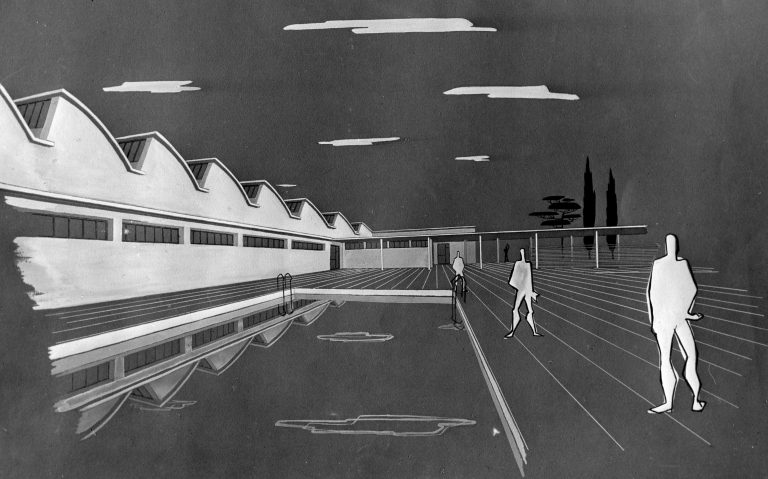
Perspectiva de la piscina exterior de l'Institut Ramon Berenguer IV.
-
- Date:
- 1955 - 1957
-
- Type:
- Drawing
-
- Fonds / Held by:
- Fons MBM / Arxiu Històric del COAC
-
- Rights:
- © Fons MBM / Arxiu Històric del COAC
-

Perspectiva de l'accés a l'Institut Ramon Berenguer IV.
-
- Date:
- 1955 - 1957
-
- Type:
- Drawing
-
- Fonds / Held by:
- Fons MBM / Arxiu Històric del COAC
-
- Rights:
- © Fons MBM / Arxiu Històric del COAC
-

Persperctiva de l'interior d'una aula de l'Institut Ramon Berenguer IV.
-
- Date:
- 1955 - 1957
-
- Type:
- Drawing
-
- Fonds / Held by:
- Fons MBM / Arxiu Històric del COAC
-
- Rights:
- © Fons MBM / Arxiu Històric del COAC
-

Perspectiva de l'interior de Institut Ramon Berenguer IV.
-
- Date:
- 1955 - 1957
-
- Type:
- Drawing
-
- Fonds / Held by:
- Fons MBM / Arxiu Històric del COAC
-
- Rights:
- © Fons MBM / Arxiu Històric del COAC
close

Works (24)


On the Map
Awarded
Cataloged
Disappeared
All works
Constellation
Chronology (27)
-
First Refurbishment of the Government Store
Martorell-Bohigas, Oriol Bohigas i Guardiola, Josep Maria Martorell i Codina
 The property will consist of four floors housing a total of three dwellings, with the following layout: Ground floor - Commercial premises, entrance hall to the property, providing access to the staircase and two rooms for rubbish collection, water and electricity meters. First floor - This consists of a dwelling that extends between the two façades and an upper floor with access to a terrace. Second floor - This complements the first floor, forming a single dwelling. Third floor and attic - These will be used for residential purposes. The concrete foundations support the metal pillars and solid brick walls. The floors will be ceramic, and the loads and characteristics of the load-bearing elements are outlined in the structure section. The façades will have stuccoed walls and will consist of a 15 cm thick exterior wall, a 10 cm air chamber and a partition wall. The interior walls and ceilings will be plastered and painted with tempera. The bathrooms and kitchens will have tiled vertical walls. The flooring in the dwellings will be 30x30 terrazzo. The interior and exterior carpentry will be made of top-quality Flemish pine wood painted with enamel. The electrical installation will be fully protected by recessed Bergman tubing and the conduit sections will be as required. The plates, switches, sockets, etc. will be BJ brand ‘star type’ Bakelite and television plates. The risers will have the sections required by the supply company, as specified in a prior report. The water installation will be made of lead for indoor installations and will have the sections required for the flow rate. Iron pipes will be used for outdoor installations and risers. All these materials, as well as any others used in the work, will be of the highest quality and the construction methods used will be those traditionally used in this city.
 -
Farmàcia Coves
Martorell-Bohigas, Oriol Bohigas i Guardiola, Josep Maria Martorell i Codina
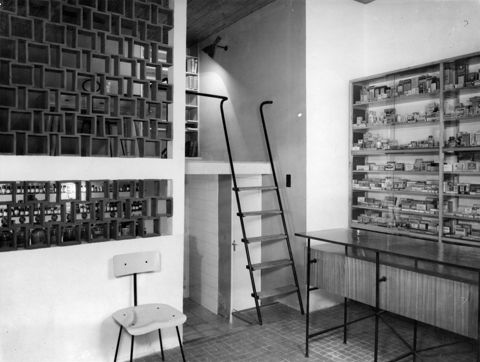 Aquest projecte afecta la reforma d'una botiga situada al carrer de la Creu núm. 89 cantonada al carrer de Colom de Badalona. A l'exterior s'eixamplarà la va d'entrada, es revestiran els massissos d'un material noble i es col·locaran uns anuncis lluminosos. A l'interior es construirà un petit altell amb biguetes de ferro i entaulat de fusta, al qual s'enfilarà mitjançant una petita escala de fusta i tub de ferro. Així mateix, es canviarà el paviment, es construiran els armaris prestatgeries, es construirà un WC i es tornarà a pintar tota la botiga.
 -
CEAC Publishing House
Martorell-Bohigas, Oriol Bohigas i Guardiola, Josep Maria Martorell i Codina
 This project involves the construction of a building comprising a ground floor, basement and first floor, to be used as offices. The site will be excavated to a depth of 3.20 metres below street level. Once this excavation has been completed and the soil transported to the landfill, the foundation work itself will begin. The perimeter walls of the basement will be constructed of waterproofed concrete with a density of 200 g of cement per cubic metre and a constant thickness throughout the height of the basement, as indicated in the plans. The foundations for the pillars will be made using reinforced concrete footings measuring 2.35 x 2.35 metres at the base, 0.60 m high at the periphery and 1.20 m high at the junction with the foundation pillar. The buried part of the pillar will have a square section measuring 0.80 x 0.80 m. On the main and rear façades of the ground floor and on the rear façade of the basement, large windows will be installed, consisting of prefabricated concrete elements, 20 x 40 cm ‘SAS’ type, which will be installed on site by reinforcing the joints and then filling them with Portland cement mortar. Twenty per cent of the surface area of these windows will be openable by assembling metal frames according to a system to be indicated at the appropriate time by the architects in charge of the project. The roof of the building will be made of ‘Granada’ type fibre cement sheets on wooden purlins, which will be supported by walls built for this purpose. The ground floor and first floor will be tiled with 15x30 cm hydraulic mosaic tiles. To prevent cracks caused by expansion, expansion joints will be left every 4 m. The stairs will be made of reinforced concrete. The steps and risers will be covered with marble.
 -
Ramon Berenguer IV Secondary School
Martorell-Bohigas, Francesc Bassó i Birulés, Oriol Bohigas i Guardiola, Joaquim Gili i Moros, Josep Maria Martorell i Codina
 El projecte original correspon a un Institut Laboral encarregat pel Ministeri d’Educació, dins un programa de desenvolupament endegat després de la postguerra. L’edifici s’articula en forma d’una gran H que dóna lloc a un pati d’entrada i a un pati posterior més petit. Les dues ales laterals que flanquegen el primer recinte es destinen a aules, mentre que la part posterior acull les dependències comunes. La planta s’organitza extensivament, seguint un esquema de corredors axials que donen accés a cada part del programa. Les cobertes de les aules segueixen dos tipus, segons la seva posició: un primer tipus en dents de serra, amb el vessant de directriu circular, i un segon tipus amb una coberta de teula amb dos vessants desiguals, un cos baix adossat i les obertures als tancaments laterals. El conjunt reflecteix un exercici d’aplicació estricta d’alguns principis del moviment modern, abans de la revisió que els mateixos autors durien a terme durant la dècada següent.
 -
Roger de Flor Apartment Building
Martorell-Bohigas, Oriol Bohigas i Guardiola, Josep Maria Martorell i Codina
 In this building, the same problems that the GATCPAC architects had with the ordinances of Barcelona's Eixample reappear, where the buildable depth and the dividing walls forced them to use small ventilation patios. In this case, an important innovation was introduced by projecting the building as if it were two parallel blocks, separated by a large 5 m wide intermediate patio for ventilation. This new distribution ensures that all the houses have two façades and cross ventilation, but a part of the constructed area has had to be given up to make it suitable for building. The load-bearing walls are parallel to the façade, without setbacks of any kind. The façades are exposed brick, and those on the ground floor are glazed exposed brick. The windows to the street are metal carpentry with roller shutters; those of the other façades are made of wood with wide-slat booklet blinds. The balconies have a solid front parapet, which forms an L shape with the cantilever, and is covered in white tile, forming a very abstract composition, Bauhaus style-like: a uniform pattern of white spots on an absolutely flat red canvas. The shutters and railings are blue, and the metalwork has been painted black.
 -
El Timbaler del Bruc School Group
Martorell-Bohigas, Oriol Bohigas i Guardiola, Josep Maria Martorell i Codina
 This project involves the construction of a double school complex with capacity for six classrooms for boys, six classrooms for girls and a nursery. A large classroom that can be converted into a gym and an assembly hall is common to both sections. Each section will also have an auxiliary classroom for manual work or crafts and an area for the head teacher's office, the school office and the staff room. Given the limited space initially available, the school complex had to be arranged over several floors. This layout, in addition to the advantage it offers in terms of saving space, also reduces circulation areas and, if installed, saves on the installation and maintenance of heating and other services. The layout of the floors often has the disadvantage of making it impossible to ventilate and illuminate the classrooms from both sides. To overcome this drawback, only two classrooms were arranged per floor, which can be accessed directly from each staircase landing. This not only eliminates corridors, which are dead and useless spaces in schools, but also ensures that the classrooms always have ventilation and double lighting. At the same time, this layout facilitates the construction of large terraces attached to each classroom, each of which is completely separate. This issue seemed important because, from the outset, the aim was to give the school the option of teaching both indoors and outdoors. In this way, each terrace attached to the classroom is quite enclosed, independent, treated more like a courtyard than a terrace, making it very suitable for use as an outdoor classroom, as well as for the possible expansion of the school space, connecting it to the adjoining part of the classroom. The ground floor houses exclusively the administrative offices for both sections, the special classrooms (for manual work and crafts) and the space used interchangeably as a gym and an assembly hall, which has double access from each of the sections and also connects to open areas to facilitate gymnastics. Also on the ground floor is the nursery, a cylinder with a metal structure and glass enclosure, arranged in a slightly informal layout to facilitate not a purely school-like environment, but rather one of family intimacy. The entire structure is made of reinforced concrete with hollow brick walls or metal frames. The entire exterior is clad in white glass tiles, except for the stairwells, which are a light tan colour. The interior floors are hydraulic mosaic, the terraces are ceramic, and the exterior floors are concrete.
 -
Provisional Parish Church of Saint Sebastian
Martorell-Bohigas, Oriol Bohigas i Guardiola, Josep Maria Martorell i Codina
 Within the area comprising the parish boundaries, the authorities responsible for the planning process failed to set aside the necessary space for the potential construction of a parish church. As a result, this building —which serves as a temporary solution to avoid continuing to hold Sunday Mass in the middle of the street— has been erected on public land designated as green space, situated outside the neighbourhood’s urban boundaries. The aim was to provide, as quickly as possible, a covered space in which to hold the liturgical services required by parish life, as well as premises for parish offices. For the Church: Rectangular nave measuring 9 x 29.5 m. Timber structure (uprights and trusses). Asbestos-cement roofing. External walls of 10 cm thick Durisol panels. Mechanical brick paving. Ceiling of rough-sawn timber battens spaced apart. Chancel on a wooden platform raised 15 cm above the general floor level. Exposed concrete altar. Curved altar backdrop of exposed hollow brickwork. General lighting via tall wooden windows. Chancel lighting via two large stained-glass windows. Overlapping wooden entrance doors. Concrete holy water font. For the parish offices and sacristy: A two-bay structure with a rectangular floor plan. Load-bearing walls of brickwork and a ceiling of concrete joists and hollow blocks. Catalan-style flat roof. Exterior finish with plaster and whitewash. Mechanical clay brick paving. Interiors plastered and painted with tempera. Connecting passageway between the nave and the sacristy with a flat concrete roof and side walls featuring concrete windows. The complex is completed by an outdoor area bounded by a 40 cm high concrete kerb, within which the pathways to the church entrances and the offices are paved with ‘pedregalet’ stone. The remainder is divided into various flowerbeds with trees and a paved area. Next to the entrance stands a free-standing four-armed cross made of reinforced concrete.
 -
Guardiola House
Martorell-Bohigas, Oriol Bohigas i Guardiola, Josep Maria Martorell i Codina
 This project refers to the construction of a detached house on Carrer de Colom, on the corner of Carrer de Santo Domingo, in Argentona (Barcelona), for Esteban Guardiola Ferrer. The approximate budget for this work is 250,000 pesetas. Earthworks will be carried out and trenches will be dug for the foundations and drains as indicated in the attached plans. The general structure will be made of iron, with ceramic roofs and brick walls. The main and rear façades will be plastered and painted with lime. The roof of the building will be made of corrugated fibre cement sheets supported by reinforced concrete beams. The interior walls will be plastered and painted with tempera. The carpentry will be made of top-quality Soria pine wood, except for the exterior openings, which will be made of metal. Attached to the villa is a garage with space for two cars and direct access from Carrer Santo Domingo, with a fibre cement roof on a general structure of brick walls. The laundry rooms and storage rooms will be located in the same building as the garage.
 -
Mútua Metal·lúrgica d'Assegurances
Martorell-Bohigas, Oriol Bohigas i Guardiola, Josep Maria Martorell i Codina
 This project concerns the alteration and extension of the medical consulting rooms operated by Metalworkers’ Mutual Insurance Society at Carrer d’Anselm Clavé 2. The works involve constructing an intermediate floor at the usable height of the ground floor and arranging the flow of patients into two medical service units, one on each floor. To this end, various elements will be demolished; an existing partition wall will be replaced by a 15 cm thick wall, which will require the construction of foundations; and openings will be formed in several walls, as clearly indicated on the accompanying drawings. A small sanitary block currently located where the new intermediate floor is to begin at the metal spiral staircase will be removed, although the staircase itself will be retained with minor alterations. The façade windows will also be altered and divided horizontally into two independent sections, each operable from its corresponding floor. The glazed screen communicating with the entrance vestibule of the building will be substantially modified to allow access to the staff lobby, and high-quality etched glass will be installed to provide natural light to a group of lavatories and to the upper lobby. The public entrance and the ground-floor waiting room will have all walls tiled to a height of 2 m. The existing tiled wall finish will therefore be retained and restored. No alteration or adaptation of the current wooden benches is envisaged. The doors leading to the consulting room and the staff lobby will be retained, properly repainted and restored, with minor modifications as specified by the Clerk of Works. The partition separating the waiting room from the consulting room currently supports wooden cupboards fixed to it. The consulting rooms and medical facilities on the ground floor will be repaired as necessary in respect of brickwork, plasterwork, painting and finishes, leaving them in perfect condition. The treads of the public staircase will be finished in artificial granite (Figueres colour), with coloured tiled risers. The tread thickness will be 7 cm and no terminal moulding will be provided. The landing will be paved with 40 x 40 cm slabs of the same artificial granite. The staircase dado will consist of coloured tiles to a height of 1.30 m. A timber handrail will be fixed to the right-hand wall. The service staircase will be the same as that currently used to access the existing mezzanine, but adapted to the new height. The mezzanine waiting room and its corresponding lobby will be paved with first-quality hydraulic mosaic tiles, of the colour and specification indicated by the Clerk of Works. The benches and caretaker’s kiosk in this room will not be constructed. All walls will be clad with coloured tiles to a height of 1.80 m. The doors will be flush and constructed from double plywood panels. The balustrade to the lobby and that at the top of the staircase will consist of a 1½-inch iron tube handrail welded to vertical iron bars at 12 cm centres, of equal or superior quality. Walls will be tiled to a height of 1.80 m and finished with double plywood boarding where specified. A porcelain washbasin with special lever taps will be installed in each consulting room. The partition separating the two sanitary facilities on the ground floor will be constructed of glass blocks above a height of 1.80 m. The partitions separating the WCs and urinals from the washbasins will be 1.80 m high. All doors to these sanitary areas will be flush and constructed of double plywood panels. To ensure proper ventilation of the ground-floor sanitary facilities, a ventilation duct will be built into the wall of the building’s central lobby, connecting both facilities and terminating at roof level. Throughout its route, the affected wall will be made good and painted to match the adjoining rooms. The mezzanine sanitary facilities will be ventilated by means of a small circular window opening onto the façade and communicating with the void of the first window in the waiting room. Proper drainage will be constructed for these facilities to the main sewer, making use of existing drainage runs where possible. The electrical installation will comprise 20 lighting points, the positions of which are indicated on the drawings. In addition, two socket outlets will be installed in each mezzanine consulting room. These, together with the switches, will be positioned as directed by the Clerk of Works.
 -
Pallars Residential Street Block
Martorell-Bohigas, Oriol Bohigas i Guardiola, Josep Maria Martorell i Codina
 The building responds to the purpose of rationalising social housing based on the Cerdà square. The standard block contains four houses, with a small open space in the middle that serves the bedrooms. Each block is clearly separated from the neighbouring block by a cut that contains the staircase and the laundry. The apartment’s main model consists of two corridors, one for the bedrooms and the other one for the kitchen and the lavatories. The complex, containing a ground floor and 5 additional floors, creates a rhythmic façade thanks to the difference in the bodies’ volumes. The project takes care of all the work scales at the same time: from the minimum housing standards to the control of the urban shape.
 -
Radio Barcelona / Loreto Burdeus Housing Group
Martorell-Bohigas, Oriol Bohigas i Guardiola, Josep Maria Martorell i Codina
 Group of dwellings between Carrer de Loreto and Carrer de Burdeus in Barcelona.
 -
Fàbrica PIHER Badalona (Fase 1)
Martorell-Bohigas, Oriol Bohigas i Guardiola, Josep Maria Martorell i Codina
 An industrial complex, intended for the manufacturers of electronic parts, was made up of two buildings: The large workshop area and a smaller complementary service building. The first was formed by a series of steeply sloping metal roofs, providing an even source of light from the North and ample space for the installations. The end walls are angular like the saw-shape of the roof with openings to the South. Offices are incorporated within the same volume of the workshop building, along the nave to the North. The canteen and changing-rooms are accommodated in the smaller service building. Some years later this building was dismantled and transported to another city, Tudela, and re-erected there for the same company.
 -
Passeig Maragall / Sagnier Residential Complex
Martorell-Bohigas, Josep Alemany i Barris, Oriol Bohigas i Guardiola, Josep Maria Martorell i Codina, Francesc Mitjans Miró, Antonio Perpiñá Sebriá, Josep Maria Ribas i Casas
 This project concerns the construction of 100 dwellings arranged in two blocks, one located on Carrer de Maragall and the other on Carrer de Luis de Sagnier. Trenches will be excavated as required for the foundations of the load-bearing walls. These trenches will be 60 cm wide and approximately 2.00 metres deep, although these dimensions may vary at the discretion of the supervising architect according to the bearing capacity of the ground. Earthworks will also be carried out to install the drainage network indicated on the drawings and described in the relevant section of this specification. Excavation and embankment works will be undertaken as necessary to achieve the levels shown on the corresponding plans. Once the ground resistance and the exact dimensions of the trenches have been determined, they will be filled with cyclopean concrete containing 200 kg of Portland cement per cubic metre, with 30% rubble stone masonry. The internal load-bearing walls, together with the façades facing courtyards and party walls, will be constructed in solid ceramic brickwork bonded with a mixed lime and Portland cement mortar. The façades facing the street and garden will be executed in fair-faced common ceramic brick, including the interior wall surfaces of the ground-floor entrance halls, except for the enclosure walls of the Agency, which will be built in ordinary brick finished with glass tiles, and the window sills of the mezzanine floor on Passeig de Maragall, which will receive a 2 cm coating. The ground-floor columns will be built in bush-hammered reinforced concrete. Internal partition walls will be constructed in hollow brick finished with common plaster. The dividing walls between dwellings will consist of double hollow brick walls 10 cm thick, except for the central dividing wall of each block, which will be built in solid brick 15 cm thick, using the same mortar employed for the load-bearing walls.
 -
FAD Award
Award-Winner / Winner. Category: Architecture Pallars Residential Street Block
Germans Amat School Group
Martorell-Bohigas, Oriol Bohigas i Guardiola, Josep Maria Martorell i Codina, Josep Pratmarsó i Parera
 In Terrassa there had long been a need to educate a large number of boys and girls who belonged to immigrant families. To solve this problem, the city council acquired three plots of land located on the outskirts of the city, precisely in the areas where the school-age population was most neglected. Analysing this situation, certain political and social parallels could be found with the Catalan national schooling programme proposed by the Republican Generalitat and the GATCPAC in the 1930s. For the three school groups, a common programme was drawn up and the need to standardise as many construction elements as possible was raised to reduce construction costs as much as possible. Based on these premises and to achieve maximum simplicity and clarity of distribution, the architects proposed differentiating the different blocks and playgrounds, connecting the blocks through the gym-function room, orienting and ventilating the classrooms as best as possible, and standardising the constructions and simplifying the structure as much as possible. Taking these guidelines into account, the projects ended up being the result of adapting the school programme to the terrain. The structural system has been standardised for the three school groups and a uniform orthogonal reinforced concrete framework has been used that is evident on the exterior to give an air of constructive sincerity to the complex. This decision responds to economic reasons, but also cultural ones, since it follows the postulates of Grup R to “rescue” the modern movement that had developed during the Republic. Furthermore, the use of load-bearing walls would have made the construction of large windows difficult. The specific function of each building, however, is expressed through the enclosures, which can be opaque or transparent depending on the spatial and lighting needs of the interior (blind walls in the assembly rooms and heavily glazed in the classrooms).
Baró de Viver School Group
Martorell-Bohigas, Oriol Bohigas i Guardiola, Josep Maria Martorell i Codina
 This project involves the construction of a school complex with two sections, each with five classrooms, for boys and girls separately. In addition to these ten classrooms, an assembly hall was designed to also be used as a gymnasium in an intermediate area, which could be used interchangeably by both sections. There is also a nursery next to the girls' section. Each section consists of a hall, an administrative area (headmaster's office, secretary's office, staff room, changing rooms and toilets), and five classrooms, all of which have an extension to the outside with a porch, which allows for easy expansion of the classroom area, as well as comfortable outdoor teaching. In this way, the school allows for outdoor teaching. The nursery consists of a single room, to which a small waiting hall, a toilet and a kitchenette for preparing meals and baby food and for the hygienic care of the children are attached. Given that the plot of land available was sufficiently large, it was decided from the outset to design the project on a single floor. This layout has the enormous advantages of eliminating stairs and allowing immediate and direct contact from the classrooms to the garden. However, it has the disadvantage of the abundance of space allocated to horizontal circulation, which, although it could have been partly avoided by eliminating corridors and using intermediate halls for more educational purposes, is a difficult and complicated solution when there are so many classrooms and, as in this case, a specific orientation is required. The entire structure of the building is based on a grid of reinforced concrete columns and beams with exposed brick walls. The roof is a succession of Catalan-style flat roofs. In general, the concrete has been left exposed in its original state, as it comes out of the formwork. Apart from concrete and brick, only glazed ceramic tiles have been used to cover the parapets. The flooring is white hydraulic mosaic with black speckles, while the exterior flooring is concrete (‘pedregalet’). The steps are also made of concrete. The exterior enclosure alternates between prefabricated concrete elements and brick walls. Above the exterior areas of the classrooms is a porch with a metal structure and a ‘bruch’ roof. Outdoor circulation from each hall to the assembly hall and from the entrances to each of the halls takes place under a porch, also with a metal structure and a corrugated fibre cement roof. With the exception of two small green flowerbeds, the landscaping is reserved exclusively for strategically placed groups of trees to provide significant areas of shade. The visual separation between the boys' and girls' areas has been achieved with a sculpture by Moisès Villèlia on a green flowerbed behind the glass window of the girls' section lobby. It is an extraordinarily interesting sculpture based on vertical fibre cement tube elements.
Calvet Apartment Building
Martorell-Bohigas, Oriol Bohigas i Guardiola, Josep Maria Martorell i Codina
 The purpose of this project is the construction of a Limited-Rent building, Group 1, comprising 15 dwellings on the upper floors, a commercial unit on the ground floor, and basement levels housing the building’s shared services (central heating and coal store). The ground floor also contains the residential entrance and one dwelling. The main characteristics of the building are as follows: The basement and ground-floor structure is of mixed construction, consisting of brick load-bearing walls combined with reinforced concrete columns and beams. The structure of the remaining floors is formed by brick walls and floors made up of concrete joists with ceramic infill blocks. Interior floor finishes consist of hydraulic mosaic tiles, with terrazzo flooring in the entrance hall and staircases. Walls are plastered and painted with distemper. Ceilings are finished with reed lath and plaster, painted with distemper. Bathrooms, kitchens and utility rooms are tiled with 15 × 15 cm ceramic wall tiles to full height. Sanitary fittings are first-quality porcelain. The electrical installation is concealed, run in Bergman conduit, with first-quality bakelite switches, sockets and bells. A power distribution network is also provided. Cooking appliances are of a mixed gas and coal type, except in the ground-floor and attic dwellings, which have a more reduced programme and are equipped with gas cookers only. A central heating system is installed, with boiler and coal store located in the basement. A passenger lift and a goods lift are provided, supplied and installed by a reputable specialist company. Gas and cold-water installations are concealed and executed in lead pressure pipes of diameters required by the utility companies. Each dwelling is equipped with a domestic hot water system using electric water heaters of 100 litres and 25 litres capacity (except in the attic and ground-floor dwelling, where 15-litre units are installed), with a concealed galvanised steel distribution network. In compliance with Article 100 of the current building regulations, individual mailboxes for correspondence are installed in the entrance hall, in accordance with the applicable standards. Façade openings are fitted with metal joinery, and solid wall sections are clad with high-temperature fired ceramic tiles. The building is intended for the sale of individual dwellings.
FAD Award
Shortlisted. Category: ArchitectureCalvet Apartment BuildingEscorial Apartment Building
Martorell-Bohigas, Josep Alemany i Barris, Oriol Bohigas i Guardiola, Josep Maria Martorell i Codina, Francesc Mitjans Miró, Antonio Perpiñá Sebriá, Josep Maria Ribas i Casas, Manuel Ribas i Piera
 The block has established the typical arrangement of buildings lined up along the surrounding streets with large building depths around a central courtyard, which is also buildable in part. The urban planning proposal consisted of breaking this closed scheme and opening up the interior as a public space related to the streets, trying, however, not to contradict the morphological reality of these streets. It was a question of combining three fundamental premises: to improve the hygienic conditions of dwellings in depth that occurred in traditional urbanisation; to integrate the public use of the inner spaces of the building, breaking the formal recidivism of the streets; to maintain, however, the urban character of the adjacent streets that belong to an urban network very characteristic of a Barcelona neighbourhood. That is why two linear buildings were organised following the alignment of two streets and the interior space was opened towards Escorial Street, which has a less local nature. The tall building that accumulates in height a large part of the buildability of the building was in the middle of this space. The housing types are adapted to the obvious general morphological requirement: the linear buildings group paired homes with access by stairs for each of them (of 80 and 90 m2), and the tall building corresponds to homes in two floors with access through longitudinal corridors, (100 m2). The exterior finish of the tall building is concrete and white tile and that of the low buildings is solid brick and ceramic lattices.
Luján House
Martorell-Bohigas, Oriol Bohigas i Guardiola, Josep Maria Martorell i Codina
 The purpose of this project is the construction of a small detached dwelling within the municipal area of Palau de Plegamans. Taking advantage of the difference in level between the plot and the road, a covered space and a small room are to be built at semi-basement level for use as a garage and storage room. Above these, the dwelling will be erected, comprising two sections: one containing the living–dining room and kitchen, and the other containing the bedrooms, dressing room and WC, both connected by the entrance hall. The load-bearing walls will be entirely of exposed brickwork, and the roof will consist of a vaulted structure with a traditional Catalan vault. The internal flooring will be of hydraulic mosaic tiles, and the terraces will be finished with machine-made tiles. All internal wall surfaces will be plastered and painted throughout. The joinery will be of first quality. The construction materials required for the works are: 3 tonnes of cement; 1 tonne of lime; 2.5 tonnes of plaster; 20 m³ of gravel and sand; 25 m³ of bricks; 0.8 m³ of timber; 0.5 tonnes of structural iron; 0.2 tonnes of iron for other elements; and 2 kg of electrical wiring.
Rubberstamping and Administration Floor of the Architects' Association of Catalonia (COAC)
Martorell-Bohigas, Oriol Bohigas i Guardiola, Josep Maria Martorell i Codina
 When the commission to organise, complete and furnish one floor of the Architects’ Association building was undertaken, the space was already largely finished in terms of structure, windows and external enclosures, parapet finishes, flooring, suspended ceilings, and air-conditioning and electrical installations. The departments to be accommodated were those corresponding to the plan approval (‘visat) and administration sections, a basic and fundamental unit in the functioning of the Association, since it is here that the inspection and certification of projects is carried out, which essentially constitutes the institution’s core activity. In the preliminary design competitions for the building, the programme established for these sections was as follows: Plan Approval: waiting and submission area, office of the Duty Board Member, office of the Head of Plan Approval, general office, archive and records. Administration: offices of the Treasurer and the Accountant, cashier’s desk, accounting office, and document collection area. From the time of the competition call to the moment of this commission, the requirements of these sections had increased extraordinarily, particularly in terms of office capacity and the number of architects responsible for plan approval. From the first sketches it became clear that the available space was very insufficient and that, in order to function effectively —as was appropriate given the importance of the section— an additional floor would be required. Several consultations were held with the Building Committee, and it was ultimately agreed to limit the intervention to the available floor and instead eliminate the waiting room, the office of the Duty Board Member and that of the Accountant, while enlarging the general lobby as much as possible, with the potential use of the stair landing. It was also suggested that the Association Club could be used as an extension of the waiting area for the plan approval section, although the drawback of its lack of proximity was immediately apparent —a problem that, given the advanced stage of construction, could no longer be effectively addressed. In accordance with the programme, two somewhat independent units were established: plan approval and administration. The former was structured according to the strict sequence of document processing: document submission counter – entry registration – auxiliary plan-approval staff – archive and metal filing cabinets – architects responsible for plan approval – cashier – document collection counter. At the centre of this unit is the isolated office of the Head Architect, the only space with direct access from the lobby, in order to facilitate personal consultations. In this respect, and in line with a general criterion for organising the work of this section, direct contact between the public and the architects personally carrying out the plan approval process was deliberately avoided. The second unit consists of the general administration office, which is connected to the Treasurer’s office, the other of the only two rooms with direct access from the lobby. The two units are separated by the staff entrance corridor, which also serves as the zone through which the lobby connects visually with the exterior—that is, with views towards the Roman towers and the neo-Gothic façade of the Cathedral. Given the constraints of the available space, consideration was given, as mentioned, to enlarging the lobby by incorporating the stair landing. While this solution made it possible to create an area for the review and preparation of documents by members, it also implied the impossibility of fully isolating the office complex—outside public service hours—from the vertical circulation routes leading to that landing, namely the staircase and lifts. The Building Committee pointed out the disadvantages of this situation and the need to establish an effective enclosure. With this criterion in mind, an intermediate solution was adopted, consisting of encroaching upon the landing only with solid elements, thus providing a fixed enclosure, and separating the remaining free area by means of a simple glass partition without mullions or transoms, incorporating a “Securit” glass door. This solution at least ensured visual continuity between the two spaces, even though they could not be physically unified. The furniture was arranged in such a way as to reinforce this perception while also allowing some effective use of the landing. For this reason, two identical benches were placed, one on each side of the aforementioned glass partition.
Casa Orpí
Martorell-Bohigas, Oriol Bohigas i Guardiola, Josep Maria Martorell i Codina
 This holiday home is situated on a very high plot of land in El Figaró, with extraordinary views over the entire Congost valley. The slope, the sunlight and the views recommended building a linear house following the contour lines. The earthworks required to place the house and the garage were used to the maximum by covering both buildings with a "Catalan-style" roof terrace, which practically creates the only two flat spaces in the entire garden. These roof terraces seamlessly join the terrain and only the rocks and the natural vegetation serve as a boundary between them. Most of the walls are made using the traditional technique of the region: masonry with ordinary stone and pieces of brick, with the corners also made of brick. Outside, in addition to the masonry, concrete has been used in the railings, in the protection of the guides of the sliding shutters and in the stops of these shutters. Where the concrete had to be subsequently drilled to secure the metal railing, a caramel-coloured glazed ceramic piece was superimposed at a 45º angle to cover the hole and the damage to the concrete. All the carpentry in the building, both inside and outside, is made of pine varnished in its natural colour. The flooring is made of hydraulic mosaic pieces alternating between black and white. All the furniture is from the normal series manufactured by "Best-form", "Aresta" and "H-muebles", or belongs to the popular crafts of Catalonia. The interior walls are either made of masonry or plastered and painted in white tempera, except for the central volume of the fireplace, which is Pompeian red. The electrical installations on the masonry walls are not embedded in iron pipes. All the landscaping has been done with the attempt to leave the mountain almost in its natural state.
FAD Award
Award-Winner / Winner. Category: ArchitectureEscorial Apartment BuildingArchive (7)
-
Drawing
Perspectiva Exterior del Grup Escolar Baró de Viver
© Fons Col·leccions / Arxiu Històric del COAC
-
Drawing
Perspectiva Exterior del Grup Escolar El Timbaler del Bruc
© Fons Col·leccions / Arxiu Històric del COAC
-
Esbós
Esbós de Plantes de l'Illa de Cases Pallars
© Fons Col·leccions / Arxiu Històric del COAC
-
Drawing
Perspectiva de la piscina exterior de l'Institut Ramon Berenguer IV.
© Fons MBM / Arxiu Històric del COAC
-
Drawing
Perspectiva de l'accés a l'Institut Ramon Berenguer IV.
© Fons MBM / Arxiu Històric del COAC
-
Drawing
Persperctiva de l'interior d'una aula de l'Institut Ramon Berenguer IV.
© Fons MBM / Arxiu Històric del COAC
-
Drawing
Perspectiva de l'interior de Institut Ramon Berenguer IV.
© Fons MBM / Arxiu Històric del COAC
Routes & Notes (9)
-

Rutes 78
-
Rutes 42
-

Rutes 73
-

Apunts 4
Authors