









-
Old Pujol i Bausis Ceramics Factory
autoria desconeguda
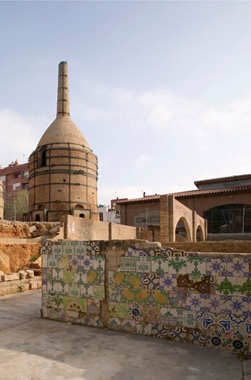 The old ceramic factory in Pujol i Bausis, popularly known as "La Rajoleta", was one of the most important centres of industrial ceramic production in Catalonia. It is located between Carrer de l’Església and Passatge del Puig d'Ossa, in the city centre of Esplugues de Llobregat. This industry began its activity in the last quarter of the 19th century, although its industrial antecedent began its activity in the middle of the 19th century. The culminating moment of its manufacturing activity came at the end of the 19th century during the modernist era with the commissions of prominent architects of this artistic movement such as: Gaudí, Domènech i Montaner or Puig i Cadafalch. The factory ended its activity in 1984 and then the city council acquired the property. Several buildings were demolished and archaeological surveys were carried out which allowed the underground spaces to be discovered and documented, such as the large underground oven, which is, 20 m long, or the six Arab-type ovens (ca. 1887). The large 22-metre-high brick chimney located at the southern end of the plot and the two large bottle ovens also made of brick remain standing. These last bottle kilns, named because of their shape, were built between 1913 and 1914 to bake stoneware and porcelain, in the context of a remodelling of the factory under the direction of its owner, Pau Pujol. With a circular base, they are formed by a cylindrical section covered by a conical section topped by a chimney. They are made of brick reinforced with a steel mesh made of iron rings and strips to prevent expansion of the facing during the firing of the pieces. Several semicircular arched openings at the base. The industrial antecedent of the Pujol i Bausis ceramics factory dates back to 1858, when two French businessmen built a mill on this land owned by the Pujol family. In 1876 the factory was acquired by Jaume Pujol i Bausis, who remodeled it in the 1880s to manufacture ceramics, and since then it has been known as "La Rajoleta". Its heyday corresponds to the period of modernism, during which the main architects of this artistic movement commissioned work at the factory. In 1901, Joan Baptista Alòs, renowned ceramic designer and teacher at several arts and crafts schools, began working there as artistic director. After the Spanish Civil War (1936-1939), the factory became a limited company, it stopped manufacturing ceramic tiles and started manufacturing high voltage insulators for the electricity companies. Finally, its activity ended in 1984 and the city council acquired the property. After several archaeological prospecting campaigns, in 2002, the La Rajoleta Ceramics Museum was inaugurated in a newly constructed space located in the centre of the old industrial site.
1880
-
1902 - 1903
-
Refurbishment of Masia de Can Brillas
autoria desconeguda
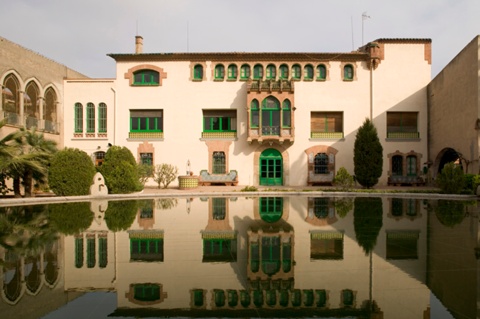
 From 1808 until the end of the 19th century, it was the first house you could see if you were coming from L'Hospitalet. From 1906 to 1923, it became the social residence of the Cultural and Recreational Entity ‘L'Avenç’. In 1924, the Brillas family set up a wine business which later became the Marguery champagne cellars. In 1972, they sold the house to the town hall, which used it as a ceramics school and exhibition hall. The building is structured on three levels: ground floor, first floor and attic. It is made up of three sections, with a gable roof. The façade is almost symmetrical. The main door opens on the central axis, topped by a segmental arch, above which is the inscription: ‘Anno Domini MDCCCVIII’. The side door is pierced by a lintel. It was rebuilt in 1906, maintaining a certain Catalan Art Nouveau touch in the wrought-iron balconies and the second-floor window. Recently, a side section was added to the left of the main façade. Extensions were carried out to accommodate the cultural activities of the house. The 2000 m2 of gardens that surround the house are worth mentioning.
1906
-
1946
-
Iranzo House
Josep Maria Sostres i Maluquer
 The project outline, very generous and permissive, is interpreted in this case from a desire for a very strict correspondence between each of the parts of the house and its own structural and volumetric solution, so that the articulation between the different bodies is forced upon themselves. The result is a combination of volumes and openings that form a series of tense rhythms where no element is repeated. Sostres revitalises several compositional guidelines from the modern movement: the location of the entire program on the first floor refers to Le Corbusier, while the strict equation of use-form-structure comes from the more rigid principles of the Bauhaus. Despite everything, the result is not a mere exercise of historicism: by interpreting ideas and procedures, and not stereotyped forms, Sostres manages to regenerate the vitality of the house as a complex system of rooms, where the blown volume of the living room being ends up playing a predominant role.
1955 - 1956
-
Moratiel House
Josep Maria Sostres i Maluquer
 It is the best critical interpretation that Sostres made of the masters of the modern movement that influenced him so much. The program is developed on a single floor, slightly raised from the ground, and with the different rooms well placed with respect to the solar abacus. The combination of different types of supporting elements and facings, originating from the interest in Terragni and other Italian rationalists, tends to dematerialise the house and to incorporate transparencies as a more intense experience of space. From the street, the two plans differentiated by colour, the cut of the entrance and the view of the two overhangs of the roof, the study and the staircase, reflect a revision of the old icon of the Savoie Villa: an almost square house almost, with the passable roof, and a small inner courtyard that completes the organisation of the whole space and contributes to creating a richer domestic atmosphere than that of the old international style interiors.
1955 - 1957
-
1956 - 1957
-
1957
-
1959 - 1960
-
1962
-
Montesa Factory
Correa Milá Arquitectes, Federico Correa Ruiz, Alfonso Milá Sagnier
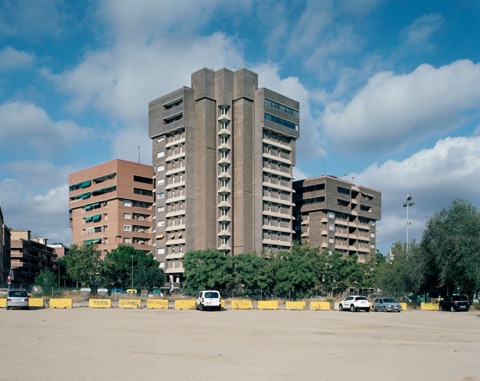
 When Correa and Milà faced the project, there was already a previous proposal that set the spans between pillars at 24 metres. The authors considered this to be an automatic decision and analysed it critically, judging it unnecessary to resort to large spans for an industrial installation that operated with small machines. They therefore decided to halve the spans to 12 m, which allowed them to reduce the foundation costs and win the contract. The programme called for the construction of a mass concrete slab capable of uniformly resisting the loads to allow the distribution of the machines to be changed at any time. This slab could not contain any installations or conduits that would hinder the possible changes, so the installations were placed exposed on the roof, while the downpipes were taken to the outside. The importance of this decision is reflected in the length of the gutters, which run 100 m between the sawtooths. The watertightness of the building also had to be guaranteed, so the skylights were built entirely vertically.
1957 - 1964
-
1963 - 1965
-
1971
-
Garbí School
MBM Arquitectes, Oriol Bohigas i Guardiola, David Mackay, Josep Maria Martorell i Codina
 Construction of a new school, built in three phases, for Kindergarten, Primary and Secondary for a total of approximately 1300 students. The construction of the first phase was developed in accordance with the team of pedagogues, with the idea that the architecture had to collaborate in the educational process, creating in the student the full awareness of belonging responsibly to a community. All the outbuildings were grouped around a central multi-use covered square, although primarily used as a dining room. The organisation had a certain urban analogy: the central community square that gathered around it the various more privatised areas. Shortly after, it was decided to transform and expand the building in three successive phases, in which they tried not to modify the initial concept. The common space, with its urban analogy, was maintained, but the image of the square was transformed into that of a succession of interior and exterior streets and squares. The enlargement technique was simply additive, thanks to the fact that the building had no compositional rigidity and could grow according to an almost unforeseen morphology, in a way related to popular forms. This aspect is underlined by the materials and construction systems used: brick walls, traditional ceramic tiles, concrete and natural wood.
1962 - 1973
-
1969 - 1976
-
1978 - 1983
-
Extension and Incorporation of a Multipurpose Room and Lobbies in the Nestlé Office Building
MBM Arquitectes, Oriol Bohigas i Guardiola, David Mackay, Josep Maria Martorell i Codina
 The new Nestlé office building in Esplugues, Barcelona, is in fact an extension to a relatively recent complex constructed in the 1970s. The design parameters were established after a lengthy period of discussions involving considerations of space, corporate image and maintenance raised by the client, together with volumetric restrictions imposed by local planning regulations influenced by the surrounding roads and nearby motorway. These factors, along with the visual and solar conditions of the site, determined the final siting and form of the new building. The existing complex consisted of an eight-storey rectangular office block set on a north-east/south-west axis parallel to the main road, and a two-storey pavilion to the north-west containing laboratories at ground level and a dining room above, overlooking an immaculately maintained garden, almost Swiss in its perfection. Three basement levels beneath the office building provided staff parking which, being insufficient, was supplemented by a large surface car park to the west of the site. A small nursery completed the complex, located to the north-east of the plot, well away from the main buildings. One of the client’s principal concerns was that the new building should provide working conditions virtually identical to those in the existing offices, in order to avoid potential conflict and to allow the free movement of staff and office furniture between the two buildings. This requirement established a basic 1.20 m planning module for internal partitions, offset from the structural grid to avoid clashes with columns. The total above-ground floor area of the new building is just over 7,000 m². An initial client proposal to link the new building to the existing one in an L-shaped block had the advantage of facilitating communication between the two areas. However, the architects pointed out that this would cast shadows over the gardens, block views from the dining rooms towards the wooded area to the south, and create a radically different character in the new office space, facing north or south rather than east or west. These arguments readily convinced the client to accept a separate building, positioned on a north-east/south-west axis at the western edge of the site alongside the motorway (acting as an acoustic barrier to traffic), connected to the existing ground-level entrance by means of a covered walkway. This new arrangement allowed for the construction of six basement levels beneath the garden: five for parking, accommodating 380 cars for both office blocks, and the first basement housing a 900 m² public conference hall together with an experimental and teaching kitchen and dining complex. The form of the nine-storey office building was determined by positioning it as far as possible from the existing building in order to ensure maximum morning sunlight and a wider garden court. As a result, its basic rectangular shape had to adapt to the legally defined building lines aligned with the slopes of the side streets and the motorway. This gives the building a distinctive form that corresponds to its setting. The shape is further articulated by two large three-storey “cut-outs”: one at ground level on the southern corner to “receive” the covered link between the two office buildings and signal the entrance; and the other at the top of the building on the northern corner, forming a giant balcony (scaled to the motorway) overlooking Avinguda Diagonal, the principal approach to Barcelona. These two cut-outs reinforce the sense of place and lend a distinctive character to what might otherwise have been another international-style glass curtain wall office block. Early façade proposals included an external skin of adjustable louvres separated from the glazing by a metal maintenance grating walkway, allowing hot air to rise and dissipate away from the glass. However, this solution was abandoned in favour of a conventional curtain wall, as the client wished to avoid potential maintenance problems and any subsequent deterioration of the company’s image. The additional cost of air conditioning resulting from a fully glazed façade in Barcelona’s climate was not considered significant by the engineers. On this basis, the glass curtain wall was developed to extreme technological and aesthetic limits: the prismatic form is emphasised by reducing the supporting mullions to a flat neoprene joint; it was found that the mirror effect of the tinted double glazing was less distorted when using imported Italian-manufactured glass; the “swimming pool” effect of tinted glazing in the internal offices was reduced by introducing clear glazing corresponding to the depth of the suspended ceiling, thus allowing occupants to perceive the true natural colour of daylight; clear glass was also used in front of the floor slabs, where tinted glazing was unnecessary, and the steel supports of the curtain wall were left exposed and painted yellow to add a functional decorative effect to the façade. Grey glass is used to clad the end walls, base and roof, expressing their distinct function. The covered link between the two office buildings is half tunnel and half bridge as it crosses the garden, spanning the garage ramp and the sunken garden court that provides direct access to the conference centre. It is constructed in steel, clear glass, glass blocks and white tiles, allowing it to integrate fully with the garden. To reduce the tunnel effect, the floor rises towards the centre, creating a variable height and also providing space for structure and air-conditioning services. From this glazed corridor, a triangular branch allows a steel-and-glass staircase to descend in natural light to the conference centre beneath the garden. The retaining walls are clad in bands of rustic and polished stoneware, chosen to emphasise the classical connotation of the building’s base. The remaining walls are finished in white Formica within the main foyer, black glass in the projection rooms and translation booths, and red curtains that allow the foyer to open into the surrounding lobbies. These lobbies are lit from the sunken garden, the car park and a glass-brick light well that extends down through all the parking levels below. The floors of the foyer and surrounding lobbies are unified as a flexible space by means of natural-fibre carpeting, while the access areas are finished in intense green terrazzo cut into 10 x 10 cm tiles. This reduction in the usual terrazzo tile size produces a more uniform paving surface. The conference hall has been rotated by 45 degrees to achieve a better proportion between the conference table area and the audience, and to blur the spatial boundaries, allowing more flexible use for receptions and varying audience sizes. The garden courtyard has been kept as simple as possible, bearing in mind that it is viewed mainly from the offices above. Nevertheless, a pathway has been introduced to allow a lunchtime walk. Water has been added in the shaded area to reflect the light of the sky and to facilitate visual connection with the lower floors of the existing building. In summary, the architects’ principal concern was to avoid the anonymity of the “international glass curtain wall office block” and to create a strong sense of place, related both to the existing buildings and their immediate surroundings, and to its prominent position at the gateway to Barcelona.
1982 - 1987
-
La Solidaritat Park
Àrea Metropolitana de Barcelona (AMB), Xavier Casas i Galofré, Sergi Godia i Fran

1997 - 1998
-
Esplugues-Pare Miquel Central Library
Artigues & Sanabria Arquitectes, Ramon Artigues Codó, Ramon Sanabria i Boix
1995 - 1999
-
Espai Baronda
Alonso i Balaguer Arquitectes Associats, Lluís Alonso Calleja, Sergi Balaguer Barbadillo

2005
-
1968 - 2017
-
Noves Oficines per Galenicum
H ARQUITECTES, David Lorente Ibáñez, Josep Ricart Ulldemolins, Xavier Ros Majó, Roger Tudó Galí
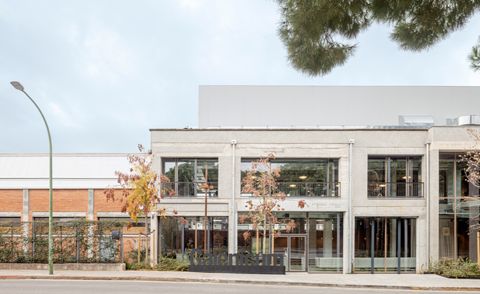
2020 - 2022
Awarded
Cataloged
Disappeared
All works