








Awarded
Cataloged
Disappeared
All works
-
Rusiñol Colony
autoria desconeguda
 Halfway between the colony and the urban factory, Can Remisa featured housing, a chapel, a company store, an inn and a small school. Throughout the 1880s, the Rusiñol family expanded the colony and built an imposing manor named Cau Faluga by Santiago Rusiñol, a true gem of industrial modernism. The walled complex, situated between the river and the cultivated fields, is dominated by the chimney—a cylindrical tower over 40 meters tall—and the imposing owners' manor, a building that displays eclectic features, blending romantic and modernist architecture. In several parts of the colony, modernist elements can be found, such as lampposts with wrought-iron detailing, although the colony itself belongs to the pre-modernist style. It is enclosed by a wall made of river stones and cement. The colony was organised linearly, with factory buildings ready for expansion. Parallel to these, the workers' homes and the owner's residence—used seasonally—were located. The colony was also structured around a large open space, which included an intriguing two-storey building for the owners, a single-storey work nave with an unfinished central section intended for expansion, and two housing blocks for the workers.
1857
-
Sant Nicolau Cemetery
 Funeral complex that, originally, was laid out with a Greek cross plan centred on an octagonal square, with a central department, three districts and a dissident area. Due to various subsequent extensions, the latter is organised into four quadrants or departments (Sant Oleguer, Sant Nicolau, Santa Eulàlia and Sant Salvador). External areas have also been included (departments of Sant Oriol, Sant Otó, Sant Nicodemus, Gregal and Sant Joaquim).
1864
-
1878
-
El Guixaró Colony
autoria desconeguda
 The name of Guixaró is associated with the country house known as Casa Gran del Guixaró. The toponym is known from a 17th-century document. The heiress of this house married Francesc Guixaró, and since 1627, the house became known as Casamitjana i Guixaró. In the 19th century, due to family disputes and inheritance issues, the Guixaró family sold the house and lands to Miquel Vilanova i Marsinyach, the heir of the country house of Sierra de Cabo de Costa in Puig-reig. In 1877, he commissioned an engineer to conduct a technical study for the construction of a sluice and a canal. In 1879, Esteve Comelles i Cluet, from Berga, purchased part of the country house lands to build a cotton spinning and weaving factory. The factory was built between 1888 and 1889, and the old wooden sluice, with a small diversion canal, was built in 1895. From the outset, the factory was equipped with a turbine to transform water power into mechanical energy to drive the machinery and a steam engine to provide supplementary power during drought periods and fluctuations in the river's flow. Mr. Comelles did not limit himself to building a factory. These were the days of industrial colonies, and alongside the Guixaró factory, housing for workers and a range of services and facilities were built so that workers could have everything they needed within the colony. Another building constructed as a "service" for the workers was the church. Historically, the Guixaró church was located next to the factory, as was the director’s house. Today, a small chapel remains in the old school building. Until about thirty years ago, since the origin of the colonies, religion and the priest played a crucial role in the social order and daily life. The priest coordinated social and festive activities, acted as the owner’s vigilant eye in the colony, and spread the message that the owner was like a father to the workers, a protective figure who provided them with jobs, food, housing and services. In 1902, Esteve Comelles, the colony’s founder, died, and the colony passed to his children. In 1917, the Comelles family sold it to Joan Prat Sellés from Manresa, who, along with his partners, sold it in 1929 to Marc Viladomiu i Santmartí, the owner of Viladomiu Nou. At this point, the colony experienced a resurgence: a road was built connecting Guixaró with Viladomiu Nou, worker housing was expanded with galleries for bathrooms and laundries, a new school was inaugurated in 1932 along with a football field, and by 1935, electricity and potable water were introduced. After the Civil War, new services and facilities continued to appear: a new sluice and canal in 1942, a nursery in 1946, a library in 1948, a theatre in 1949 and new apartments in 1953. The factory’s electrical system was consolidated, and the industrial space expanded between 1948 and 1950. These improvements helped the colony gradually overcome the hardships of the post-war years. By the 1970s, signs of crisis and the decline of the textile sector and the industrial colony model became more apparent. The colony began to lose population, and traditional services such as the school and shop closed. The factory ultimately shut down in the late 1980s. After the factory closed, the resident workers were given the option to purchase their homes. Today, around forty people live permanently in Guixaró, and the factory has once again resumed industrial activity.
1879
-
Red Tower
 Detached single-family house (currently divided into two houses), surrounded by a garden, with a tower at the back which has a square base and an octagonal upper body. It has a complex structure, with a Greek cross plan, made up of several bodies that have roofs on two sides. The material used in is exposed brick, which gave the house its name. The Red Tower was built in 1899 following the criteria of the eclectic architecture typical of that period, although it incorporated some medieval elements. The urbanisation of the Sant Ramon Street area (the old road from Cerdanyola to Sant Cugat), which became known as the "Dalt neighbourhood", had begun around 1828 with the construction of houses in some land owned by the Serraparera farm. Subsequently, new construction processes were carried out there, especially during the 1860s and 1880s. (Dating provided by source)
 -
Les Corts Psychiatric Institute
 It was originally the sanatorium run by Doctors Dolsa and Llorach. Dr Pau Llorach was the owner of the land. Although the design and date of construction are unknown, the sanatorium was already in operation by 1863, and in 1867 it is recorded as bordering the land of Vicenç Cuyás i Barberá, who mentions it when drafting his will that year. The construction was based on the principles advocated by Samuel Tuke in England in the 18th century: integration with nature, making particular use of the woods, and landscaping featuring architectural elements such as ponds and waterfalls. Of the original construction of the Les Corts Mental Hospital, built in the early 1860s, the main façade has been preserved. This features an axial composition, rooted in Neoclassicism, centred on the central chapel, which separates the men’s and women’s sections. Above their entrances, a pediment bears the inscriptions ‘gentlemen’s ward’ and ‘ladies’ ward’. The building’s original volume has been preserved in elevation, comprising two storeys, with the second storey featuring openings with balconies and balustrades. The roof is gabled. A compact two-storey residential mansion with a hipped roof has also been preserved, situated on the corner of Carrer Mejía Lequerica and Gran Via de Carles III, in a garden enclosed by an iron fence.
1872 - 1883
-
Pintor Tàpias's Tower. La Pescadora
 It is a small, square-plan building with four doorways: one providing access to the interior and the others leading to a balcony that surrounds the structure. The foundations are made of stone, while the rest of the building is constructed in brick, used as a geometric decorative element. The building was probably erected at the same time as a new wing of the Cal Sala lime factory, with which it shares its decorative style.
1882 - 1885
-
Domènec Coll House
 The Domènec Coll apartments are located on the block of the Eixample district, which is bounded by the streets Bruc, Diputació, Girona and Gran Via de les Corts Catalanes. These are two residential buildings, one of them between partitions and the other forming a corner. The building located at the corner of Bruc and Diputació Streets has a particular structure. The ground floor and mezzanine follow the alignment of the chamfer, but on the ground floor it recedes, forming perpendicular façades to Bruc and Diputació Streets that converge in a tower that contains the stairwell. In this way, façades are obtained, open to the street, which contain galleries more typical of the façades that face the courtyards. The structure in height comprises a ground floor and five upper floors, all covered by a passable flat roof. The entrance portal of the building, the apex of the roof of the existing small building on the terrace of the chamfer and the tower of the stairwell form an axial axis from which the openings are distributed. The facing of the façades facing the street is covered by a stucco that imitates limestone, broken by the openings framed in stone, where those on the first floor and the central tower have pilasters crowned by a classicist pediment. This system contrasts with the light solution of the open galleries on the main façade, of which the use of coloured glass stands out. The main access leads to a lobby area and the central tower where the residents' staircase is located. These elements are decorated with fire-ironed stucco in different colours and geometric shapes, hydraulic mosaic... On the other hand, the building facing number 62 Bruc Street responds to the most common solutions for buildings between partitions in the Eixample. Rectangular in plan, it has a structure in height that includes a ground floor and five upper floors, with three axes of openings on the ground floor and four on the rest of the upper floors, all formed by an axial axis that is in the central entrance hall. The façade presents the same facing solutions as in the chamfer building, with smooth stucco imitating ashlar and openings framed by classic pediments on the lateral axes. The ground floor opens onto the street through three large vestibules where the main access is located in the central one which gives way to a lobby area and to a central rectangular clerestory in which the residents' staircase is located. The crowning of the building is identical to the other, with stone permodules supporting a cantilevered cornice, with the roof enclosed by a balustrade.
1886
-
Sitges Municipal Market
 Building located in the oldest part of Sitges, next to the Casa de la Villa. It is a single-nave building with a gable roof. The brick façade has a symmetrical composition and the most notable element is the iron canopy at the entrance. Originally, the market was an isolated building; later, a new body was added to join it to other buildings. The Sitges market building was the first iron construction in the town. It was designed and directed by the municipal architect Gaietà Buigas i Monravà, and is the first Sitges building. The plans date from 1889. The auction of the works was awarded to Pere Ferran for 24,700 pesetas. The market was officially inaugurated on the 15th of August 1890. The original drawings of the cast-iron marquee at the entrance, also by Gaietà Buïgas, still survive from 1891. In 1935, expansion work was carried out.
1889 - 1890
-
Edifici d'Habitatges Ronda Sant Antoni 41
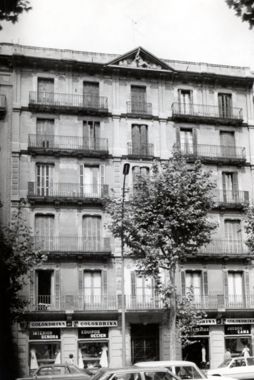 La utilització de la “serliana” esdevé el motiu compositiu principal a partir del qual s’articula la façana d’aquest edifici, format per baixos comercials i cinc plantes destinades a habitatges de lloguer. A partir d’aquest recurs, la composició comença a superar els cànons clàssics basats en la repetició vertical d’un mòdul preestablert, introduint una major llibertat formal. En aquest sentit, l’edifici reflecteix ja l’inici d’una sensibilitat més expressiva, vinculada a les primeres manifestacions de l’expressionisme arquitectònic.
1891
-
1892
-
Roser School
 Religious building. The school has a rectangular ground plan, with a horizontally elongated central body and two bodies at each end with a vertical layout. The one on the left corresponds to the porter's lodge and the one on the right to the chapel. On the left side there is an annexe that forms a kind of tower with battlements, which served as an observatory. The opening systems are different, they do not follow any pattern (rectangular, arched, etc.), and opposite this building there is another one used as a storehouse with similar construction characteristics. The materials used are very varied: stone, red brick, mosaic, stained glass and iron. Josep Puig i Cuyer, born in Breda, spent his summer holidays in Sant Julià de Vilatorta and, with the desire to carry out charitable work, had the orphan school built, which was inaugurated in 1894. Three years later, a meteorological observatory was installed, which was the first in the region. An interesting natural science museum was also created. These two tasks were carried out by Father Cazador. In 1958, a fire destroyed the museum and the library. In 1972, the internal structure of the school was partially modified.
1894
-
Edifici d'Habitatges Ronda Sant Antoni 43
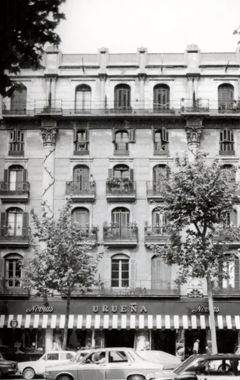 Edifici entre mitgeres de planta baixa i cinc pisos, amb una façana esgrafiada que destaca per les línies horitzontals, les quals contrasten amb la verticalitat marcada per dues columnes adossades que articulen la composició. Les obertures, resoltes amb arcs rebaixats, donen lloc a balcons rectes protegits amb baranes de ferro, configurant un conjunt equilibrat i de notable interès ornamental.
1895
-
1897
-
1897 - 1898
-
Roca Umbert Factory
autoria desconeguda
 Isolated industrial premises with a rectangular plan, consisting of a basement, ground floor and two floors. The façades are equal and flat with a symmetrical composition formed by a series of pillars with semicircular arches, the pillars have a double height value giving the whole a monumental character. It is the largest industrial building in Sant Feliu. It had been an important textile factory and for many years it has employed many people in the town. In 70s, and due to the serious economic crisis and in particular that of the textile sector, most of the machines had to stop, leaving many people unemployed. It is currently partially exploited, and textile products are produced there. The plans for this building have been attributed to Gaudí, but this has not been verified.
second half of the 19th century
-
Pere Sitges Bassa House
 Civil building. Construction with a ground floor, main floor, attic and a rooftop with a square tower that remains in the central part of the façade. Its interest lies in the refurbishment that took place at the end of the 19th century. It is characterised by the great profusion of ornamental sculptural elements that crown the openings (curiously none of them are of the same shape or size): breakwaters with shields, fleurons, garlands, human figures; imposts and capitals with floral and animal elements; animal gargoyles at the corners of the tower. The main floor is accessed via a two-flight staircase with sculpted handrails. The façade is decorated with sgraffito. There is a garden at the front of the house, enclosed with an iron gate also decorated with floral elements. It is one of the most characteristic buildings of Passeig de Vilassar. There is no date of construction, but in the photographs we can see that it was already built in 1898.
1899
-
1900
-
Viladomiu Nou Colony
 All the industrial colonies in the upper Llobregat are similar: a tower, the church, the school and the workers' housing in three-storey blocks organised in parallel streets close to the factory. The factory was founded in 1870 and the Viladomiu Nou colony in 1874 by Tomàs Viladomiu i Bertran, who also owned the neighbouring industrial complex Viladomiu Vell. He had acquired the land of ‘Grau de Sant Marc’ and began work on a new factory and its annexed services, which, together with Viladomiu Vell, obtained the status of Agricultural and Industrial Colony in 1882. In 1907, the two companies were separated: the new production centre was given to Jacint Viladomiu and the old one to his heir, Josep Viladomiu. In 1929, the family bought the neighbouring Guixaró Colony and began a period of expansion that continued until the 1980s, when the textile crisis forced the company to close its doors.
1880 - 1902
-
1902 - 1903
-
1903
-
Can Cucurella
 Isolated house surrounded by a stone and brick wall. It is made up of two bodies: one on the main façade with a ground floor, first floor, a small tower and a small roof terrace, and one behind it, consisting of a ground floor, first floor and rooftop. The main façade is notable for its symmetry. The lintels of the ground-floor openings are decorated with plant-themed mouldings made of artificial stone. The glazed ceramic roof overhang on both the façade and the tower is interesting. Also interesting are the roof railing that forms small battlements and the wrought-iron railings on the balconies, as well as the decorative ceramic elements on the façade. The rear façade has a porch and terrace with an artificial stone railing. This house was built by Enric Cucurella i Vidal. The construction was carried out in two stages: in the first one the ground floor was built, and in the second one the rest of the building was constructed. In 1983, it was acquired by the town council and today it houses the municipal offices. Carrer J. Mestre Lladós was developed at the beginning of the 20th century. This building is part of the complex formed by the houses number 1,3,5,7.
 -
1904