









Awarded
Cataloged
Disappeared
All works
-
Institut de Cultura i Biblioteca Popular per a la Dona
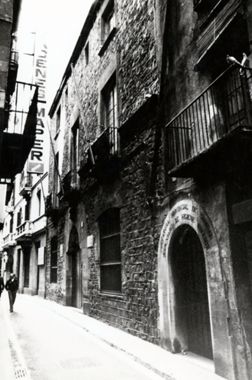 Es tracta d’una construcció noble, de planta baixa i dos pisos, amb una façana simètrica de carreus rejuntats. A l’interior destaca un pati amb una escala, protegida per una llotja, que aporta caràcter a l’edifici. A la façana principal hi trobem un elegant portal de mig punt amb grans dovelles, així com balcons de ferro forjat i rajoles del segle XVIII al pis principal. La porta d’accés és de fusta xapada amb ferro i presenta una acurada decoració geomètrica artesanal; a sobre, hi ha un escut. A la part superior, sobre les golfes, sobresurt una cornisa decorada amb carasses i amb sis gàrgoles. A la part posterior, de construcció més moderna, es poden admirar, a l’interior de la capella, uns frescos de Josep Obiols.
1857
-
Víctor Balaguer Library-Museum
 Isolated building that, together with the Teresa house, forms a complex surrounded by a large garden located near the railway station. It is a building with a complex ground plan as a result of the numerous extensions it has undergone. It has two floors in the rear central body and one in the rest. The roof is four-sided, flat or with a lowered barrel vault. A lantern in the form of a hemispherical dome with a cylindrical drum on an octagonal base protrudes from the building. The main façade is symmetrical. It presents a central access portico, with a circular pediment with reliefs. On the sides, double windows open side by side and separated by pilasters finished in bell-shaped capitals that run the length of the façade. The facings have sgraffitos. A perimeter cornice with palmettos runs along the entire façade. The back is symmetrical in the central body and asymmetrical in the side bodies, unfinished. The decorations are neo-Greek and neo-Egyptian elements. In the portico there are two sculptures, one of the poet Cabanyes, sculpted by Campeny, and the other one of Archbishop Armanyà, by Fuxà. Mr. Gumà i Ferran ceded the land for the construction of the library-museum in 1881. The following year, work began according to the project of the master builder Jeroni Granell. The completion and inauguration of the new building dates from 1884, according to a tombstone nailed to the façade. Three years later, an extension was made, directed by the architect B. Pollés i Vivo. Between 1920 and 1930 it experienced a new expansion, directed in this case by J. M. Miró i Guibernau. In 1951 the interior of the art gallery was renovated and in 1979 the roofs were repaired under the direction of the architect Jordi Ambrós, repairs commissioned by the Ministry of Culture. In 1981 the City Council carried out new refurbishment and conditioning works. Two years later, the Generalitat took charge of the restoration works of the Library, according to a project by the architect Bonet i Correa. The sculptural image of Archbishop Armanyà was placed in 1887. That of the poet Cabanyes was installed six years later. The Víctor Balaguer Library-Museum houses a collection of works of art and more than 22,000 volumes. Víctor Balaguer bequeathed it to the town in 1900.
1881 - 1884
-
Canetenc Athenaeum
 In 1883, the Ateneu de Canet de Mar society was founded, a social organisation with Catalanist roots. Domènech i Montaner was commissioned to design its headquarters on the most central corner of the town, between La Riera and Carrer Ample. Domènech made use of part of the buildings that occupied the site he had acquired, and erected a building with a ground floor and a first floor, joining it to the main theatre next door. It had a meeting room, a reading room and library, a meeting room, a billiard room and a triple room. A continuous balcony reaches the corner, where a tower that starts from the first floor makes it turn towards the façade of the wide street, which is where the entrance was, giving continuity to the two façades. The façade facing the stream has a clear symmetrical composition with a central body topped with a pediment and a large rose window. The continuous balcony takes on a double flight at this point, supported on metal corbels inspired by the style of Violet-le-Duc. The façades are finished with decorative stucco work by the prestigious Barcelona firm Saumell i Vilaró. The decorative motifs are mythological allegories, largely taken from Verdaguer's Atlantis. There is also a rich decoration of wrought iron and cut iron plate by the locksmiths Pujadas de Canet. In 1923, the building housed the Ateneo Obrero (Workers' Athenaeum) and during Franco's regime, the Education and Rest trade union work. In 1985 the building was acquired by Canet Town Council. The interior was completely modified over the years and only the façades remain. Since 1999 it has been the Gual Pujades library of Canet de Mar.
1884 - 1887
-
Remodelling of the Royal Academy of the Sciences and Arts
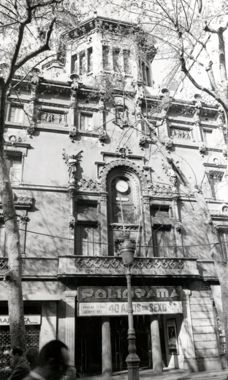 Edifici monumentalista de curosa composició arquitectònica, desenvolupat en planta baixa més dues plantes. La façana s’organitza al voltant d’un cos central octogonal que forma una torreta, flanquejada per dues torres retranquejades. La façana, ricament decorada, incorpora un rellotge que actualment marca l’hora oficial de la ciutat.
1883 - 1894
-
1904 - 1906
-
Agricultural Athenaeum
 The building was started in 1908, still in full modernist euphoria, and a year later, thanks to the efforts of a handful of people from Sant Sadurní d’Anoia, it was finished. The progressive spirit of the entity is reflected architecturally with a balanced building, where the style is already devoid of eclectic elements. The work is distributed over two floors, with a symmetrical composition on the only façade, in which a central body stands out with interesting pinnacles of naturalistic ornamentation.
1908
-
Rogelio Rojo Factory
The Rogelio Rojo factory is located between Rogelio Rojo, Fàbrica, Santa Clara streets and Catalunya avenue. It is an architectural complex for industrial use built in different periods: 1917, the 1930s, the 1950s, the 1960s and 1973. The main volume of the complex is U-shaped, consisting of two single-storey buildings and one two-storey building. There are also a number of annex buildings that have been added over time. The interior space is open-plan and large, thanks to the large windows and the sawtooth roof. The exterior, made of exposed brickwork and ceramic tiles, has end walls crowned with curvilinear and mixtilinear headboards inspired by the Baroque style. The vertical structure consists of steel pillars and load-bearing walls made of solid brick. The roof is made of Arabic tiles on a ceramic base supported by wooden and metal trusses (replacing the original wooden ones). The main nave and the other two are joined together, as the side walls have been replaced by metal beams with a masonry pillar (solid brickwork) in between. The foundations are 60 cm wide continuous stone masonry walls. The roof of the long nave is made of ceramic tiles on ceramic tongue-and-groove. The floors are concrete and show some unevenness and repairs. Inside, there are full-height divisions with brick walls and reinforcement pillars. The industrial complex occupies a 9,752 m2 site, of which 4,675 m2 is built on. During the First World War (1914-1918), there was an increase in demand from the warring countries, which encouraged the development of the textile and metallurgical industries. At that time, the Rojo family began manufacturing accessories for the garments they made themselves. Finally, they decided to manufacture only metal trimmings such as buckles, buttons and needles, as well as plaques for cava bottles. After the war, Catalan exports suffered a slump. The crisis led to unemployment and social unrest. The Rogelio Rojo company set up its new factory in Masquefa, far from the unrest of urban areas. The architect in charge of the project was Josep Donés i Torres. The pace of production in the early years was stable, the balance between imports and exports was favourable, wages were low and the workforce was mainly made up of women. In 1936, with the outbreak of the Spanish Civil War, production remained unchanged. In 1937, in contact with the War Industries Commission of the Generalitat de Catalunya, the factory began manufacturing projectiles for the Republican army and a new building was also constructed. On 22 January 1939, Masquefa was bombed by the Italian air force. The post-war period was a difficult time, and the factory became an economic benchmark and a socialising element for the municipality of Masquefa. During the 1970s, a new two-storey building was constructed, designed for the galvanising production process. At the end of the 1980s, the factory's facilities became obsolete and it could no longer compete in the market. The factory closed at the end of the 20th century. This factory has been involved in activities related to metallurgy. The last company ceased operations in 2002. It currently houses, among other services and cultural activities, the Municipal Library. In 2002, the complex was acquired by the Masquefa Town Council.1917
-
Biblioteca Popular de Valls
 És un edifici aïllat. La façana principal presenta tres cossos, un central i dos laterals simètrics, damunt dels quals s'eleven dos templets de base circular amb vuit columnetes jòniques que sostenen una volta semiesfèrica. El cos central està format per dues columnes i quatre pilastres jòniques, i dona accés al vestíbul d'entrada. L'acabament el forma un frontó coronat per un timpà de línia sinuosa. Està construït amb maó arrebossat i pintat de gris i blanc. Pel que fa a la distribució de la planta, cal destacar cinc espais: el despatx de la bibliotecària, el guarda-roba, els serveis, la sala de lectura i la sala de conferències. El juny 1915 la Mancomunitat de Catalunya convoca el primer concurs per a l'adjudicació de quatre biblioteques populars, i a la tardor del mateix any s'inaugura l'Escola Superior de Bibliotecàries. Tres anys més tard, el 1918, es gradua la primera promoció de bibliotecàries i s'obren les quatre primeres biblioteques populars, una a cada província: Valls, Sallent, les Borges Blanques i Olot. Aquests edificis segueixen uns esquemes comuns: es troben en zones envoltades de vegetació, sovint una mica allunyades del centre de la població. Així doncs, la Biblioteca Popular de Valls es va encarregar a l'arquitecte Lluís Planas, i es va ubicar als terrenys cedits pel senyor Francesc Dasca i Boada. La primera pedra es va col·locar el 23 d'octubre de 1916, i el 24 de juny de 1918 es va inaugurar l'edifici. El 16 de juliol del mateix any es va obrir al públic, però fins al maig de 1920 no es va establir el servei de préstec. Fou la primera Biblioteca Popular de la Mancomunitat de Catalunya, inspirada en els models arquitectònics greco-romans. Seguint el mateix model arquitectònic es construïren les biblioteques populars d'Olot (desapareguda), Sallent (molt modificada), Borges Blanques (desapareguda) i Canet de Mar (modificada). Després d'un llarg procés d'abandonament i posterior restauració a càrrec de la Diputació de Tarragona, el 2011 es van tornar a obrir les portes, coincidint amb la festivitat de les Decennals de la Mare de Déu de la Candela. Actualment acull un espai d'usos culturals.
1915 - 1918
-
1918
-
Pere Gual i Pujadas Public Library
 Library which follows the Public Library of Valls, inspired by Greco-Roman architectural models. The façade with its portico of Ionic columns and pilasters crowned with a curvilinear pediment stands out. Although, initially, the two lateral bodies of the façade culminated in a small temple with a hemispherical dome, a later refurbishment and extension of the library eliminated them. The Pere Gual i Pujades Popular Library was the second one built by the Mancomunitat in 1919. Initially, it had a ground floor, but in 1970 the first floor was added to provide more space for cultural activities.
1919
-
Biblioteca Popular del Vendrell
 La biblioteca popular d'El Vendrell és un edifici en forma de petit temple d'obra de fàbrica que recorda als temples tetràstils i perípters clàssics grecoromans. Projectat com edifici aïllat i disposat sobre un pòdium que li atorga certa monumentalitat. Els portals dels dos accessos que hi ha a les testeres de l'edifici estan coronats per un frontó triangular sostingut per columnes jòniques, i les façanes i les arestes estan reforçades per un ritme regular de pilastres encoixinades, que s'alternen amb els panys que contenen dues finestres superposades d'esquema vertical. Les pilastres estan decorades en la part superior amb un medalló ovalat amb garlandes i un capitell motllurat. L'edifici acaba en una cornisa motllurada damunt d'una línia de dentellons i un ampit massís, sobre els pilars del qual s'aixequen boles ornamentals. Tot plegat està concebut segons els cànons clàssics. La gran alçada de la sala va permetre una acurada ampliació a la dècada de 1970, consistent en la construcció d'una entre planta sense desfigurar l'edifici exteriorment. Les biblioteques populars sorgiren del gran moviment de normalització cultural i polític representat pel Noucentisme i per la Mancomunitat de Catalunya. És per aquest motiu que la present obra arquitectònica constitueix un bon testimoni dels equipaments impulsats per la Mancomunitat que van tenir continuïtat durant la Segona República Espanyola. En el marc d'un procés de construcció nacional i amb l'impuls modernitzador del Noucentisme, es pretenia acabar amb els desequilibris entre la Catalunya més rural i empobrida i la més urbana i rica. Els ideals polítics i ètics convergien amb els artístics, de manera que cultura i política compartien objectius comuns: la modernització i la construcció nacional en un marc mediterrani i europeu. Per tal d'aconseguir una universalització de la cultura i millorar les oportunitats laborals en territori català, es van crear equipaments culturals, docents i sanitaris. El projecte de les biblioteques populars foren una aposta personal de Prat de la Riba i Puig i Cadafalch. L'any 1915 i, basant-se en un projecte redactat per Eugeni d'Ors, la Mancomunitat, en el procés de recuperació cultural de Catalunya, creà el servei de Biblioteques Populars sota la direcció de Jordi Rubió i Balaguer. L'any següent, el 1916, l'ajuntament d'El Vendrell es presentà al concurs obert per la Mancomunitat per tal de sol·licitar una biblioteca popular per a la vila, que li fou adjudicada el 7 de desembre del mateix any. El terreny fou cedit per Odon Nin, i la projecció de l'edifici va anar a càrrec de l'arquitecte Ramon Puig i Gairalt i el contractista de Valls Salvador Serra. La biblioteca s'inaugurà el 17 d'octubre del 1920, amb la presència del president de la Mancomunitat Josep Puig i Cadafalch. L'any 1925, l'edifici quedà reintegrat a la Diputació de Tarragona. El 1978 s'amplià, amb la construcció d'una planta intermèdia.
1917 - 1920
-
1920 - 1921
-
Serra i Moret Public Library
 Public library built under the auspices of the Mancomunitat de Catalunya. Like other libraries of the period, it was inspired by Renaissance architecture, representing a classicising trend in Noucentisme. It is a detached, single-storey building surrounded by a small garden. Initially, it consisted of a lobby, reading room, office and toilet. The main façade is completely symmetrical, consisting of three vertical sections framed by four cushioned pilasters crowned with Ionic capitals. The main entrance features a porch formed by a large round arch resting on moulded imposts, which in turn rest on pilasters and two free-standing columns with Ionic bases and capitals. The central section is also crowned by a triangular pediment with a smooth tympanum. The sections on either side of the porch are almost blind, with a small vertical elliptical porthole window. The façades are crowned by balustrade railings and pillars with ornamental balls that run around the perimeter of the entire building.
1917 - 1922
-
1925 - 1927
-
Sant Sadurní d'Anoia Pension Fund building
autoria desconeguda
The building takes up all the Carrer Francesc Moragas, but also has an entrance from Carrer Hospital and Carrer Sant Antoni. It has three bodies, each intended for different uses - the central hall and staircase, the one on the left is a museum and library, and the one on the right is offices and housing. The building is currently used as offices. The image of the building responds to the criteria set by the institution since the same aesthetic is found in other contemporary buildings of La Caixa. The decoration mixes classicist elements, such as the columns and pediments, and Gothic elements such as the attic windows. At the end of 1931, La Caixa presented the request to erect a building along Carrer Vilaró, later called Francesc Moragas. The permit states that the work will be done in an easement area and that it is exempt from paying taxes thanks to the statutes of the funds. Although it does not refer to the acquisition of the land, it belonged to M. Dolors Vilaró i Raventós in 1892, when, on the occasion of a refurbishment of the house, she ceded part of it in order to widen the alley that would bear her name. The La Caixa project was not simply limited to opening offices but also offered a library and a museum, which would not be inaugurated until the 1950s. The museum would be dedicated to honouring old age, a festival closely linked to Sant Sadurní since it originated in this municipality and later spread to other Catalan towns.1931
-
Public Library Costa i Fornaguera
 The Costa i Fornaguera Library is a civil building in the Noucentista style, built in the early 20th century. It is a detached, rectangular building consisting of three distinct sections. The main section is in the centre, with a ground floor and first floor and a hipped roof, flanked on either side by a single-storey section with a gabled roof. The façade of the main section opens onto the ground floor with three large stone semicircular arched porticos resting on smooth columns, between which there is a fence with striking wrought ironwork. Above the central portico is a relief coat of arms of Calella. The fence with its striking wrought ironwork has also been preserved. On the first floor, there are three mixtilinear arched windows with a two-level sill with green glazed ceramic tiles, which are repeated in each of the side sections. The eaves are finished with interlocking ceramic tiles and terracotta vases protrude from the ridge. The exterior finish is plastered and painted, with stone panels on the corners and skirting. The interior layout remains original, with a hall facing a double imperial-style staircase leading to the first floor, where the library is located. The library is preserved in its original state. It is accessed through a wooden gate, above which is the loft. It is a spacious room with coffered ceilings and a frieze running along the top of the wall. The floor is covered with white and grey hydraulic tiles. On all four sides are the original wooden shelves, which can also be seen in the loft. Some of the original furniture is also preserved in good condition.
 -
1916 - 1934
-
1931 - 1934
-
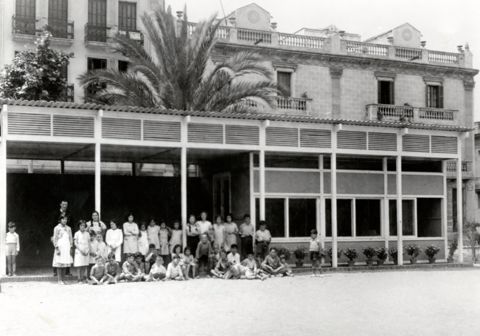
Biblioteca Infantil Desmuntable
Josep Lluís Sert, Joan Baptista Subirana i Subirana, Josep Torres Clavé
1934
-
Caixa de Pensions de Torelló Building
 It is a building between partitions with a ground floor, three upper floors and an attic. The roof is gabled with a steep slope, with the ridge perpendicular to the façade and a long overhang. On the façade, we can see that each floor is treated differently. On the ground floor, there are three large windows running from top to bottom with decorative iron grilles. The wall is plastered to imitate ashlar masonry. On the first floor, there is a large balcony that spans the entire width of the façade, with a railing made of a latticework of uprights and crossbars. Behind the façade, the window is divided by stone columns, which are separate from the window plane. The stained glass window is composed of a repeating pattern of different coloured translucent glass panes. The façade is clad with vitrified ceramic tiles. The gallery that identifies the second floor starts at that point. Here we find a bush-hammered stone surface and windows separated only by a thin piper. On the third floor, there are four windows within a single strip of stone that unifies them. The façade is crowned with a pointed gable, with a wide barbican containing the openings that ventilate the covered floor below. These are in the form of grid-like lattices. The eaves rest on wooden necks, the reverse side of which is clad in glazed ceramic. The building's current appearance is the result of the renovation carried out by Josep Maria Pericas between 1957 and 1958. The architect used his personal style with certain modernist and Noucentista influences. The most notable elements are the staircase and the cornice. Since then, it has undergone few alterations. In 1966, the roof was tiled. The closure of the library and the renovation of the Caixa office are the most notable changes.
1957 - 1958
-
Library Floor of the Architects' Association of Catalonia (COAC)
Giráldez - López Iñigo - Subías Arquitectes, Guillermo Giráldez Dávila, Pedro López Iñigo, Xavier Subías i Fages

1962
-
1963 - 1965
-
Reforma i Ampliació de l'Ateneu Barcelonès
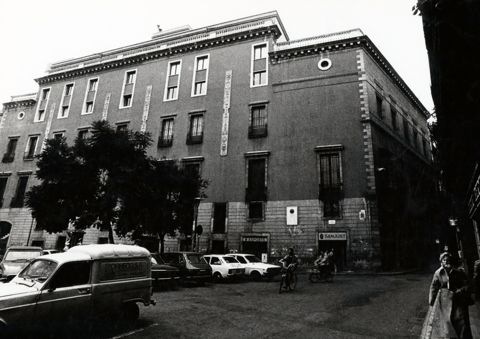 Aquest edifici, típica construcció noble del segle XVIII, ha estat posteriorment molt transformat. La part més interessant és l’accés pel carrer Canuda, que condueix a un ampli pati d’escala cobert. Cal assenyalar també alguns salons i la biblioteca, que conserven decoració pictòrica de F. Pla, “el Vigatà”. El jardí constitueix un bon exemple de l’estil romàntic del segle XIX. Finalment, la façana actual a la plaça de la Vila de Madrid correspon a la reforma realitzada a mitjan segle XX.
1968
-
1973