







-
Fountain of Neptune
 The Fountain-Monument has three parts: a base, a column and a statue. The base is square with eight springs, which are reliefs of human faces. The column is Doric in style, with the lower part of the shaft fluted and the upper part featuring girls dancing with water jugs in their hands (a symbol of civic joy). The base has garlands on the sides and animals on the corners. The statue represents King Neptune crowned and holding a trident in his right hand. The Espelt water gate had a spectacular effect on the town, and the best evidence of this can be seen in the monuments erected to commemorate the event. The monument was part of a group of four public fountains designed as the culmination of the water gate. The fountain was designed by Francesc Vallès, an engineer of French descent, and the artistic work was carried out by the sculptor Damià Campeny. It was inaugurated on 11 June 1832. In 1970, the town council had the monument rebuilt. The work was carried out by Hugo Pratch under the direction of the architect Joan Bassegoda Nonell.
1832
-
1833 - 1834
-
Monument a Galceran Marquet
Francesc Daniel Molina i Casamajor
 A la part central de la plaça, urbanitzada per Daniel Molina, s’hi va instal·lar una columna rostral de ferro amb una base de grans dimensions, a la qual posteriorment s’afegí la decoració escultòrica. Es tracta del primer monument de ferro construït a la ciutat.
1851
-
Font del Geni Catalá
Francesc Daniel Molina i Casamajor
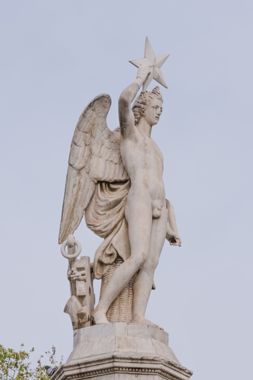 Font de marbre dedicada al Geni Català, ornamentada amb escultures i motius que evoquen l’arribada de les aigües de Montcada a Barcelona. El conjunt representa el Geni Català, els rius Llobregat, Ter, Ebre i Segre, així com les províncies catalanes.
1855
-
1861
-
Gràcia Clock Tower
 The clock tower stands in the centre of the Plaça de la Vila de Gràcia and, at almost 33 metres high, is the tallest public tower in the district. Although it is built mainly of stone ashlars, brick was used for the construction of the windows that open out, the vertical bands that decorate it and the corners of the structure. The tower has a solid square stone base, topped on each side with the coats of arms of the Vila de Gràcia, Barcelona, the Principality of Catalonia and the arms of Queen Isabella II. In the keyhole of the base facing the City Hall building, there is a fountain, framed by a large arch and with two sculpted spouts in the shape of faces that spout water from their mouths. On the upper part of the fountain, also framed by the arch, is a commemorative plaque commemorating the year of its construction (1864), the damage it suffered during the popular uprising of the “Quintes” in 1870 and its restoration in 1882. The body of the tower itself is built on the square base. It is octagonal in plan, although the eight faces are not of a unitary size; rather, those that make up the corners are smaller and projecting, more like a kind of chamfer. For this reason, the windows that open onto the tower are only on the four main faces, which coincide with those of the square on the ground floor. The tower is organised in elevation on three clearly differentiated levels, the first of which runs directly on the square podium and is topped by a large cornice. This cornice is decorated with twelve sculpted plaques representing the zodiac, which are the most emblematic element of the tower, making it the only civil tower in the Vila de Gràcia (the rest were church bell towers). The next section, which is higher than the previous one, has two groups of windows that are configured as small openings in sardinel brickwork and are framed by the vertical brick strips that decorate the tower. These strips extend to the cornice that closes this second body and are finished off with a kind of arches reminiscent of those found in Romanesque mountain constructions. This cornice, which separates the second part of the tower from the crowning, develops in the form of a continuous cantilever, giving rise to a circulation element that surrounds the top floor. This continuous balcony with an iron railing makes sense because of the structure of the building itself: a bell tower with a clock. On the top floor there is a clock with four dials that can be seen from any point in the town. The machinery was built by the Swiss watchmaker Albert Billeter, the true precursor of electric clocks in Spain. The structure is crowned by a large bell, the work of Isidre Pallarès, decorated with elaborate friezes, the coat of arms of Gràcia and reliefs of Saint Isidore, the Virgin of Gràcia and the Blessed Sacrament. On the ground floor, there is a door that leads to the inside of the tower, where there is a spiral staircase with a continuous return and without landings that leads to the clock machinery.
1862 - 1864
-
1863 - 1865
-
Sant Joan Fountain
Public fountain with four spouts and four sinks with a circular base, located in the centre of Plaça de Sant Joan. In the central body a pillar with a square section rises, at the top of which there are plaques showing the date of construction and the coat of arms of the town. The work, of great formal simplicity, is eclectic. It is made of stone.1866
-
Waterfall and Artificial Lake
Josep Fontserè i Mestre, Antoni Gaudí i Cornet
 Conjunt monumental format per un sistema d'escales i replans que articula i emmarca la cascada monumental, les rocalles i el conjunt escultòric que la corona. A la part superior s'hi integra una petita edificació, concebuda originalment per acollir un aquari, que completa la composició arquitectònica.
1875 - 1881
-
Pintor Tàpias's Tower. La Pescadora
 It is a small, square-plan building with four doorways: one providing access to the interior and the others leading to a balcony that surrounds the structure. The foundations are made of stone, while the rest of the building is constructed in brick, used as a geometric decorative element. The building was probably erected at the same time as a new wing of the Cal Sala lime factory, with which it shares its decorative style.
1882 - 1885
-
1888
-
Triumphal Arch
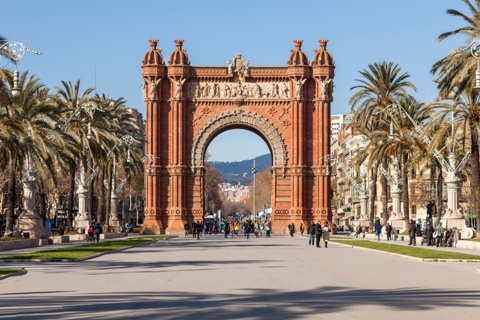 Situated on the boundary of the Ciutat Vella district, the Arc de Triomf is a free-standing structure that presides over the Passeig de Lluís Companys at its junction with Carrer de Trafalgar and Avinguda de Vilanova. It is a construction of simple design, consisting solely of a large monumental arch flanked on either side by two pairs of giant semi-columns. The walls defining the intrados of the arch contain, on both sides, access points to the interior of its piers. As these piers are not solid, the interior space is articulated by a series of partitions and arches that support the structure. In addition, within these spaces rise the two spiral staircases that provide access to the roof terrace above, concealed inside the semi-columns flanking the arch. Access to the terrace is gained through two crown-shaped openings which serve as models for the other six ornamental cupolas that complete the structure. The principal feature of the triumphal arch is its material configuration, based on the use of exposed brick ornamented with glazed ceramics and with certain stone detailing. Indeed, although the foundations and plinth were constructed using large blocks of Montjuïc stone, the visible structure of the building is fundamentally ceramic, making its construction easier and more economical. Furthermore, the formal composition of the building constitutes a catalogue of the ornamental resources of late Eclecticism moving towards early Catalan Art Nouveau, although some authors have sought to identify similarities with Neo-Mudéjar architecture, which was practically non-existent in Catalonia. As for the ornamentation, this is based on the interplay of volumes created by projections and recesses according to the arrangement of the bricks. The monument’s plinth stands out for the wedge-shaped bases of the semi-columns, as well as for the arrangement of horizontal bands of yellow and red brick. This plinth is crowned by a continuous frieze of yellow and green glazed ceramics decorated with vegetal motifs. Within this plinth, in the intrados of the arch, are the two entrances to the interior of the building, formed by triple doorways closed with wrought-iron grilles bearing the four bars and the Cross of Saint George. The imposts of the arch are ornamented with floral stone capitals and reliefs in the form of bats (an emblem attributed to James I the Conqueror). Although the vault of the arch is made of brick, the façades display, through sculpted stone voussoirs, a large laurel wreath supporting the coats of arms of the 49 provinces that formed the Kingdom of Spain in 1888. The keystone of both arches features the city’s coat of arms. The spandrels of the arch display decorations in earth-coloured glazed ceramics and reliefs fashioned in brick. The crowning of the building is its most interesting part. Above a frieze of corbels running around the four façades rest four sculptural stone friezes. The frieze on the mountain side, entitled “Barcelona Receives the Nations”, was sculpted by Josep Reynés i Gurguí and depicts Barcelona as a crowned and enthroned lady extending her arms to either side, surrounded by other female figures representing Spain, the French Republic, the Austro-Hungarian Empire and the British Empire, among others. The frieze on the sea side, entitled “Reward”, was an early work by Josep Llimona i Bruguera and, in a more restrained language, shows Barcelona awarding prizes to participants in the Exhibition, among whom Spain, with her lion, and France, with the Phrygian cap, stand out. The frieze on the Besòs side, created by Torquat Tasso i Nadal, is entitled “Apotheosis of the Arts and Sciences” and depicts the god Apollo surrounded by male and female allegories of architecture, sculpture, literature, painting, music and geography, among others. The frieze on the Llobregat side, created by Antoni Vilanova i March, is entitled “Apotheosis of Agriculture, Industry and Commerce” and depicts a Victory receiving homage from various figures bringing fruits and gears as attributes of agriculture and industry, under the gaze of Hermes, representing commerce. Each of these friezes is flanked by the capitals of the semi-columns surrounding the monument. These abstract brick capitals are adorned with stone sculptures executed by Manuel Fuxà Leal and Pere Carbonell i Huguet. They represent twelve winged Victories or Fames who, resting their feet upon spheres, raise their arms bearing wreaths of flowers and laurel and cast-iron trumpets. The building is finished with a cornice composed of brick corbels and panels of yellow glazed ceramics in the shape of stars. At the centre of the two principal façades (mountain and sea), this frieze is interrupted by the presence of the full coat of arms of Alfons XIII flanked by two lions. Crowning the building, eight brick cupolas clad in yellow and green ceramics (two of which function as openings) adorn the roof terrace, all surmounted by immense comital crowns made of earth-coloured glazed ceramics.
 -
Monument to Josep Anselm Clavé
 The monument to Anselm Clavé stands in the middle of the last pedestrianised section of Passeig de Sant Joan, between Carrer de Antoni Marià Claret and Travessera de Gràcia. The figure of Clavé, raised on a 5-metre high pedestal, is made of bronze and is shown standing, with a baton in his raised right arm. The sculpture's vertical axis is very rigid, and the head is oriented in the same direction as the baton. The pedestal is made up of different sections or drums. The first, which is wider, has no decorative elements. The second, which is also very regal, is crowned by a lower section decorated with geometric motifs made up of dots. The third drum is the longest, narrowest and most complex one, and reaches the foot of the sculpture. In the lower sections there are four small buttresses which, in their vertical development, have a small pedestal crowned with vegetal motifs (probably laurel wreaths). In the middle of the two buttresses facing Avinguda Diagonal, one can read ‘Clavé’. Above this section there is a narrower section formed by four claws on the same line as the buttresses mentioned above. Above it there is a small drum with the sculpture by Anselm Clavé.
 -
Font dels Alls
autoria desconeguda
Public fountain with lantern at the top. It has a single spout, with attached trough and a central stone column. The set responds to the characteristics of the eclectic language. The Font dels Alls was built in November 1890. The stone and the tap came from the fountain that was previously located at the gate of the disappeared barracks. The trough was previously located on the corner between Carrer de Consellers and Rambla de Sant Francesc.1890
-
Fountain of Plaça dels Carros
 A stone fountain with a circular base with two steps, a triangular pedestal with three sinks and three spouts, a triangular-section pillar and a sculptural crown. The spouts are placed on supporting elements of classical inspiration. They simulate columns with decorated bases, shafts and capitals. The pillar bears several inscriptions, and the crown is decorated with a warrior's helmet, the coats of arms of Catalonia and Vilanova, and acanthus leaves. It was inaugurated on 17th January 1893. It was erected in memory of Joaquim Soler i Gustems, who, upon his death (1891), had left a legacy of 7,500 pesetas for the construction of a fountain-monument to him. The town council chose the site in the Plaça dels Carros and commissioned the architect Josep Font i Gumà to design the project. On 5 June 1902, by municipal agreement, the square was named after Soler i Gustems.
1893
-
1895
-
Funerary Monument to Victor Balaguer
 Funerary monument composed of a rectangular base resting on a stone paving that forms a step, a rectangular pedestal with smooth faces and the following inscriptions: 'Víctor Balaguer. Without love for me I had it for everyone'. Plus a crown formed by an altar and a sarcophagus. The base contains two inclined tombstones worked in relief and with floral motifs. These contain inscriptions in Latin with the birth and death dates of Víctor Balaguer and his wife Manuela Carbonell. The altar is decorated with ogival tracery, folds of clothing and coats of arms with the four bars of the Catalan flag, the cross of Sant Jordi, of Vilanova and his initials. The sarcophagus – rectangular and with a gable roof – is divided into bands, with floral motifs and inscriptions. In 1905, the remains of Víctor Balaguer were transferred from the Samà family pantheon to the new monumental pantheon, built in his memory by his heirs. This monument was designed by architect Bonaventura Pollés i Vivó, cut by Alfons Juyol and carried out by builder Joan Sas i Gorgori.
1905
-
1906
-
1907
-
Mundet Pantheon
autoria desconeguda
 Sculpture depicting a woman sitting on a tomb with a thinker's attitude, resting her head on one hand. She wears a long dress that covers her feet. The head is very similar to the other statue, elaborated by the same artist, Llimona. It is very near and both wear the same hairstyle – long hair with a clip in the middle and pulled back towards the corner where the hand that supports it is. Also, like the other, she keeps a distant and thoughtful look. This one, however, shows a stronger emotivity than the other. Its state of conservation would be good if it weren't for the holes it has, which were produced by bullet shots.
 -
Restauració de la Església de Sant Pau del Camp
Francesc de Paula del Villar Carmona
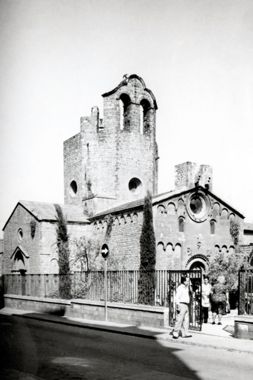 És un conjunt romànic format pel claustre i l’església. Alguns dels seus elements decoratius, com els capitells, provenen d’antigues construccions del mateix monestir de Sant Pau, d’origen visigòtic, i van ser reutilitzats. L’església té planta de creu grega i està coberta amb volta de canó. Al creuer s’hi alça una torre de planta ortogonal, coronada per una espadanya que s’hi afegí al segle XVIII. Pel que fa al claustre, data del segle XIII.
1896 - 1908
-
Santa Florentina Castle
 Ramon Montaner, Lluís Domènech's uncle and co-owner of the Montaner i Simón publishing house, bought the Casa Forta in Canet in 1881, thus returning the property to his family. He commissioned his nephew to restore and extend the building in order to monumentalise it and turn it into a representation of his lineage. With this intention, the publisher had acquired several historical buildings to extract their architectural elements of value and transfer them to his castle, such as the medieval monastery of Tallat. The original building was an old domus, the Casa Forta de Canet de Mar, which before the intervention had the appearance of a compact fortified country house. Domènech's project consisted of building new rooms around a courtyard that recreated a castle, reusing stone elements from other medieval buildings. From the monastery of Tallat, Ramon Montaner bought a large part of the cloister and several window and door frames, which were drawn, numbered piece by piece, dismantled and transferred to Sant Florentina, where they were reassembled in their new location. The new courtyard had a monumental exterior staircase in the style of Gothic palaces, and the towers were topped with battlements, barbicans and machicolations. The complex has many stone sculptures, decorated corbels, sculpted gargoyles, medievalist stained glass windows, polychrome wooden coffered ceilings and antique furniture, in which original Gothic pieces were mixed with modern fragments to achieve a medieval fantasy. Antoni Samarra i Tugues, Carles Flotats i Galtés and Dídac Massana collaborated on the stone sculptures and Josep Pujol on the stained glass windows. In 1905 work began on the crypt, in the basement of one of the old towers of the fortress, for the late wife of Ramon Montaner, Florentina Malató. In 1908, with the renovation of the castle almost finished, King Alfonso XIII was there, the same year that he granted Ramon Montaner the title of Count of the Canet Valley. The Montaner family ruled the castle until the marriage of their daughter Julia passed to the Capmany family. It is currently owned by investors and although it is still used as a private home, it is a museum and can be visited.
1900 - 1908
Awarded
Cataloged
Disappeared
All works