





-
Restauració i Façana del Teatre Principal
Francesc Daniel Molina i Casamajor
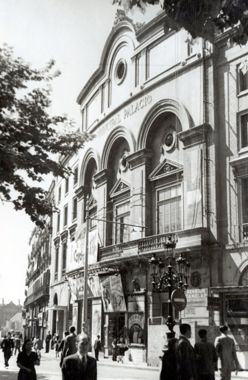 La façana es compon de tres arcades que arrenquen al primer pis, on s’obre una balconada de marbre. Tant al centre com als extrems s’hi disposen figures al·legòriques. El conjunt queda rematat per un frontó semicircular amb rellotge, baix relleus i plafons amb figures decoratives. L’edifici tenia un ús polivalent i incloïa botigues, un night club, cinema, cabaret, club d’escacs i billar, així com taquilles per a la venda d’entrades de braus.
1847 - 1848
-
Restauració de la Capella de Santa Àgata
 Aquesta capella, construïda sobre tres torres de la muralla romana, presenta una sola nau articulada per tres arcs diafragma i coberta de fusta. L’absis, de planta poligonal, es resol amb volta ogival, mentre que el campanar, de planta octogonal, s’aixeca sobre una volta de canó que cobreix la sagristia. Al llarg del temps s’hi han incorporat diversos afegits, com el cor alt, capelles laterals adossades exteriorment i algunes obertures en forma de finestres i portes. La manca d’estabilitat estructural, provocada pel fet que les parets laterals són buides, va motivar intervencions de consolidació al segle XIX i posteriorment al segle XX. La urbanització de la plaça de Berenguer el Gran va permetre, l’any 1934, deixar visible la façana d’aquest costat sobre la muralla romana, moment en què es va dur a terme la restauració del conjunt.
1856
-
Plaça Reial Square
Francesc Daniel Molina i Casamajor
 Plaça que comunica amb la Rambla pel carrer Colom a la Rambla i, a través del passatge Madoz, al carrer Ferran, en un espai que havia deixat el desamortitzat Convent dels Caputxins. El 1848 l'Ajuntament va convocar un concurs públic que va guanyar l'arquitecte Francesc Daniel Molina Casamajó, format a la Llotja i a l'Acadèmia de Belles Arts de San Fernando. La plaça és de planta rectangular porticada construïda entre el 1848 i el 1960 convertint-se en un dels projectes més importants de l'arquitecte, ben actiu a la ciutat de Barcelona amb altres projectes. La plaça d'estil neoclàssic és una versió de la tradicional plaça major espanyola connectada per carrers i passatges que condueixen a la Rambla, al carrer Escudellers i al carrer Ferran. Les façanes dels edificis són de model isabelí, els balcons s'alternen amb les pilastres sobre la planta baixa porticada. A l'entaulament trobem un àtic lleugerament reculat on la cornisa és una balustrada. Aquest ordre en les façanes només es trenca pel passatge Bacardí, el primer cobert de Barcelona i el passatge descobert Madoz. Al centre de la plaça s'hi va col·locar una font de ferro de la casa Durenne de París anomenada les Tres gràcies, però segons el projecte original s'hi havia de col·locar una escultura de Ferran el Catòlic encarregada a Josep Piquer. A la plaça no hi trobem cap referència a la reialesa espanyola, però originàriament homenatjava a la reialesa i Isabel II va col·locar la primera pedra. A la plaça hi ha també dos fanals centrals dissenyats per Gaudí i un conjunt de palmeres.
1848 - 1859
-
Gran Teatre del Liceu First Reconstruction
Josep Oriol Mestres i Esplugas
 Edifici entre mitgeres que fa cantonada, format per planta baixa i quatre pisos. La façana, d'estil neoclàssic, destaca per les grans obertures en arc i les balconades amb balustrada. L'accés principal s'organitza mitjançant un pòrtic de tres arcades que condueix a un vestíbul d'ordre grec, dividit en tres naus. A continuació s'hi desenvolupa l'escala principal, íntegrament revestida de marbre. Al replà principal hi destaca l'estàtua de la Música, obra de Vallmitjana, presidint l'espai i emmarcada entre dues làpides commemoratives. El saló de fumar, situat al primer pis, està decorat en estil neoromànic, d'acord amb el gust del Segon Imperi francès (segons A. Cirici), i presenta columnes corínties. La sala de butaques té una capacitat de 1.500 localitats, distribuïdes entre la platea, l'amfiteatre i cinc pisos. Les pintures són obra de Martí Alsina, Vicens, Rigalt i Cada. L'embocadura de l'escenari fa 14 metres d'amplada, mentre que la sala té una superfície de 1.117 m² i una alçada de 20,50 metres.
1862
-
UB Historic Building
 The University of Barcelona is one of the first buildings to be arranged in the plot designed by Cerdà. Its genesis, however, is older, because Rogent designed several projects for the University in different locations inside the old town that had to return from Cervera to Barcelona after Philip V took it from the city in retaliation for the events of 1714. The final configuration leaves a 130-metre façade on the Gran Via, asymmetrical with respect to Universitat Square, in the middle of two blocks of the Eixample (with a 220-metre front) that it does not fill. The building follows the tradition of the great European universities: two courtyards, one for Science and the one for Humanities, which are completely symmetrical and are separated by a central body with a very powerful marble staircase leading to a beautiful auditorium located above the lobby. The urbanisation of the area, which makes the building adapt to the Cerdà plot, was carried out in the 1930s by architects linked to the GATCPAC. On the short sides, facing Aribau and Balmes streets, there are a series of buildings that prevent the full view of the side façades. The building is built in neo-Romanesque style, with a sober, powerful, severe stone façade, built with beautifully preserved ashlars. The interior spaces are of great beauty and the cloisters still retain their original life and still house several schools linked to the current University of Barcelona. Visiting the building means seeing it through the eyes of today's students who, thanks to its flexibility, can continue to use it with the same freshness of the first day. The sequence of spaces formed by the access lobby, made of worked and exposed stone, and some interesting enough vaults that support the Auditorium and the staircase to access it, is particularly recommended. A visit to either of the two cloisters is also recommended.
1859 - 1873
-
Waterfall and Artificial Lake
Josep Fontserè i Mestre, Antoni Gaudí i Cornet
 Conjunt monumental format per un sistema d'escales i replans que articula i emmarca la cascada monumental, les rocalles i el conjunt escultòric que la corona. A la part superior s'hi integra una petita edificació, concebuda originalment per acollir un aquari, que completa la composició arquitectònica.
1875 - 1881
-
Bruno Cuadros House
 Edifici d'estil neogrec, en el qual l'arquitecte encara mostra la influència de la tendència ornamentalista pròpia de l'Exposició Universal de 1888. L'edifici, d'esquema volumètric goticista, es caracteritza per la decoració amb ombrel·les i vitralls, així com per un ampli ventall de panòplies. Josep Vilaseca planteja en aquesta obra la possibilitat d'una nova arquitectura que recull, en síntesi, l'eclecticisme i el medievalisme, mitjançant la juxtaposició d'estils en una mateixa composició. A més, s'hi aprecia un intent de revalorar el paper de les arts.
1883 - 1884
-
Quiosc de Música del Parc de la Ciutadella
 Estructura de planta circular formada per petits pilars de ferro fos que sostenen una coberta de fusta, amb una base perimetral que incorpora un banc continu. Concebut com a quiosc de música, proporciona un espai cobert destinat a les actuacions musicals.
1884
-
Vicens House
 This is Gaudí's first commission, having just finished his studies. The house consists of two floors with a low ceiling which house the main floor and the bedrooms, and a much higher attic under a multi-slope roof. The treatment of the built factory combines exposed stone and brick masonry, which is drawn and organised according to horizontal rows, and vertical elements of ceramic tile, which always draw a draftboard pattern and incorporate the corner tribunes and their elements of support. The house was conceived as a large optical device linked to the garden and the skewed views from the street.
1878 - 1885
-
Guards Pavilion, Entrance and Stables of the Güell Estate
 These are the only remaining constructions from the works done by Gaudí on the baron de Güell's estate, which reached as far as the Pedralbes palace. The entrance is flanked by two royal wall constructions, and the large space of the stables is covered with a series of barrel vaults through which the light enters, supported on parabolic brick arches. On the outside, the abstract ornamentation is combined with iron elements that capture the symbolism of the poem by Jacint Verdaguer: the dragon cannot prevent Hercules from tearing a branch from the tree of golden apples, which crowns the large brick pilaster on which the door pivots.
1884 - 1887
-
1888
-
Triumphal Arch
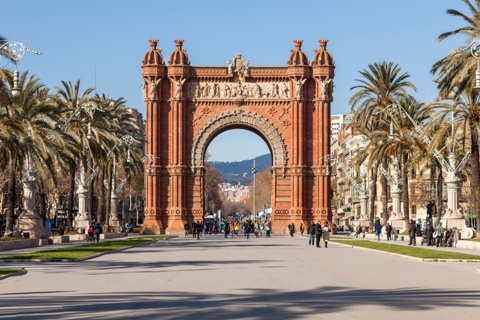 Situated on the boundary of the Ciutat Vella district, the Arc de Triomf is a free-standing structure that presides over the Passeig de Lluís Companys at its junction with Carrer de Trafalgar and Avinguda de Vilanova. It is a construction of simple design, consisting solely of a large monumental arch flanked on either side by two pairs of giant semi-columns. The walls defining the intrados of the arch contain, on both sides, access points to the interior of its piers. As these piers are not solid, the interior space is articulated by a series of partitions and arches that support the structure. In addition, within these spaces rise the two spiral staircases that provide access to the roof terrace above, concealed inside the semi-columns flanking the arch. Access to the terrace is gained through two crown-shaped openings which serve as models for the other six ornamental cupolas that complete the structure. The principal feature of the triumphal arch is its material configuration, based on the use of exposed brick ornamented with glazed ceramics and with certain stone detailing. Indeed, although the foundations and plinth were constructed using large blocks of Montjuïc stone, the visible structure of the building is fundamentally ceramic, making its construction easier and more economical. Furthermore, the formal composition of the building constitutes a catalogue of the ornamental resources of late Eclecticism moving towards early Catalan Art Nouveau, although some authors have sought to identify similarities with Neo-Mudéjar architecture, which was practically non-existent in Catalonia. As for the ornamentation, this is based on the interplay of volumes created by projections and recesses according to the arrangement of the bricks. The monument’s plinth stands out for the wedge-shaped bases of the semi-columns, as well as for the arrangement of horizontal bands of yellow and red brick. This plinth is crowned by a continuous frieze of yellow and green glazed ceramics decorated with vegetal motifs. Within this plinth, in the intrados of the arch, are the two entrances to the interior of the building, formed by triple doorways closed with wrought-iron grilles bearing the four bars and the Cross of Saint George. The imposts of the arch are ornamented with floral stone capitals and reliefs in the form of bats (an emblem attributed to James I the Conqueror). Although the vault of the arch is made of brick, the façades display, through sculpted stone voussoirs, a large laurel wreath supporting the coats of arms of the 49 provinces that formed the Kingdom of Spain in 1888. The keystone of both arches features the city’s coat of arms. The spandrels of the arch display decorations in earth-coloured glazed ceramics and reliefs fashioned in brick. The crowning of the building is its most interesting part. Above a frieze of corbels running around the four façades rest four sculptural stone friezes. The frieze on the mountain side, entitled “Barcelona Receives the Nations”, was sculpted by Josep Reynés i Gurguí and depicts Barcelona as a crowned and enthroned lady extending her arms to either side, surrounded by other female figures representing Spain, the French Republic, the Austro-Hungarian Empire and the British Empire, among others. The frieze on the sea side, entitled “Reward”, was an early work by Josep Llimona i Bruguera and, in a more restrained language, shows Barcelona awarding prizes to participants in the Exhibition, among whom Spain, with her lion, and France, with the Phrygian cap, stand out. The frieze on the Besòs side, created by Torquat Tasso i Nadal, is entitled “Apotheosis of the Arts and Sciences” and depicts the god Apollo surrounded by male and female allegories of architecture, sculpture, literature, painting, music and geography, among others. The frieze on the Llobregat side, created by Antoni Vilanova i March, is entitled “Apotheosis of Agriculture, Industry and Commerce” and depicts a Victory receiving homage from various figures bringing fruits and gears as attributes of agriculture and industry, under the gaze of Hermes, representing commerce. Each of these friezes is flanked by the capitals of the semi-columns surrounding the monument. These abstract brick capitals are adorned with stone sculptures executed by Manuel Fuxà Leal and Pere Carbonell i Huguet. They represent twelve winged Victories or Fames who, resting their feet upon spheres, raise their arms bearing wreaths of flowers and laurel and cast-iron trumpets. The building is finished with a cornice composed of brick corbels and panels of yellow glazed ceramics in the shape of stars. At the centre of the two principal façades (mountain and sea), this frieze is interrupted by the presence of the full coat of arms of Alfons XIII flanked by two lions. Crowning the building, eight brick cupolas clad in yellow and green ceramics (two of which function as openings) adorn the roof terrace, all surmounted by immense comital crowns made of earth-coloured glazed ceramics.
 -
Palau Güell
 It is the Baron de Güell’s main urban residence, built on the site left by two old apartment buildings, at a peak for the city’s culture due to the imminence of the first Universal Exposition. The whole organism revolves around a large central space located on the main floor, with a height above the roof, where all the cultural and social life takes place. Gaudí creates an unusual vertical order, where the four floors above the street are expressed on the façade in six different orders, also broken horizontally. At the entrance, two inverted catenaries channel the differentiated access to the garages, the stables and the large hall. The palace is conceived as a unitary space experienced through the staircase, which ascends around the great hall until it reaches the bedrooms. Gaudí’s respect for the medieval urban palace typology is obvious, although it is full of a very sacred sense of space.
1885 - 1890
-
1892
-
1893
-
Güell Winery
Francesc d'Assís Berenguer i Mestres, Antoni Gaudí i Cornet
 It is a small building intended to store the wines grown on the estate that Eusebi Güell had in Garraf. The construction is formed by three orders of parabolic arches, which decrease as they move up, in a way that they form a pronounced gabled roof. The winery is located on the edge of the road, next to a large slope. The whole factory is of pumice stone masonry, with monolithic reinforcements at the corners, and boldly unloaded in some places, as at the entrance to the chapel on the upper level. Although its authorship has always been attributed to Francesc Berenguer, Gaudí's intervention in some details on a smaller scale is clear, such as the chimneys, the access door and the latticework. The intermediate level, which houses the administrator's apartment, connects with the street level and with the access, where the slope of the roof rises gently and forms a profile similar to a pagoda.
1895 - 1900
-
Ca l'Espinal
 House with an almost square floor plan, located on the corner of Monturiol and Malvehy Streets, towards which its main façades face. It consists of a ground floor and a first floor, in which horizontal strips of exposed brick alternate with others of stone conglomerate. The openings and other architectural elements are also solved with exposed brick. The most outstanding element is the door, located in the chamfer, and above which rises a little balcony on the upper floor. On the ground floor and first floor there are single and twined windows in the shape of an elongated hexagon. As a colophon and unifying element of the façade and the tower, there is a reticulated border of bricks, on which the whole is topped off by the railing of the upper roof. The building, designed by the architect Joan Rubió i Bellver, has a marked influence of the early Gaudinism in terms of the use of historicist elements of Gothic inspiration. The house was built at the same time as the rest of Colònia Güell. The date "1900" is written on the forgings of the entrance.
1900
-
1901
-
Puig i Cadafalch House
 It is the result of the refurbishment of three old, attached houses, in which the entrance has been moved to the interior garden and some façades have been doubled in order to create galleries in the remaining spaces. The project breaks the typological features of the old houses and creates a unitary dwelling: a stepped volume from the south façade to the partition wall on the west side, with a doubled brick wall crowned with battlements. Numerous wooden elements are used on the façades, such as the corner struts. The interior recreates a fresh atmosphere, with wisteria and Arabic ornaments, an ideal refuge for the architect after his exile.
1897 - 1905
-
Lluch House
 Small palace with three floors with a functional overlap characteristic of palaces: semi-buried ground floor taking advantage of the natural unevenness of the hill, floor plan with halls, rooms, small rooms, dining room and library. Second floor where there are the bedrooms and a second floor where there is the attic with access to the roof. The facade is structured from volumes of geometric bodies divided into three distinct parts making a triangular portal with smooth pointed in the central crugia. On the outside there is a combination of white and blue trencadís majolica combined with white plastering, exposed billet and stucco. Decoration of lights and wrought iron grills.
1906
-
1906 - 1907
-
Palau de la Música Catalana
 The Palau de la Música project is linked to the opening of the Via Laietana, in which Domènech i Montaner himself was strongly involved, and to the founding of the Orfeó Català, in 1891, by the composer Lluís Millet. The Palace is located on the corner of two narrow streets, and the emphasis of the whole project is to penetrate the scant natural light into every corner of the interior through numerous polychrome partitions that recreate a dreamlike atmosphere. The large auditorium is located on the first floor and is accessed via a transverse staircase that divides the entire building into two parts and encourages the use of the ground floor for administrative functions. Domènech decides to treat the façades of the two streets with the same profusion, despite their unequal hierarchy, in a demonstration of his expertise in working in unfavorable locations. The exposed brickwork, the stone worked with musical allegories and the stained glass partitions make the building shine in a special way under the daylight, which penetrates to the large auditorium. Attention to the functional aspects of the program reveals a modern Domènech who understands ornamentation as the necessary culmination of an architectural work.
1904 - 1908
-
Clergy House - Rectory
 It is a building intended for parish housing services. It presents some ornamental and constructive elements typical of the last stage of modernism where simple geometric shapes such as pointed arches formed with blown bricks are mixed with other curved geometric elements. A tower-shaped element stands out in one of the corners in one of the vertices in which the entrance door is located, covered by moulded buttresses and a gallery formed by a roof supported by stretchers. The floor plan of the building is rectangular with a hipped roof.
1908
-
Joan Baptista Rubinat House
Francesc d'Assís Berenguer i Mestres
 The residential building at Carrer Or 44 is located in the Gràcia district, in a block bounded by Carrer Torrijos, Carrer Torrent d'en Vidalet, Carrer Sant Lluís and Carrer Or, with the main entrance facing Plaça Virreina. It is a residential building that Joan Baptista Rubinat i Planas commissioned Francesc Berenguer Mestres to build at the beginning of the 20th century, although, as he did not yet have the title of architect, the project was signed by Joan Rubió i Bellver. Rectangular in plan with a back courtyard, it has a stairwell in the centre and, aligned with it, two small light courtyards. The structure in elevation has a ground floor and five storeys, with a flat, walkable roof enclosed by a wrought iron railing. The façade has a flat, symmetrical composition, with its openings arranged on four vertical and five horizontal axes in a regular rhythm. On the ground floor there are four identical doorways, all of which are formed by gently moulded stone pillars with four angular brick arches. The doorway leading to the entrance hall of the building, located in the westernmost part, has the door set back from the façade. On the rest of the floors there are four balconies with sinuous slabs, the lower part of which shows the iron joists that support the vaults, decorated in trencadís. These balconies have a meticulous wrought-iron closure, with wavy, interlocking bars. They also mark the four vertical axes, and are crowned on the roof by sharp brick pinnacles and a wrought-iron support to hold the pulley. From the first floor upwards, except for the brick framing around the openings and the crown of the building, the façade is covered with mortar and decorated with two-colour sgraffito work with floral and geometric motifs.
1909
-
Milà House
 This is Gaudí’s latest civil work, in which he places full emphasis on the experimentation with the structure and opts for risky and well-differentiated solutions from traditional procedures. The load-bearing straight feet are made of limestone from Garraf, combined with metallic elements, and are dimensioned and configured according to the casuistry of their specific position. The slabs are made of metal beams, which follow an irregular order according to the configuration of the floor. The façades on the street merge with the perimeter pillars in a monolithic and self-supporting system. Gaudí proposes to detach the forms from their material content and to look for a synthesis between the abstraction and the evocation of the elements of nature. This led him to turn the building into a large monument dedicated to the Virgin, which was to crown the house as if it were just a pedestal. The help of a naval engineer or the shapes suggested on the deck reveal a Gaudí forerunner of modern architecture, interested in freeing himself from the rows of masonry, orders or the weight of building materials. The Pedrera is a completely unfinished work that solves every spatial and constructive challenge through unpublished and sometimes incomprehensible solutions.
1906 - 1910
Awarded
Cataloged
Disappeared
All works